
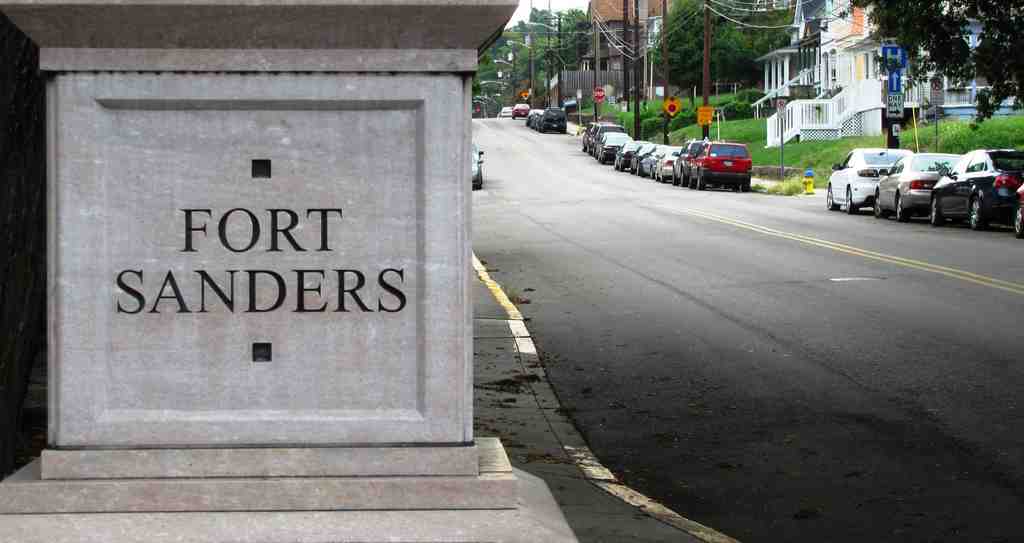
Look to your left for a solid, pale stone block carved with the words FORT SANDERS in crisp, dark lettering, standing like a sentinel beside the paved road that slopes uphill.
It is quite a shift from the industrial grit of Knoxville Station earlier. Today, this neighborhood is famous for massive house parties, packed bars, and the occasional burning couch after a major football victory over Alabama. But in the fall of eighteen sixty three, this very landscape was violently transformed into a massive, blood-soaked Union bastion. Deep local divisions meant neighbors often fought neighbors here, creating a desperate need for absolute defensive control.
The fort was originally called Fort Loudon, but was renamed to honor General William P. Sanders. Sanders actually bought the vital time needed to construct these very defenses. He sat exposed on a white horse, riding up and down the Union line to delay the advancing Confederate forces. He was mortally wounded by a sharpshooter, but the hours he secured allowed Union engineer Captain Orlando Poe to work a brutal kind of magic. Poe later stated that every spadeful of earth turned in those borrowed hours was worth a thousand men each.
I find Poe's methods ruthlessly brilliant. He ordered his men to build towering twelve-foot parapets... which are heavily fortified earthen walls... and reinforced them with cotton bales covered in raw animal hides to extinguish incoming artillery sparks. Poe also ordered telegraph wire to be strung between tree stumps across the open fields. It was an ingenious, near-invisible booby trap designed to trip charging Confederate soldiers.
It gets remarkably darker. The night before a major assault, Union defenders poured water down the trench walls, creating a sheer, inescapable sheet of ice. When General Longstreet's Confederate troops charged, they plunged into a freezing ditch they simply could not climb out of. Union soldiers then lit artillery shells with shortened fuses and tossed them by hand into the trapped crowd below. The battle lasted just twenty minutes, but it left a horrific slaughter of over eight hundred Confederate casualties.
Decades later, grand Victorian homes were built directly over those filled-in trenches. The earth buried the trauma, but the historical gravity lingered. This neighborhood became the childhood home of James Agee. Following the sudden, devastating loss of his father, Agee used this landscape to process his grief. He immortalized the decaying, overgrown clay ruins of the old fort as a silent witness to his own human tragedy. He wrote vividly of taking walks down these very streets, pausing with his father to listen to the train engines coughing in the valley below.
You can see an ongoing, brutal tension playing out here right now. The physical remnants of history are constantly being erased by university expansion. Take the grand Pickle Mansion, built in eighteen eighty nine by a Confederate veteran. It suffered years of neglect, burned to a masonry shell in two thousand and two, and despite a massive decade-long campaign by preservationists to save it, it was ultimately bulldozed for apartments. A fiercely stubborn community keeps fighting to salvage these architectural ghosts, but the bulldozers rarely sleep.
As we head to our final stop, just a five-minute stroll away, prepare yourself. I will show you the full scope of the lethal guerrilla tactics that defined the Knoxville campaign.


