
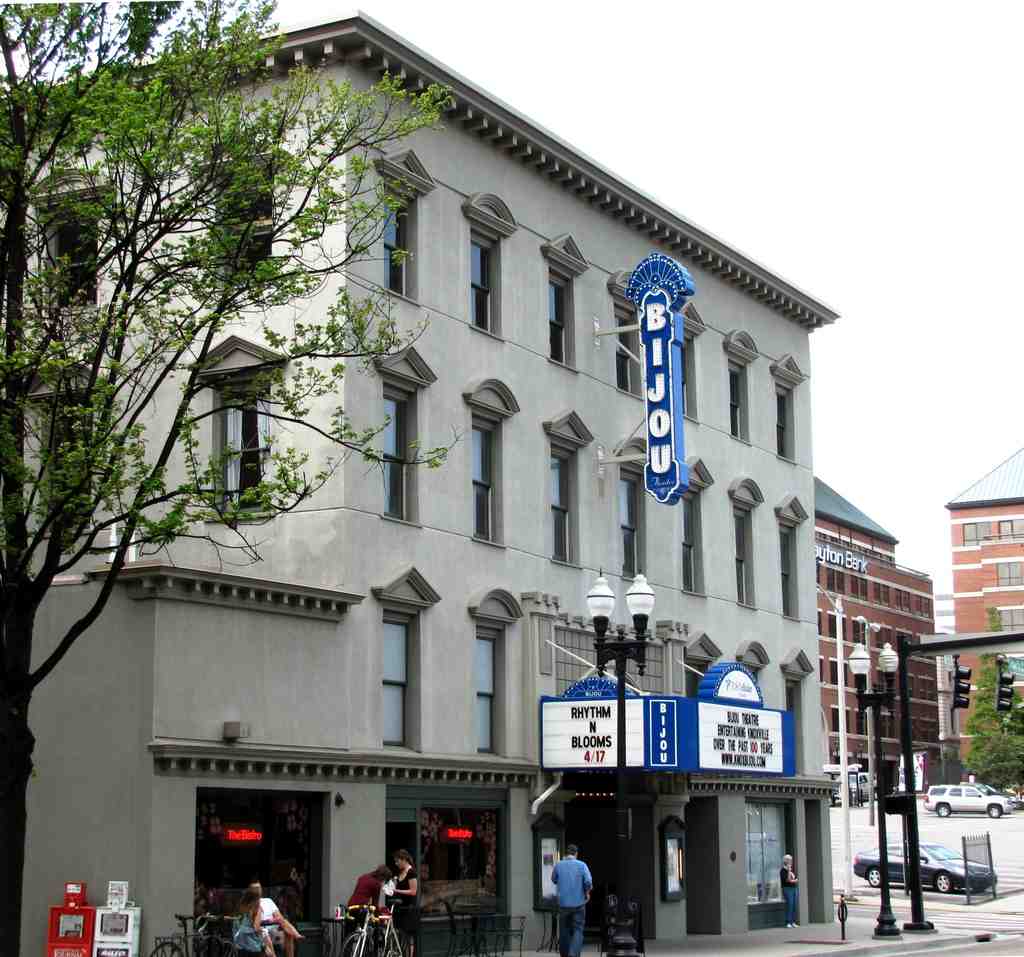
Look to your right for a stout brick building featuring a prominent vertical neon sign spelling out B I J O U, perched above a classical marquee. You are standing across from the Bijou Theatre.
You are also standing on Gay Street. This thoroughfare has always been a living, shifting entity that literally reshaped the architecture along it, forcing buildings to adapt or perish. The front section of the structure you are looking at is actually much older than a movie house. It began in 1817 as the Lamar House Hotel.
By 1854, the city decided to macadamize Gay Street. Macadamizing is an early method of paving using compacted layers of broken stone. To make the new grade work, engineers carved the street level down, which completely exposed the hotel's dirt cellar. The owners did not panic. They simply altered their entire facade and converted the newly exposed basement into the grand main entrance you see today.
The building survived the Civil War, during which the Union Army commandeered it as a hospital. General William P. Sanders died in the bridal suite in 1863, and theater lore insists his ghost never left. Staff frequently report seeing a phantom in a brass-buttoned uniform wandering the closed-off third-floor balcony. Locals joke the general just likes the music and sticks around for the concerts.
By 1908, new owners tore down the rear wings of the hotel to bolt on a theater. They spent 50,000 dollars, which is roughly 1.7 million dollars today. They equipped the Bijou with electric lighting and elaborate classical elements, including reclining muse pediments. A pediment is simply a triangular gable, and these featured statues of lounging Greek goddesses.
The Bijou hosted everyone from the Marx Brothers to Houdini. It was also one of the few theaters in the city that admitted Black patrons for general performances, though they were strictly confined to a segregated third-floor gallery with a separate entrance.
When the Great Depression hit, audiences dried up. The owners briefly repurposed the massive auditorium floor into an indoor used car lot, and later a fruit stand. You have to admire the sheer logistical desperation of parking automobiles exactly where the Russian ballet used to perform.
By the early 1970s, the theater had devolved into a pornographic movie house attached to a hotel that operated as a brothel. In a twist of extreme irony, the property was bequeathed to a local Methodist church. The horrified church leadership quickly sold it off, and by 1974, the historic structure was slated for the wrecking ball.
But this site represents another victory in the local battle to save historic landmarks. A grassroots group scrambled to raise funds, successfully buying the theater just before demolition. It faced the brink again in 2005 due to a high-interest mortgage, but two local businessmen bought the note and halted foreclosure until a massive fundraising campaign could repair the water damage and stabilize the venue. It stands today as a monument to stubborn survival.
Let us keep moving down Gay Street. Our next stop is the East Tennessee Historical Society, about a three minute walk away, where I must warn you about a time when history simply could not be saved from the flames.


