
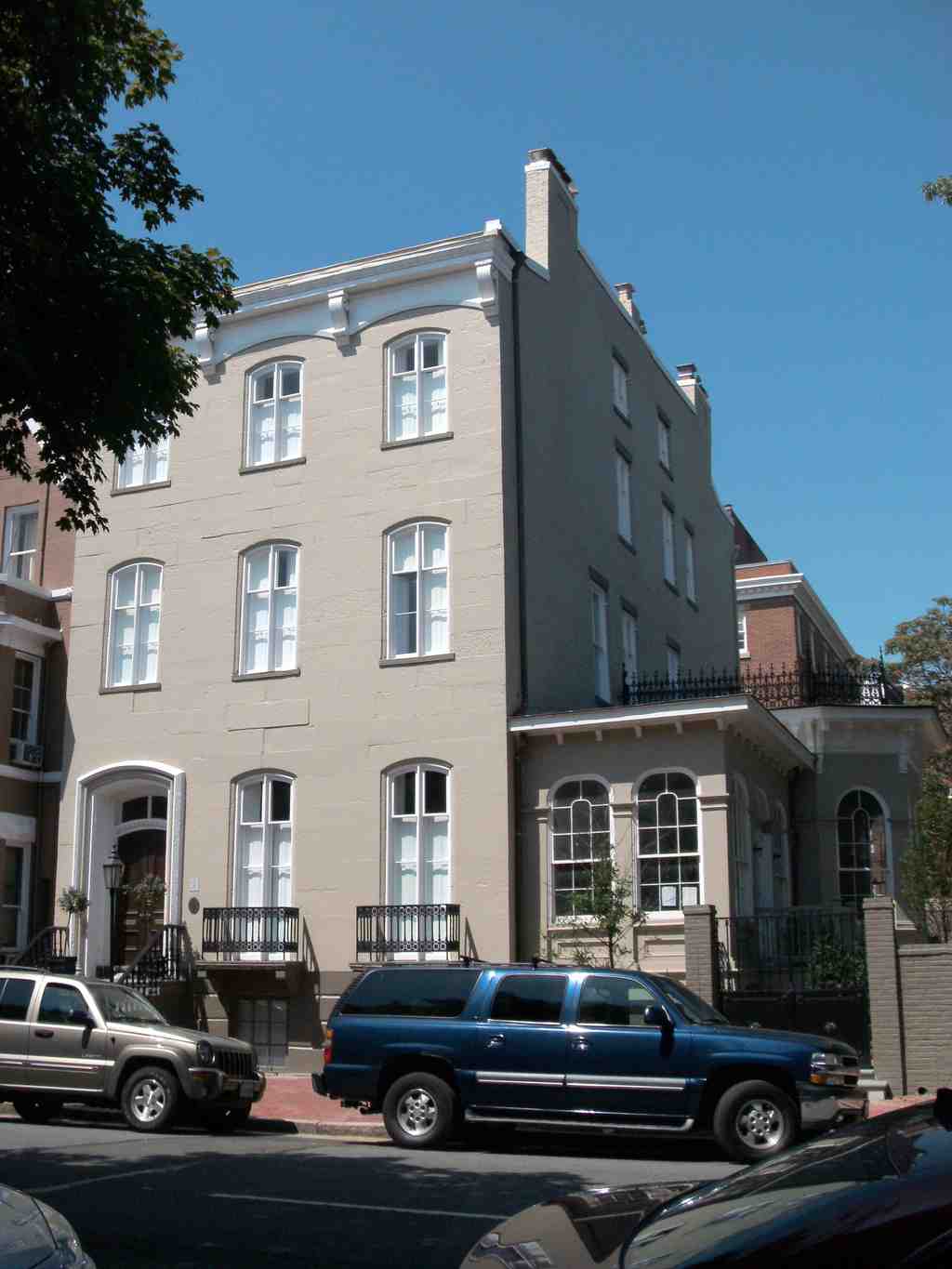
Take a look to your left at the Bayne-Fowle House, a towering three-story painted gray masonry building with tall, arched windows and a distinctive flat-roofed glass conservatory extending out on the right.
Now, we have spent a lot of time uncovering the incredible resilience of the people who were forced into bondage here, building their own sanctuaries while surviving unthinkable cruelty. But to fully grasp the world they were up against, we need to look at the people holding the power. Because behind these pristine brick walls, the wealthy white elite of Alexandria were already fracturing.
This house is practically dripping with high society drama. Let me tell you about William H. Fowle, a wealthy commission merchant... basically a middleman who sold wholesale goods for a cut of the profits... who bought this grand mansion in 1855. It was built in the Italianate style, a very trendy architectural design back then meant to mimic the look of romantic European villas. But long before he moved into this swanky pad, Fowle was involved in one of the city's most scandalous feuds.
Back in the 1820s, a local guy named Louis Cazenove publicly accused Fowle of refusing to help put out a fire at a nearby mill. Fowle was furious. He demanded an apology, did not get one, and challenged Cazenove to a duel.
Now, you would think this was a sure thing for Fowle. He was an experienced marksman. Cazenove had literally never held a loaded pistol until the night before the duel. They met the day after Christmas across the river in Maryland. They fired. Fowle missed completely. Cazenove, the absolute amateur, shot Fowle directly in the face.
Against all odds, Fowle survived the catastrophic injury, patched things up with his rival, and went on to live a very rich life right here. You can actually pull out your phone and see the beautiful side conservatory of the house where he might have relaxed, complete with its original scalloped wooden shelves.
But the drama did not stop with a bullet to the face. As the Civil War approached, the Fowle family was torn down the middle. The elder Fowle was the son of a Massachusetts man and was rumored to sympathize with the abolitionists, the activists fighting to legally end slavery. His son, however, went the exact opposite route, enthusiastically enlisting as an officer in the Confederate Army. When the war broke out, the family abandoned this luxurious home with all its gilded mirrors and marble mantels, fleeing to Richmond.
The Union army immediately seized the mansion, turning it into a military hospital. Up in the unfinished attic, recovering Union soldiers carved and penciled their names into the plaster walls. Those signatures are still there today, safely preserved under modern plexiglass.
It really makes you think about the stories we choose to preserve and the ones we pave over. People look at a beautiful historic facade and imagine a perfect, genteel past, but the reality was messy, violent, and deeply divided. Let us keep pulling back those layers as we walk over to the Alexandria Fire Department, which is just about a three minute stroll from here.


