
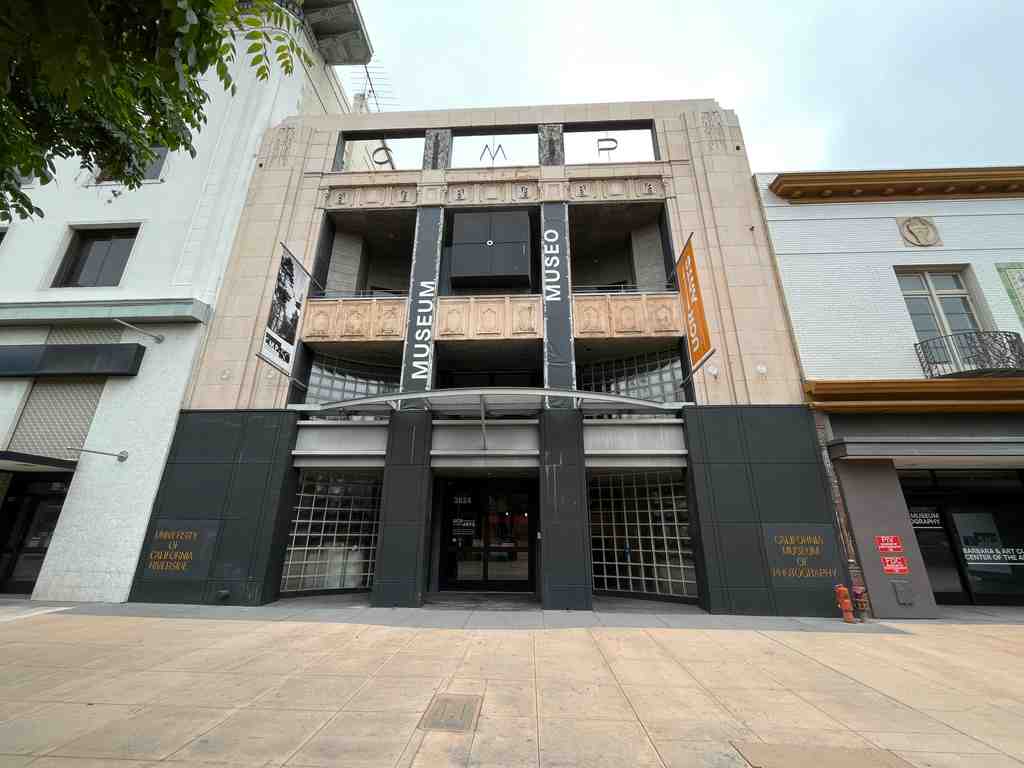
On your right, look for a pale stone storefront with broad rectangular windows and, above the entrance, an old camera suspended over the doorway like a quiet badge of identity.
This is the California Museum of Photography, an off-campus museum of the University of California, Riverside, and it occupies one of downtown’s cleverest transformations. In nineteen eighty-six, the university bought this former S-H Kress dime store from the city for just one dollar. Then, in nineteen ninety, San Francisco architect Stanley Saitowitz remade it with a wonderfully literal idea: the whole building would behave like a camera, and, as he put it, “people are the film.”
That is not just a poetic line. The entrance camera hanging above you announces the theme at once, and inside, Saitowitz stripped the old store and rebuilt it as a sleek machine, with details that suggest the sprockets and rolling strips of film that once fed through cameras by the mile. If you glance at the older image in the app, you can get a sense of this downtown home in its Kress-store guise before the museum fully took hold here. The most enchanting feature sits out of sight above you: a walk-in camera obscura, which is simply a dark room that uses a small opening and optics to project the outside world inside. In this one, people can step into a large black box and watch the street appear upside down, live and moving, on a white wall. Before you even enter the galleries, the building teaches you how early photography understood light.
The museum’s story began before it had this address. In nineteen sixty-nine, Riverside orthopedic surgeon Doctor Robert Bingham teamed up with art professor Edward Beardsley. They worked out of the basement of the Tomás Rivera Library and built momentum through a nineteen seventy-three exhibition called Revolution in a Box, from eighteen thirty-nine. Beardsley co-curated it with a graduate student named James Turrell, who later became one of the great artists of light and space.
From those beginnings, the collection grew into the most extensive photographic holdings in the western United States. Bingham first donated two thousand vintage cameras; that technology collection now holds about ten thousand cameras, viewing devices, and pieces of photographic apparatus. It includes treasures such as a Louis Daguerre camera and humble Kodak Brownies, reminding you that photography has always belonged to inventors and ordinary families alike.
The print collection is just as rich: more than twenty thousand images by more than one thousand photographers, including seven thousand Ansel Adams negatives from his Fiat Lux project, meaning “let there be light.” In the mid-nineteen sixties, University of California president Clark Kerr asked Adams to photograph the university’s future, to make the invisible work of knowledge visible. The bitter twist came when the book appeared in January of nineteen sixty-seven, the very month Governor Ronald Reagan presided over the regents’ meeting that fired Kerr.
Then there is the Keystone-Mast archive, a vast store of stereoscopic negatives, paired images designed to create a three-dimensional effect. Much of it survived only because the Mast family saved it from destruction. Even now, those old images still give up secrets: in nineteen ninety-five, artist John Divola studied them closely and discovered dead animals hidden in the foliage of landscape scenes, details the original viewers likely never noticed.
This museum has never hidden from difficult subjects either. In nineteen ninety, it showed Victorian photographs of the dead in Memento Mori and, at the same time, mounted a blunt exhibition about censorship, sexuality, and the body during the fiercest public arguments over arts funding.
If you want to return and go inside, it is usually closed Monday through Wednesday, then open Thursday and Friday from noon to five, and Saturday and Sunday from eleven to five.
From out here, this building feels less like a container for pictures than a camera aimed at memory itself.
From a building devoted to seeing, the route now turns to urgent response at the fire department.




