
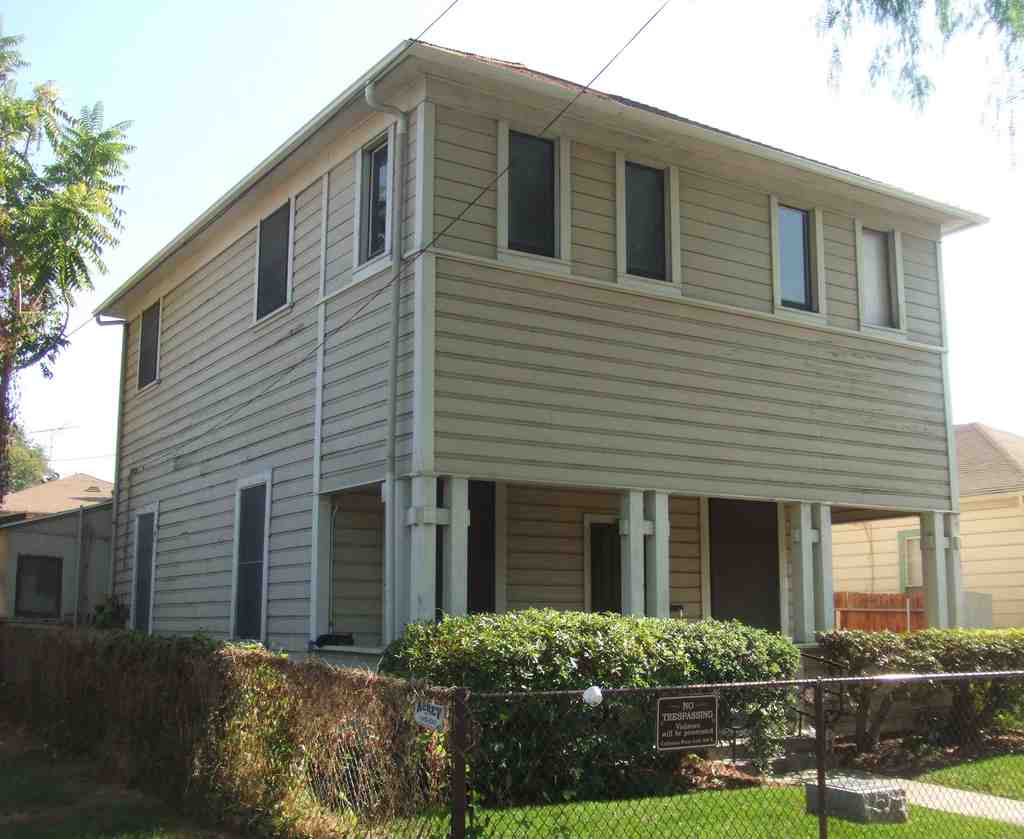
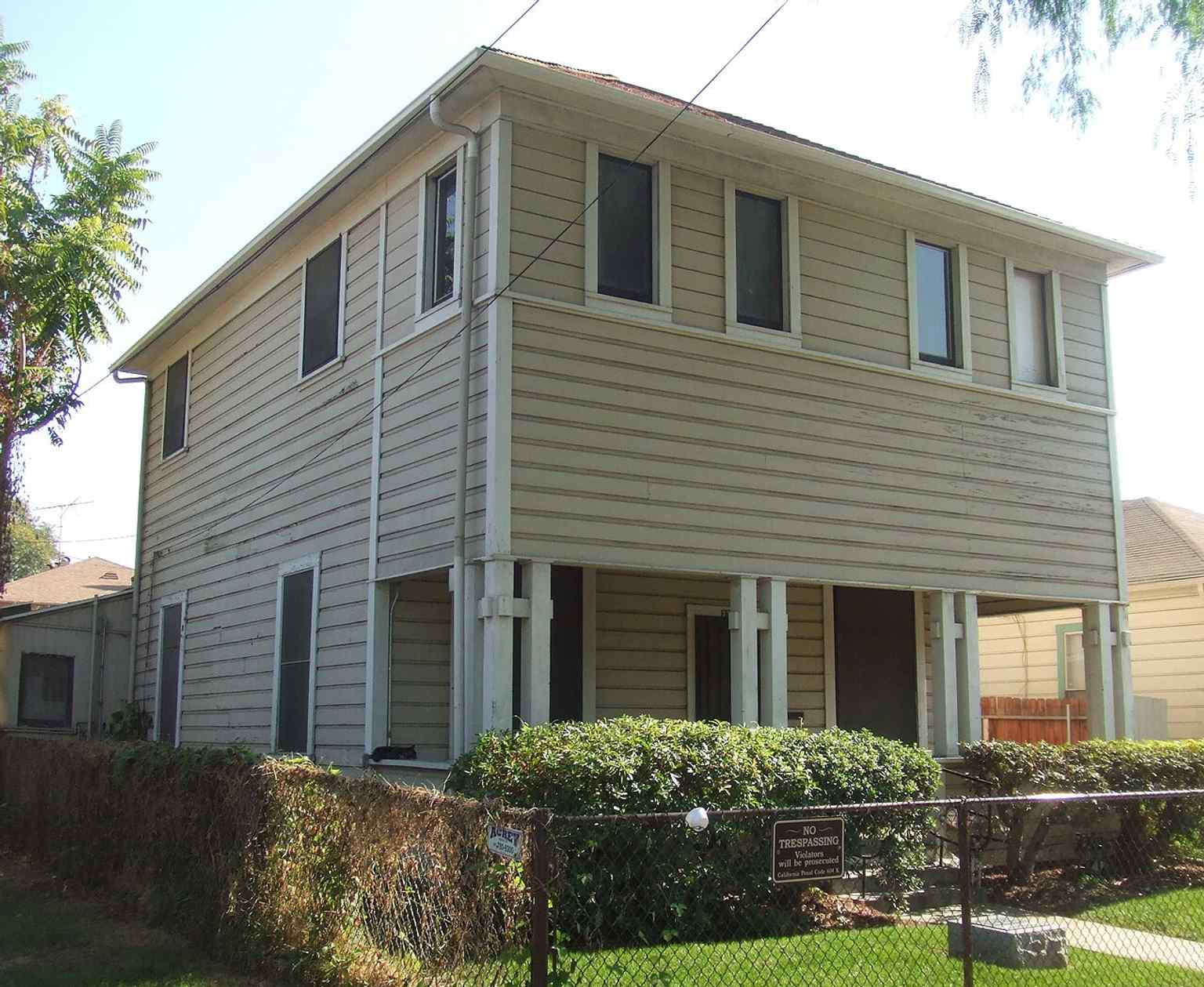
On your right, look for an unassuming two-story wooden house with shiplap siding, a broad porch carried on heavy posts, and an enclosed upper porch that gives the front a slightly closed, watchful face.
The Harada House does not shout for attention. That, in a way, is part of its power. It began in eighteen eighty-four as a modest one-story saltbox cottage - a simple house shape with one roof slope longer than the other - clad in wood siding and topped with wooden shingles. Then, in nineteen sixteen, the Harada family expanded it upward, adding a second story with four bedrooms, a bathroom, and an open front porch. Later, that upper porch was enclosed to make more room. What you see now is plain, practical, and deeply human: a family house altered as life demanded.
Jukichi Harada came from Japan with his wife, Ken, and their first son, Masa Atsu. In Riverside they leased a boarding house, ran a restaurant, and welcomed more children: Mine, Sumi, and Yoshizo. Then came a cruel blow. In nineteen thirteen, their five-year-old son, Tadao, died of diphtheria, a dangerous bacterial infection. The family’s cramped living conditions made that loss even harder to bear. Jukichi began looking for a better home, close to the family’s church and the children’s school.
He found this one in nineteen fifteen. But California’s Alien Land Law of nineteen thirteen blocked immigrants who were ineligible for citizenship from owning property. In plain terms, the law targeted people like Jukichi and Ken, even though they had built their lives here. So Jukichi placed the house in the names of his American-born children, who were citizens by birth.
That should have settled it. It did not.
Neighbors tried to force the family out. When that failed, the state stepped in. In October of nineteen sixteen, California sued the Harada children to seize this property. The case, California versus Harada, became an early constitutional test of whether citizen children of Japanese immigrants could truly exercise the rights promised to them. Even in the photo, the exterior looks quiet enough. Yet this modest facade stood at the center of an international legal drama.
The hearings ran until September of nineteen eighteen. Judge Hugh Craig ruled that the Harada children, as American citizens, had the right to own property regardless of race. The state did not appeal. It was an important victory, though not a perfect one: the wider law still stood, ready to burden others.
Then, during the Second World War, the family suffered another injustice. The Haradas were sent to internment camps, and both Jukichi and Ken died there. A white friend occupied the house so the family could keep it. After the war, Sumi Harada returned and opened the home to other Japanese families who had lost theirs.
If you look at the National Historic Landmark plaque on your phone, you can see how the country eventually recognized what happened here. In the nineteen seventies, Sumi worked with researcher Mark Rawitsch to preserve the family records and prove the house’s importance. The city recognized it in nineteen seventy-seven, and national landmark status followed. Today, the Museum of Riverside oversees the house and its careful restoration.
For a final stop, this feels fitting. Not grandeur, but courage. Not spectacle, but a front porch, a lawsuit, and a family insisting that home meant belonging.





