
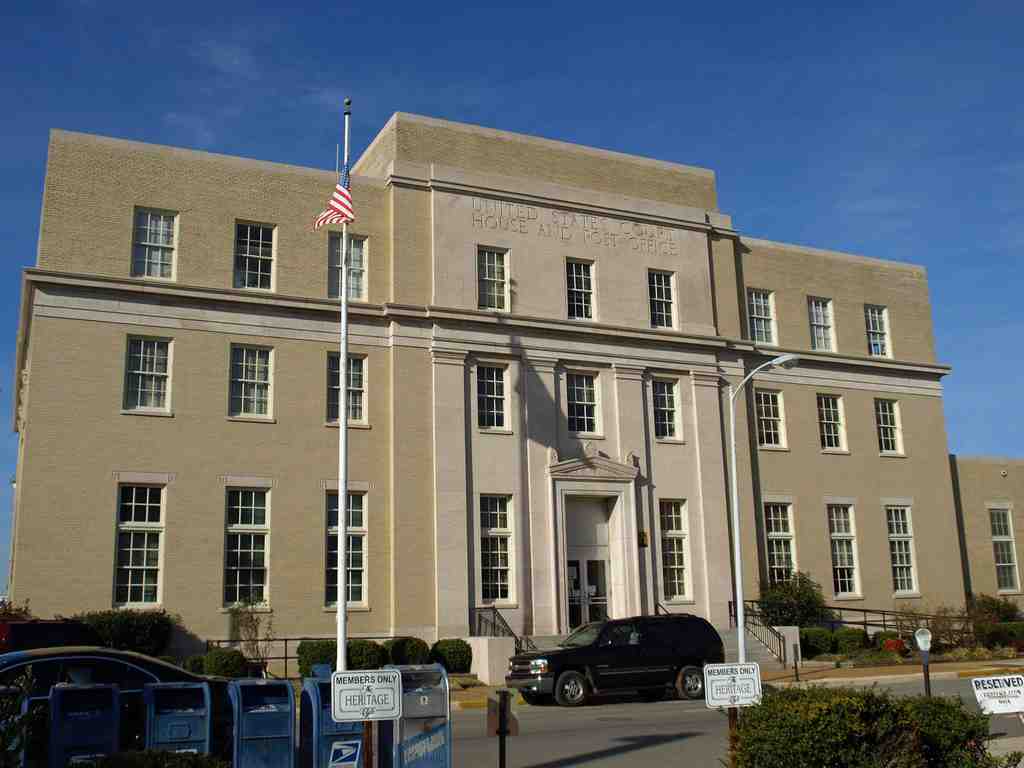
To spot the United States Courthouse and Post Office, look straight ahead for a solid, three-story building made of buff-colored brick with a bold, central limestone entrance framed by four flat columns and topped with an American flag waving proudly.
Imagine the year is 1932, Huntsville’s streets see everything from Model A Fords to well-dressed men and women briskly mailing letters. Rising up before you is the brand-new U.S. Courthouse and Post Office, a symbol of importance with its Neo-Classical Revival style-one of only two in downtown. Designed by the local architect Edgar Lee Love and a team from Birmingham, but with Uncle Sam’s own Supervising Architect Louis A. Simon keeping a watchful eye on every detail, the building feels serious but welcoming, as if it knows a lot of secrets.
Walk closer, and you’ll see buff brick walls softened by sun, the strong lines of limestone pilasters, and an impressive entablature that wraps all the way around, keeping everything neat and tidy like a judge with a sharp suit. The entrance-framed by columns with simple Tuscan caps-invites people in for their day in court or to collect an eagerly awaited package.
This building was multipurpose from the start. Inside, during its early days, postal workers sorted mail, while judges in crisp black robes oversaw justice in the second-floor courtroom. Picture the bustling lobby-once the post office, now transformed-but listen closely because the echoes of shuffling feet and clipped conversations still linger. In fact, this place was a star player in Huntsville’s big architectural makeover, thanks to the Public Buildings Act of 1926, which gave towns across America updated federal buildings.
Though today the post office has moved on, its presence remains in the details-eight of the original 18 restrooms still survive almost untouched, classic tiles gleaming, and beneath your feet, the basement hums with mechanical and storage routines, the silent workhorses of the building.
Now, here’s where history gets colorful. In the main courtroom on the second floor, sunlight spills in through a small light court, setting off the deep wood paneling and decorative pilasters. But the real showstopper? Above the judge’s seat is a grand mural by Xavier Gonzales, unveiled in 1937. He painted five figures to capture the spirit of Huntsville-youth, artistic dreams, motherhood, work, and even high-tech farming. That mural, made on Belgian linen and painted with rich earth tones, gives the whole room a sense of drama, as if the city’s entire story is being watched over while the judge hammers that gavel.
The building has had its share of changes over the years-spaces adapted for new judges, new kinds of offices, even a U.S. Marshall’s suite with its own detention cell. Some corners have secret jury rooms and a few original restrooms that seem ready for a ‘30s detective to pop out, hat tipped over his brow.
So whether you’re a fan of fancy facades or just enjoy a good legal drama-minus the lawyers yelling “Objection!”-this building has stories in its stones and a legacy that still shapes Huntsville’s downtown today.




