
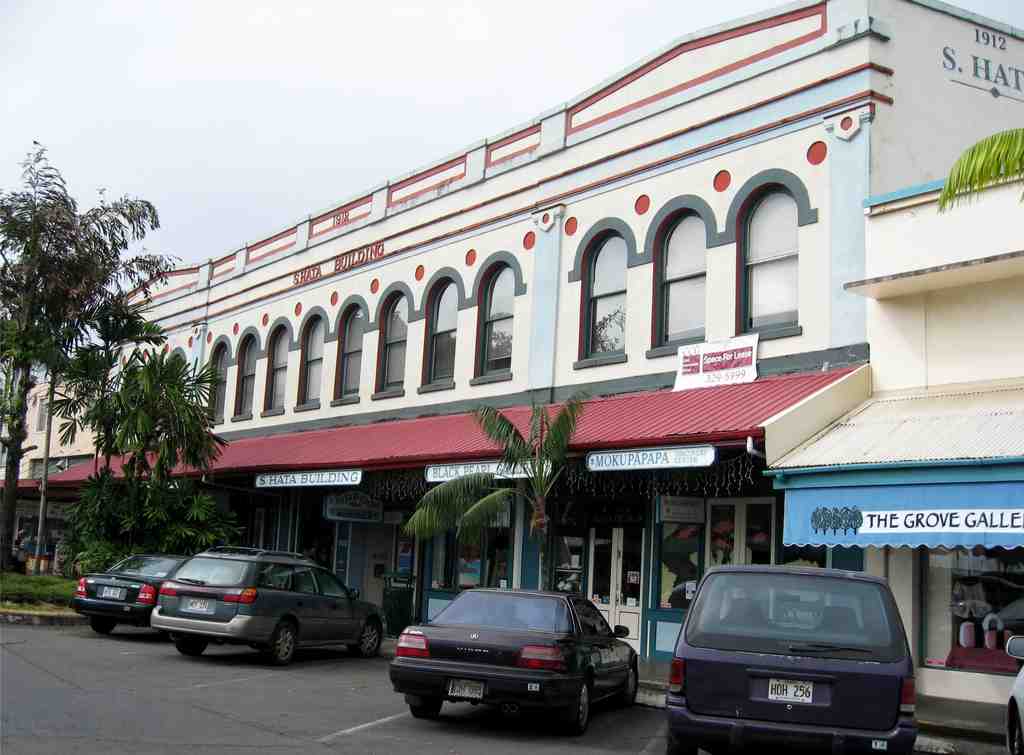
To spot the S. Hata Building, just look for a pale blue and white two-story building with a row of tall, arched windows above a line of specialty shops and a bright red awning, sitting right along Kamehameha Avenue near a cluster of palm trees.
Now, let me sweep you back in time-imagine standing on this very spot over a century ago, when Hilo was booming from the relentless work of the sugarcane plantations and the busy shuffling of immigrant workers. The story of this building begins with the determined Hata Sadanosuke, born in Hiroshima in 1868, who made the journey to Hawaii with big dreams and not much more than a suitcase and a hope for something better. When he arrived in Honolulu, he worked as an agent, striding from one sugarcane plantation to the next-talk about mileage! Inspired by the growing community, he founded his own business right here in Hilo in 1896, selling fine Japanese silks, kimonos, and exotic souvenirs. Business was slow at first-so slow, in fact, that Mr. Hata briefly transformed into an early Uber by renting out his horse and carriage for taxi service!
The tides changed after Hawaii became a U.S. territory in 1898, and suddenly both the plantations and Mr. Hata’s shop flourished. Hata’s once modest store outgrew its shell, and he decided to make a bold move. In 1912, on what was then squishy wetlands, Hata poured $25,000 into building this massive concrete structure-at a time when almost everything else around was made of wood. Not only was it big, but it was strong, designed to last. Imagine the clamor and echoing of workers pouring concrete, the wet slap and scrape of shovels-it was the sound of progress in Hilo! The first floor burst with bustling shops, while twelve grand arches watched over the street, and the second floor filled up with offices.
The Hata Building quickly became the pride of the town’s Japanese community. Sadanosuke’s younger brother Yoichi joined him and they spread the business as far as Honolulu and Osaka. Even the Hilo Sake Brewing Company opened here for thirsty locals (cheers to them!). But the Hata family’s journey wasn’t all smooth sailing. After the attack on Pearl Harbor, they faced internment and in 1942, the U.S. government seized the very building you’re looking at now. But the Hata spirit wouldn’t be kept down-Kasujiro, Sadanosuke’s daughter, won it back at auction.
The building’s strength was tested again in 1946, when a mighty tsunami battered Hilo. While so much around it washed away, the Hata Building stood firm-a lucky break, but maybe also thanks to all that concrete! The trains rattling past were washed away, too, leaving a new waterfront road and a new chapter for Kamehameha Avenue. The basement, once deep and cool, was filled in after yet another tsunami in 1960-sometimes it feels like this building has seen just about everything!
By 1990, the beautiful old structure looked tired and was close to being torn down. Luckily, David Levenson saw the historic charm and lovingly restored it, bringing back the classic iron brackets and polishing its vintage glow. Today, it’s a lively bundle of specialty shops and the famous Cafe Pesto (if you get hungry, you’re already in the right place). It’s also housed cool science exhibits-a giant aquarium and even life-sized sea creatures! And if you visit on a Wednesday or Saturday, poke your head into the legendary Hilo Farmers Market right at the end of Mamo Street, where you’ll catch the buzz of local vendors and fresh tropical fruit.
So there you have it-a Japanese immigrant’s dream, a bold leap into concrete, laughter echoing in the shops, and a survivor of tsunamis and wars. If you listen close, you might just catch a whisper of history-though don’t worry, the only thing ghostly here these days is maybe an echo from old horse hooves. Ready to stroll to our next stop?




