
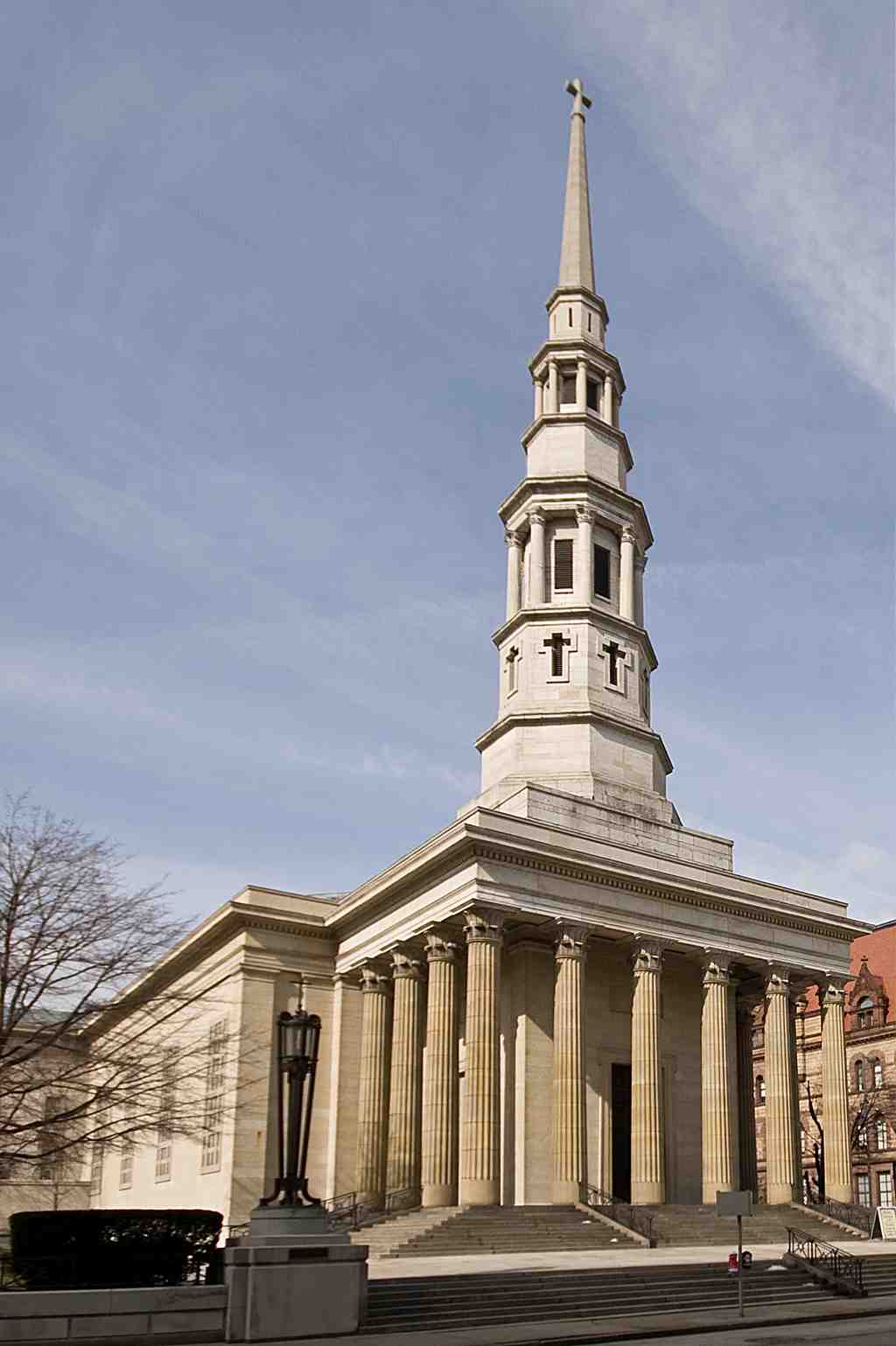
Look ahead for a stately, pale-stone building crowned with a soaring steeple and bold columns at the entrance-a true beacon reaching up into the Cincinnati sky.
Now that you’re standing in front of the Archdiocese of Cincinnati, just imagine the swirl of history and faith that’s passed through these very doors! Picture it: hundreds of years ago, when Ohio was still wilderness-first under French, then British rule-there wasn’t a Catholic church in sight. French missionaries never set up shop, so this land waited in silence while the world’s powers shifted, like chess players trading pieces.
Fast forward to the early 1800s, and a small band of determined Catholics built Cincinnati’s first church, led by the adventurous Reverend Emmanuel Thienpont. Can you see the wagons, the muddy streets, and the hope on people’s faces as they gathered for prayer? In 1821, Pope Pius VII carved the entire state out of Kentucky’s diocese and gave it the name: Diocese of Cincinnati. Talk about a promotion!
Bishop Edward Fenwick, the first leader here, was a real go-getter who traveled to Europe in 1823 for fundraising. He came back, pockets jingling, and helped build the city’s very first cathedral and parochial schools. He even opened up the region’s first Catholic orphanage and founded the country’s oldest seminary west of the Appalachians-St. Francis Xavier-in 1829. Imagine all the lively debates and hopeful young scholars within those walls!
The Cathedral Basilica of St. Peter in Chains, just around the corner, has stood as the mother church all along. And believe me, it’s seen a bit of drama: from American nuns setting up convents, to the founding of influential newspapers, to the architectural grandeur you see before you now-every stone whispers a secret.
Back in the 1840s, fiery debates flared up as Catholic immigrants-many German and Irish-poured into Ohio, sparking the growth of new parishes and churches rapidly. Bishop Purcell, another colorful character, launched the first German-language parish after leading lively processions through the city. He also built this city’s first orphanages for boys and girls, and even tangled with local Protestants after criticizing taxes on Catholic families to pay for public schools. And on Christmas Day 1853? Protesters gathered right outside his residence, furious over a Papal visitor. The angry crowd and police soon clashed, adding a dash of danger to Cincinnati’s snowy winter.
In 1850, with a flourish from Pope Pius IX, Cincinnati leveled up again-becoming an archdiocese, reshaping the religious map of Ohio and beyond, and even launching the region’s very first Catholic hospital.
Over the years, new archbishops continued to leave their mark by organizing schools, publishing newspapers, and guiding the city through times of economic hardship and scandal. By the 20th century, Cincinnati’s archdiocese was a Catholic powerhouse-running one of the nation’s largest systems of parochial schools, staffed by all manner of sisters and brothers, many beckoned from across the ocean by the generous Sarah Peter.
But, as with many vibrant stories, there were shadows too. You’ll find moments of sorrow-the financial panic of 1877 where the church nearly collapsed under a bank run, and more recent controversies over leadership decisions and tragic scandals. Yet, through every conflict and triumph, the Archdiocese has endured and adapted, connecting communities across 19 counties and guiding the spiritual life of Ohio.
Today, as you gaze at this proud, sunlit building, remember: you’re not just looking at stone and glass, but centuries of lively, sometimes stormy, always fascinating history-a tale as tall and spirited as the steeple rising right above you!
Wondering about the geography, religious orders and congregations or the churches? Feel free to discuss it further in the chat section below.




