
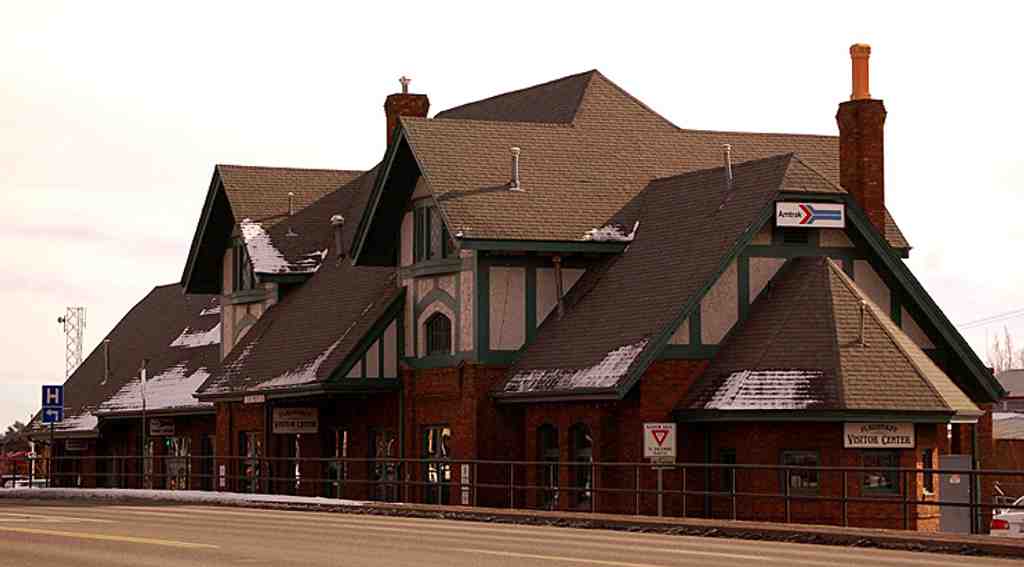
Look straight ahead at the station, a striking building with a cross gabled dark shingled roof, sturdy red brick and white plaster walls, and an old fashioned Amtrak sign near the top right peak. It is wild to think about, but this city actually started out as a rugged camp called Antelope Spring! The story of how it got its permanent name shows the raw ambition of those early settlers claiming this wild land. On July Fourth, eighteen seventy six, a scouting group known as the Second Boston Party literally stripped a massive ponderosa pine tree down to its bare trunk just to use it as a makeshift flagpole to celebrate the United States centennial. It was a bold, aggressive stake in the earth that transformed an anonymous spring into the permanent town of Flagstaff.
Now, there is a competing legend that says a surveyor climbed a tall pine in eighteen fifty five and tied a flag to it for Independence Day. Either way, that pioneer spirit defined the town. Soon after the flagpole went up, the Atlantic and Pacific Railroad crashed into this wilderness, bringing raw, dangerous progress. They built a wooden depot in eighteen eighty six that quickly burned to the ground... a disaster that eventually paved the way for the sturdy nineteen twenty five brick and stone station you see today.
That nineteen twenty five depot was built by the Atchison, Topeka and Santa Fe Railroad. The engineers designed it in a Tudor Revival style. That is an architectural style that mimics an old English manor with decorative exposed timber frames on the upper walls, specifically meant to handle Northern Arizona's demanding, high altitude winters. At six thousand nine hundred and two feet above sea level, this is one of the highest train stations in the entire Amtrak system!
This station became the beating heart of a remote community that forced its way into existence. Just across San Francisco Street is the older eighteen eighty nine solid red sandstone depot, which served as a busy freight hub. Timber was the absolute lifeblood here, an industry built on grueling manual labor. Settlers and massive Baldwin Steam Engines, like the famous locomotive nicknamed Two Spot, hauled endless logs out of the surrounding forests to feed the bones of a growing nation.
Today, the building shares its space with the Flagstaff Visitor Center, packed with Route 66 memorabilia. If you peek inside, there is a miniature train running continuously on a track suspended from the ceiling. It is also a global hub for train enthusiasts, thanks to a live Virtual Railfan camera mounted outside that broadcasts passing passenger and freight trains to viewers all over the world. They even use this depot to kick off local community events like the annual Flagstaff Chocolate Walk.
The railway brought relentless growth, transforming a lonely flagpole in the woods into a booming frontier hub. We are going to head away from the tracks now and walk toward the site of a humble chicken farm that eventually became something entirely unexpected. Let us make our way over to our next stop, the Orpheum Theater, which is just a six minute walk into town.




