
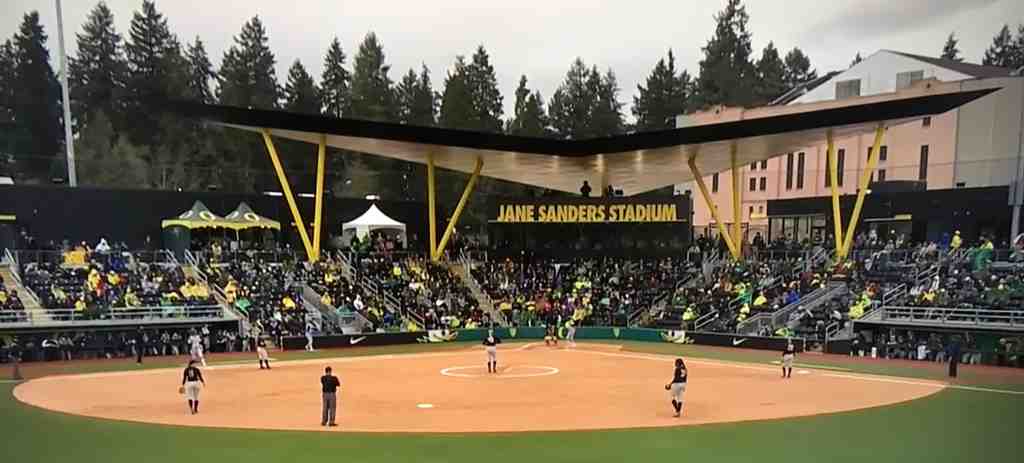
To spot Jane Sanders Stadium, just look for the big, modern structure with a dramatic V-shaped roof supported by bold yellow beams and the words “JANE SANDERS STADIUM” in large gold letters above the stands-if you see a crowd with green and yellow, and the distinct outline of a softball diamond, you’ve found it!
Now, let’s step up to the plate for a story that smacks of love, legacy, and a whole lot of Ducks spirit. This isn’t just any softball stadium-this is “The Jane,” the gleaming heart of Ducks softball, built right where decades of University of Oregon history took root. Imagine standing on ground where echoes of cheers and crackling bats stretch back to the days before color television, or even “Duck Dynasty” reruns.
This stadium’s story actually starts long before 2016. Let’s rewind to a scrappier era: Howe Field, a rough-and-ready diamond built in 1935 with a tidy $10,000 grant from the Works Progress Administration. For most of its life, Howe Field was more “backyard barbecue” than “state-of-the-art ballpark.” No dugouts, no bathrooms, a press box smaller than most Portland coffee shops, and players mowing the outfield grass themselves. If the ghosts of past Ducks ballplayers are still hovering, they’re probably looking on in awe-and relief-that they no longer have to make bathroom runs during the third inning!
For years, the Ducks’ women’s softball program nomadically hopped from spot to spot-Amazon Park, green patches near Pioneer Cemetery, and eventually a rough patch south of Hayward Field. By the late ‘80s, just as big hair and neon windbreakers were peaking, the team finally landed at Howe Field. There, with portable toilets for locker rooms and a streak of Duck grit, they transformed a humble field into a little Fenway of the Northwest-running on heart, hustle, and the occasional well-placed extension cord for the TV lights.
But the winds of change came swirling in, and standing in the center was Bob Sanders-a former Ducks football player and Eugene alum with sawdust in his veins (courtesy of a thriving lumber business) and a whole lot of love for his late wife, Jane Sanders. Jane was a Ducks superfan, a Pi Beta Phi at UO, a cheerleader, and, according to local legend, probably the loudest high-fiver at every game she attended, grandkids in tow. When Jane passed, Bob decided to turn his love and their Ducks spirit into something lasting. He kicked off the stadium fund with a dazzling $10 million donation, eventually topping it up so that this field could become one of the premier venues in all of college softball.
In 2016, after years of anticipation, Jane Sanders Stadium opened with fanfare, drawing praise from ESPN and Ducks fans alike. It wasn’t just a transformation-it was a total reinvention. Suddenly, there were permanent seats (1,500 strong at first, then up to 2,500), a grandstand shaded by that signature canopy, luxury suites, indoor training facilities, sparkling restrooms, and a videoboard so big it could play epic highlight reels visible from a mile away. Even the outfield got a makeover: artificial turf to survive those legendary Eugene rain showers, paired with a clay infield for tradition’s sake.
But this place is more than steel, turf, and a killer sound system. Bob Sanders, continuing his tribute, popped in a “grand slam” donation so they could build “The Bob”-a permanent outfield seating section, bathrooms, and another snack stand, because cheering for the Ducks works up an appetite! Hidden in the present-day sparkle, the historic cast-iron gates from Howe Field still stand here, silent bouncers watching every new hero step up to the plate.
Close your eyes and you might hear the ghosts of old games, the thumping feet of Jane Sanders herself running up the steps, grandkids tugging at her coat, and the ever-present chorus of “Go Ducks!” Jane Sanders Stadium isn’t just a venue-it’s an enduring love letter to grit, family, and the simple power of softball to bring people together. So take a breath, look around, and let the spirit of “The Jane” work its magic-you’re standing in the heart of Ducks country, where every pitch tells a piece of Oregon’s story.


