
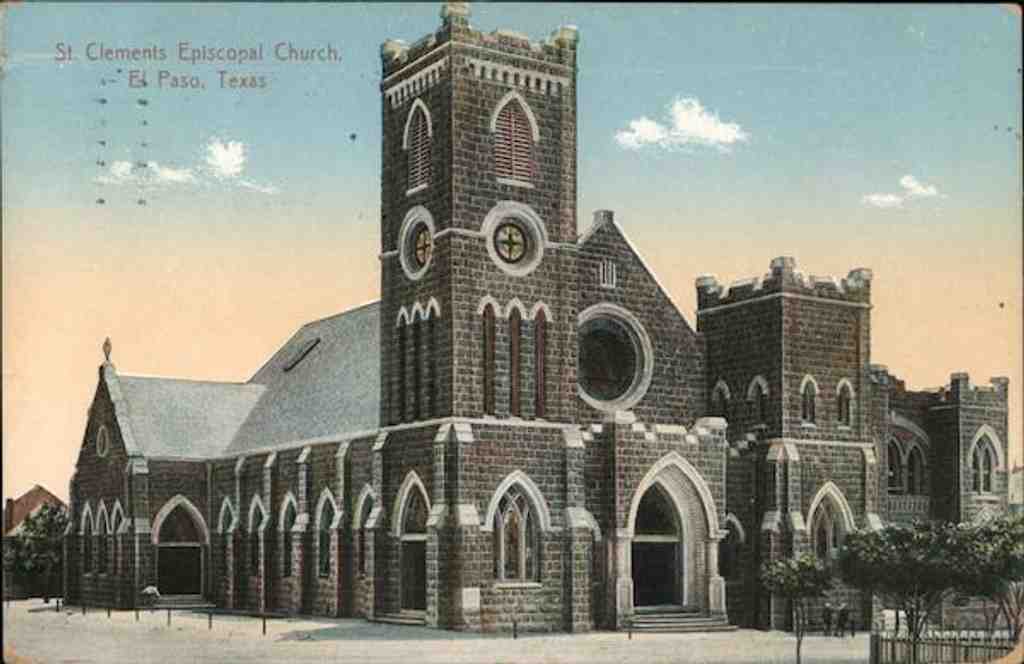
To spot the Church of St. Clement, look for a grand, stone building dressed in deep, dark blocks, with pointed Gothic arches and a tall, square bell tower that rises proudly above the street corner.
Welcome to the Church of St. Clement, a place where El Paso’s spiritual history crackles with the energy of pioneers, gunfighters, railroad tycoons, and-believe it or not-fossilized sea creatures! As you stand here, imagine the year is 1870. El Paso is less a city and more a dust-blown frontier outpost, wide open, wild, and waiting for its first Protestant congregation. The story begins in the humble parlor of Gaylord J. Clarke, a fresh-faced lawyer from New York with a heart full of hope and, apparently, a parlor big enough for every Episcopalian in town-which, at the time, might’ve been about five people and one dusty cat.
Clarke’s friend, Albert Jennings Fountain, wasn’t just anyone. He’d later be a senator and lieutenant governor, but back then, he and Clarke were dreamers, riding hundred-mile trails to Austin just to ask the Bishop for a priest to bring a little peace to El Paso’s gun-toting nights. And so, the Reverend Joseph Wilkin Tays arrived on a cloud of prayers and railway dust. On October 9, 1870, he held El Paso’s very first Protestant service-not here, but in a rented chapel, sending echoes of hymns drifting over cactus fields.
They named their new congregation after both Clarke’s late son and the ancient Saint Clement of Rome. But fate in El Paso loved drama: only two months later, Clarke heroically stepped between two feuding lawyers, guns drawn. The ensuing gunfight claimed his life, and the little flock he had nurtured fell temporarily silent. When you look at the stones of St. Clement’s, imagine the echo of those early struggles-grief, hope, and determination mixed right in.
Things went quiet during the devastating Panic of 1873, but then, with the iron song of the railroads, the town revived. Tays and the Episcopal spirit returned, eventually building a wood-framed church across from bustling San Jacinto Plaza. But the congregation outgrew the little building, and with every passing decade-belfry added here, new chancel added there-it became clear: El Paso wasn’t just surviving, it was thriving.
Now, take a look at this remarkable building before you. The cornerstone was laid in 1907, and with it, St. Clement’s set down Gothic Revival roots right here. The church’s shape follows a cruciform floor plan, and that bell tower is more than just a perch for pigeons-it is a beacon of history, its walls made of Upham dolostone, mined locally. Here’s a quirky fact: if you stare at the walls long enough, you just might see the whorled outlines of ancient marine fossils, proof that this tough, sunbaked desert was once an ocean floor, teeming with life unfathomable to nineteenth-century churchgoers. Talk about a rock-solid connection to the past!
The decades rolled on, bringing growth, new chapels, a parish school in 1958, and a booming membership that made St. Clement’s the heart of Anglican life in El Paso. The congregation didn’t just stick with one building, either. St. Clement’s helped plant churches all over town-an ecclesiastical green thumb, you could say.
The twentieth and twenty-first centuries brought big decisions and a bit of tension with the national Episcopal Church. In 2007, more than 450 members voted to strike out on their own, keeping the building after a multimillion-dollar settlement. It was bold, dramatic, and uniquely Texan, much like everything that’s happened inside these fossil-laden walls.
Today, St. Clement stands proud as part of the Anglican Church in North America, guardian of ancient stone and new stories. So give a little wave to the stone fish and ancient snails under your fingers, and remember: every brick here holds a century and a half of courage, community, and the dusty spirit of El Paso. Now, let’s quietly step onward-unless you think the fossils want to follow along!


