
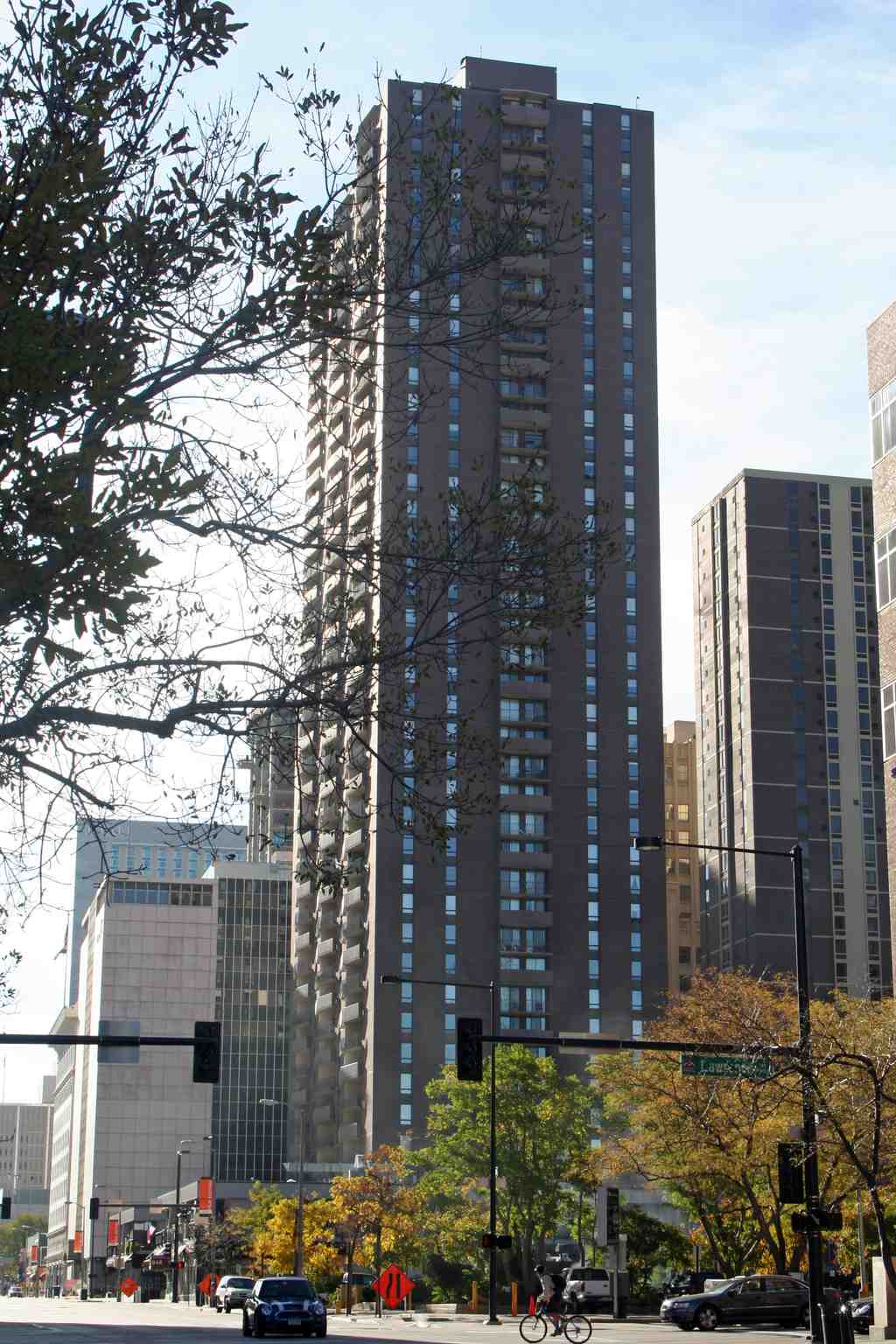
Right in front of you, look for the tall, dark brown Modern high-rise with long vertical strips of windows and a stack of small balconies running up the face like a zipper.
This is Brooks Tower, planted at 1020 15th Street, and it’s been setting its own kind of skyline standard since 1968. Forty-two stories, about 420 feet tall, and at the time it went up it wasn’t just a big deal for Denver... it was the tallest building in the entire Rocky Mountain region. Not bad for a place that was still shaking the dust off its frontier boots.
Brooks Tower was also Denver’s FIRST high-rise building meant for people to actually live in. Offices were one thing. But asking folks to ride an elevator dozens of floors to go home? In the 1960s, that was still a little futuristic. The developer, Aaron Brooks, pushed the idea through with Brooks Realty and Construction, and he brought in architect Max Ratner, based back east. The result is pure mid-century confidence: lots of concrete, brick, and glass, and a shape that’s meant to give as many residents as possible a piece of that view-downtown lights one way, the Rockies the other. If Denver had a “panoramic setting,” this building clicked the “yes” box.
The tower didn’t rise smoothly, though. Construction started June 8, 1966, under a $7.6 million contract-which is roughly around $70 million in today’s money, give or take depending on whose inflation calculator you trust. Then reality showed up: labor disputes, ugly weather, and owner-requested changes. Extensions piled up-court records say the architect approved 215 extra days-and the whole thing eventually slid into a legal fight between the tower’s corporation and the main contractor. Nothing says “new luxury living” like paperwork and lawsuits. Still, the building was substantially finished around June 1968, with a more formal public opening noted in early 1969.
There’s an older ghost on this lot, too. Before Brooks Tower, this was home to Denver’s Mining and Exchange building. And surviving that change is a 12-foot copper statue from 1891 called “The Old Prospector,” preserved out front in the garden. So while the tower points to modern urban living, the front yard nods to Denver’s original business model: dig a hole and hope.
Inside, Brooks Tower started as rental apartments-studios up to penthouses, with plenty of balconies for people who like to supervise the city from above. It later made a major leap in 1995, converting into condos in what was reported then as Denver’s biggest condo conversion: 517 units. The funny thing is, the unit count depends on who you ask-some sources say 565 or 566, and some databases toss out numbers that don’t quite add up. When your building is basically a vertical neighborhood, the math gets a little… creative.
And for a few years in the 1970s, this place even had a second life as a music landmark. From 1973 to 1977, the second floor hosted Ebbets Field, a club co-founded by promoters Chuck Morris and Barry Fey. It pulled in major acts and even won Billboard’s “Club of the Year” in 1975 and 1976-meaning while some residents were trying to sleep, history was happening upstairs.
Brooks Tower has kept aging like any 1960s giant: in the late 2010s, the building took on a massive re-piping project to replace old water risers-initially talked about at $44 million, later reported closer to $33 million-and managed it in phases so people could stay put. Because moving 500-plus households out of a 42-story building is... everyone’s favorite weekend plan.
When you’re set, the Denver Center for the Performing Arts is a 5-minute walk heading northwest.




