
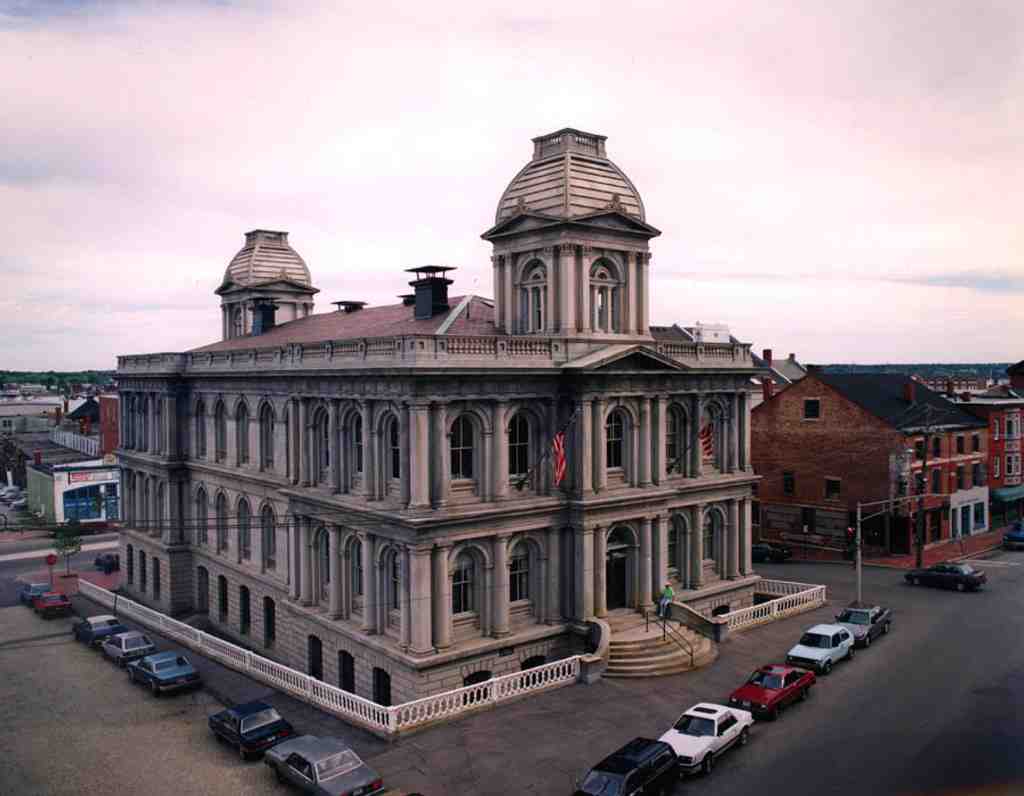
To spot the United States Custom House, look straight ahead for a grand, three-story gray granite building with rhythmic rows of large arched windows and two striking square cupolas perched on top-it stands majestic on a corner with a white stone railing along the steps.
Now, let’s go back in time, right where you’re standing-imagine the year is 1866. You’re on a bustling Portland waterfront, the salty air is sharp with the promise of commerce, and every street seems to echo with the clatter of horse hooves, the shouts of sailors, and the crash of waves against wooden docks. But suddenly-tragedy! The Great Fire tears through the city, devouring nearly 1,800 buildings, including the Exchange Building where customs officers once counted riches streaming in from across the sea.
Portland is in ruins, but the spirit here is as tough as New Hampshire granite, and the city refuses to be snuffed out. After all, by this time, Portland is one of the nation’s busiest ports, collecting an impressive $900,000 a year in customs duties. With trade booming and the need for a grand new home for customs operations, a decision is made-this city needs a landmark! In steps Alfred B. Mullett, America’s dashing Supervising Architect of the Treasury. Mullett is the kind of architect who mixes solid strength with a flair for the dramatic-think of this building as Portland’s own architectural hero in a tailored stone suit.
Building begins in 1867. Materials trickle in as slowly as a Maine spring thaw, especially the granite hauled from New Hampshire for upper levels. Five patient years pass as masons and carpenters wrestle columns and pilasters into place. By 1872, Mullett’s vision stands complete: a granite fortress with elegant Renaissance Revival curves and the signature mansard roofs of the Second Empire style. Walk up close and you’ll see those massive round-headed windows, with simple but powerful keystones. Stout Doric columns and pilasters guard each corner, topped with an intricate cornice swirling around the building like fancy icing on a sturdy birthday cake.
Perhaps the real treasure lies inside-picture yourself walking over a sophisticated checkerboard marble floor, counters stretching along either side, made from rare marbles salvaged from the heart of Lake Champlain. High above, a coffered ceiling glimmers with ornate patterns, and a grand two-story customs hall buzzes with inspectors and merchants inspecting manifests, stamping papers, and maybe even sneaking a few good stories. There’s a narrow, iron-gallery ringing the hall, decorated with emblems of trade-corn, tobacco leaves, and even playful dolphins! Right in the middle of this elegant swirl stands an eight-foot walnut counter with a proud spherical clock ticking away every second of Portland’s fortunes.
This Custom House has survived nearly unchanged for over a century and a half-through the arrival of the U.S. Coast Guard in the 1980s, through restoration projects great and small, and even the moving out of the last customs officers in 2012. In 2013, a major renovation breathed new life into these granite bones, and today it houses federal agencies whose tasks are still woven into the fabric of Portland’s story.
So as you stand here, picture bustling sailors, anxious merchants, and the oddly proud customs officials all layered across the years, arguing over sea-chests and invoices where you now gaze up at the grand old twin cupolas. This is a survivor-a building as steadfast and surprising as Portland itself! And don’t worry, they say the only things smuggled through here today are echoes of the past… and maybe, just maybe, a stray seagull hoping for a snack.
Intrigued by the architecture, significant events or the building facts? Make your way to the chat section and I'll be happy to provide further details.


