
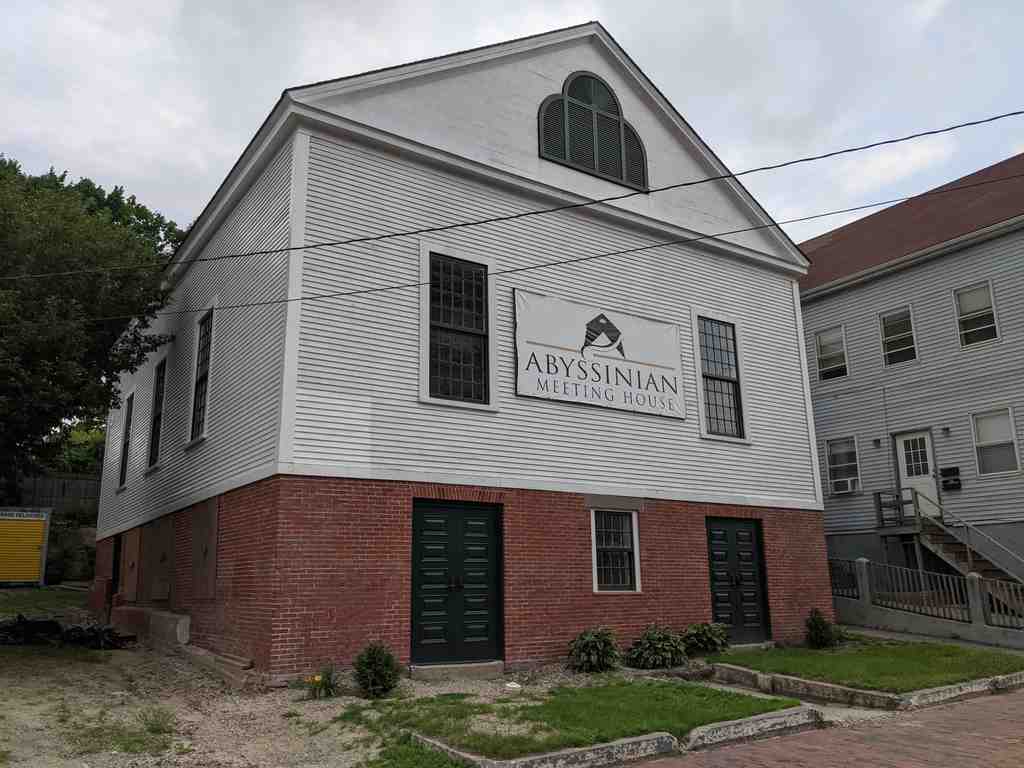
To spot the Abyssinian Meeting House, look for a simple, two-story building with white wooden siding on top, red brick on the bottom, tall black-trimmed windows, and a large sign right on the front that says "Abyssinian Meeting House."
You’re standing in front of the Abyssinian Meeting House, one of Portland’s best-kept secrets-and what a story it has to tell! Take a deep breath and imagine it’s the early 1800s, and this quiet street is alive with activity: the clacking of horse hooves, the smell of wood smoke in the air, and the determined footsteps of neighbors bustling to a meeting that could change their lives.
This remarkable building, crafted between 1828 and 1831 by free African-Americans, is the oldest African-American church building in Maine, and the third oldest in the entire United States-sort of the wise grandparent of historic Black churches! It was born out of stubborn hope, after Christopher Christian Manuel, Reuben Ruby and others bravely spoke out against segregation at the local Second Congregational Church, where Black worshippers were forced to the balcony if they were even allowed in at all. When their protest letter hit the local newspaper, you can bet it made some noise!
Refusing to accept second-class treatment, these community leaders formed the Abyssinian Religious Society. When you picture Reuben Ruby, think of a man with a heart as strong as an ox and a spirit as lively as a fiddle-he gave the land for this building, put in sweat turning it into a spiritual home, and even drove his hackney carriage around Portland, carrying not only fares but sometimes escaped slaves seeking freedom. One minute he’s helping William Lloyd Garrison plot the next anti-slavery speech, the next he’s fixing up the church interior or, yes, even hosting a spirited lawsuit to make sure the books were balanced.
This wasn’t just a house of worship. Imagine the sound of revival meetings, the pounding pulse of impassioned abolitionist speeches, the hum of the Portland Union Anti-Slavery Society planning its next campaign. In the 1840s, if you listened closely, you’d even hear children’s laughter and the scratch of slates-because this was also a school for Black children when others wouldn’t teach them. By 1851, over 75 children crowded in for lessons, the air alive with hope and the occasional groan over tough homework.
The Abyssinian was a place where church and action came together, where you might find Reverend Amos Noé Freeman helping people find jobs, arguing for temperance, or plotting ways to fight slavery. He even welcomed runaway slaves and hosted famous abolitionists, giving the place an air of both excitement and mystery-sort of like a 19th-century superhero hideout!
Through all this, the Abyssinian endured. When Portland’s Great Fire of 1866 raged through the city, parishioners reportedly banded together in a desperate stand to save the church from the flames-and they succeeded. The building fell quiet as the 20th century closed in, especially after tragedy struck in 1898 when the sinking of the SS Portland claimed seventeen of its congregation.
Still, the Abyssinian refused to disappear, even as membership dwindled and it was eventually sold, turning into a stable, then an antique store, and finally carved into apartments. The neighbors probably didn’t realize that under their feet lay remnants of abolitionist meetings and Underground Railroad activity! When the city seized it for unpaid taxes in the ‘90s, the building could have faced the wrecking ball, but local heroes stepped in again-sound familiar?-buying the place for exactly what it cost to buy the land in 1828: $250.
Today, thanks to grants, archeologists have uncovered marbles, bits of dishes, old toys, and even a wooden water pipe. The future of this site is finally looking as bright as the people who built it. So next time you hear the wind whistling around these old windows, let it remind you of all the stirring voices-teachers, freedom seekers, and fiery preachers-that once filled these walls.
Fascinated by the a house of worship (1828-1917), mandated dissolution or the landmark status and restoration? Let's chat about it


