
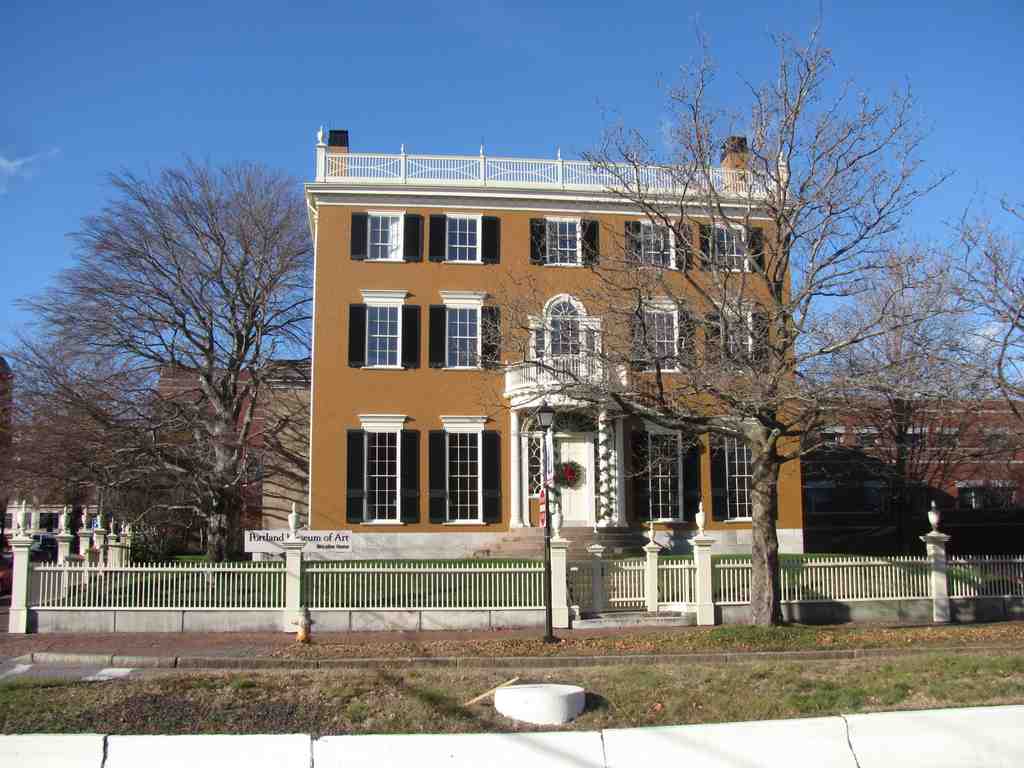
To spot the Portland Museum of Art, look for a stately, three-story brick mansion with a pale fence and tall windows; it faces the street proudly with a wreath-adorned entrance and is framed by leafless trees right here in the heart of the Arts District.
Alright, take a little breath of that fresh Maine air and look up at this historic building-you’re not just seeing a museum; you’re about to step into more than a century of drama, art, and a dash of friendly Portland controversy. Picture it: the year is 1882. The city bustles with horse-drawn carts, and a small group called the Portland Society of Art first dreams of filling these streets with creativity. But they didn’t have a permanent home-not until the generous Margaret Jane Mussey Sweat left behind this mansion, hoping to honor her late husband, Lorenzo De Medici Sweat (that’s right, a name so fancy he almost sounds like a Renaissance painting himself). The transformation from private home to public gallery brought in famed architect John Calvin Stevens, and in 1911 the L.D.M. Sweat Memorial Galleries opened their doors. Imagine the echo of footsteps and the gentle hum of awed voices from that first crowd, eyes wide as they gazed at Maine’s first major art collection.
As time pressed on, the museum kept growing, but squeezed for space like a lobster in a too-small shell. In the swinging ‘70s, things started to accelerate after Charles Shipman Payson, a Maine native, pledged his prized collection of Winslow Homer paintings-and a cool eight million dollars for a modern new wing. Suddenly, the old galleries had room to breathe, and so did Maine’s art lovers. The Payson Building became the face of the museum in 1983, and art poured in from across the world-paintings by Monet, Rodin, Picasso, and Cassatt, not to mention works from Marsden Hartley to Jamie Wyeth, making sure the museum had more drama inside than an episode of reality TV.
But the history doesn’t just hang on the walls here; it’s built into the museum itself. The PMA is a patchwork of three buildings, each one echoing a different era and architectural style. In 2002, after a major facelift, the museum finally merged the stately McLellan House, the Beaux-Arts glory of the Sweat Galleries, and the modern Payson Building into a seamless whole-no more family feuds between the centuries, just one big, art-loving happy house.
Now, every year, around 140,000 curious souls pass through these doors, hunting inspiration or maybe some peace and quiet (hey, we all need it). Sure, the walls are crowded with masterpieces, but the collection is broader than a Maine horizon: over 22,000 works, from haunting Munch prints to the sunny charm of Childe Hassam, and enough American stories to fill a whole bookshelf… or maybe a lobster trap.
And just when you think you’ve cracked the whole story, controversy barrels in as only Portland can. In recent years, the debate around 142 Free Street-an old theater turned church turned museum-fueled passionate arguments about history, inclusivity, and even affordable housing. Some wanted the brick structure saved for its past; others argued that progress sometimes means letting go. After city council drama, court cases, and more letters than a postman’s holiday, the decision was finally made-Portland’s evolving identity, echoing in the bricks beneath your feet.
So as you stand here, take a moment to hear it all: the murmur of past crowds, the quiet clash of old and new ideas, maybe even the gentle slap of a sea breeze-a place where Maine’s stories and masterpieces all come together under one roof. If these walls could talk, they’d tell you this-art is about change, and no one does change quite like Portland. Ready to move on, or do you just want to wander inside and see if you can spot a Picasso hiding behind the coat rack?


