
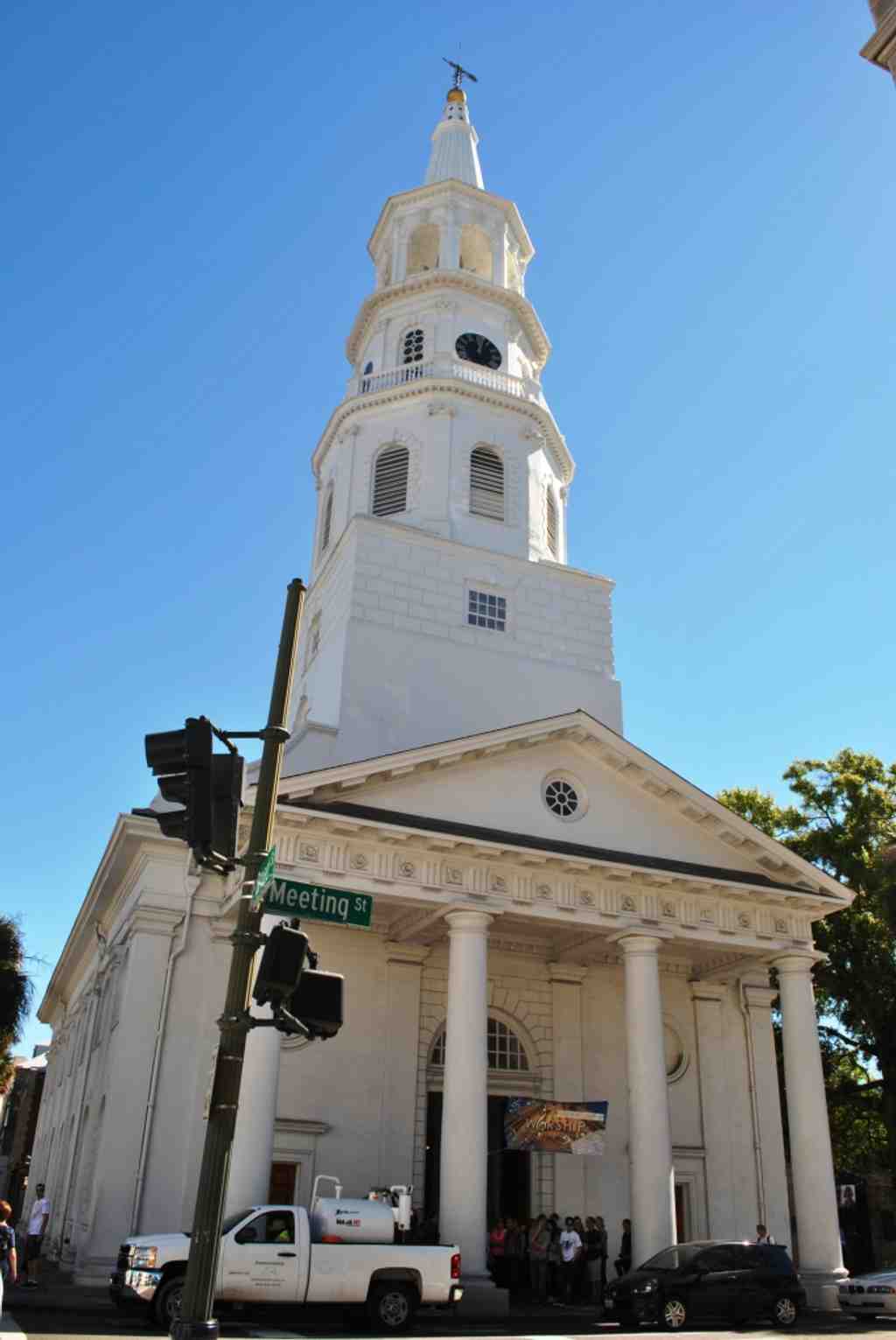
To spot St. Michael’s Anglican Church, just look for the gleaming white building at the corner of Broad and Meeting streets, topped with a tall, layered steeple rising against the sky and a grand, columned entrance that practically begs you to admire it.
Alright, you've officially arrived at one of Charleston’s most iconic and time-travel-worthy landmarks: St. Michael’s Anglican Church! Take a deep breath and let your imagination step back through nearly three centuries, because you’re standing at the oldest surviving religious building in the city, a true old-timer with stories to tell. Built all the way back in the 1750s, this beauty served not only as a house of worship but as a witness to revolutions, hurricanes, wars, and even a presidential sit-down-George Washington himself prayed here in pew number 43. If you squint hard enough, you might just see a ghostly figure in a powdered wig, nodding approval.
The story of St. Michael’s starts with a disaster: way back in 1710, a hurricane battered an earlier wooden church that stood right here, courtesy of St. Philip’s, Charleston’s first parish. With the old church ruined and eventually taken down, city leaders decided to rebuild-on a decidedly more solid foundation. No more wobbling in the wind for Charleston’s faithful! By 1761, St. Michael’s was complete, showing off its brick walls covered in white stucco, designed to look a bit like St Martin-in-the-Fields, a famous church in London. The builder, Samuel Cardy, and a team of artisans gave this church some fancy flourishes-just take a closer look at those columns and the detailed carvings on the portico. They even splurged £1000-no small sum back then-on intricate architecture and elaborate ornaments inside and out.
Now let your eyes drift up to that clock tower. The clock that chimes out the hours and quarters is as old as the United States-crafted in England and shipped across the sea. And those bells up there? Cast in London in 1764. During the Civil War, the church took a pounding from cannonballs, but just like the people of Charleston, it dusted itself off, patched up the damage, and kept ringing out the hours. One bell even took a round-trip voyage to London in 1870 to be fixed-a bell with frequent flyer miles!
Step inside-or imagine peeking in-and you’d see light streaming through stained glass that would make any artist jealous. One window, given in 1898, is a dazzling Tiffany creation using up to 2,000 individual pieces of glass. Another depicts St. Michael giving Satan the boot, inspired by a painting in the Louvre-proof that this church isn’t just a spot for prayer, but for serious art appreciation, too. Even the organ has its own backstory, with the original case dating to 1768 and a new heart installed in the 1990s.
Out in the churchyard, history continues underfoot-two signers of the U.S. Constitution are buried here, adding a little founding-father flavor to your visit. And while the church’s affiliation has changed a bit over the centuries-moving from the Church of England to American Episcopalian, and now to the Anglican Diocese of South Carolina-its commitment to Charleston’s spirit and community remains the same.
So, here at this bustling crossroads of Broad and Meeting, with the bells ready to chime above you and history humming under your feet, you’re standing in the beating heart of Charleston’s story. And don’t worry: the columns can handle a selfie or two.
If you're curious about the religious affiliation, clock and bells or the gallery, the chat section below is the perfect place to seek clarification.


