
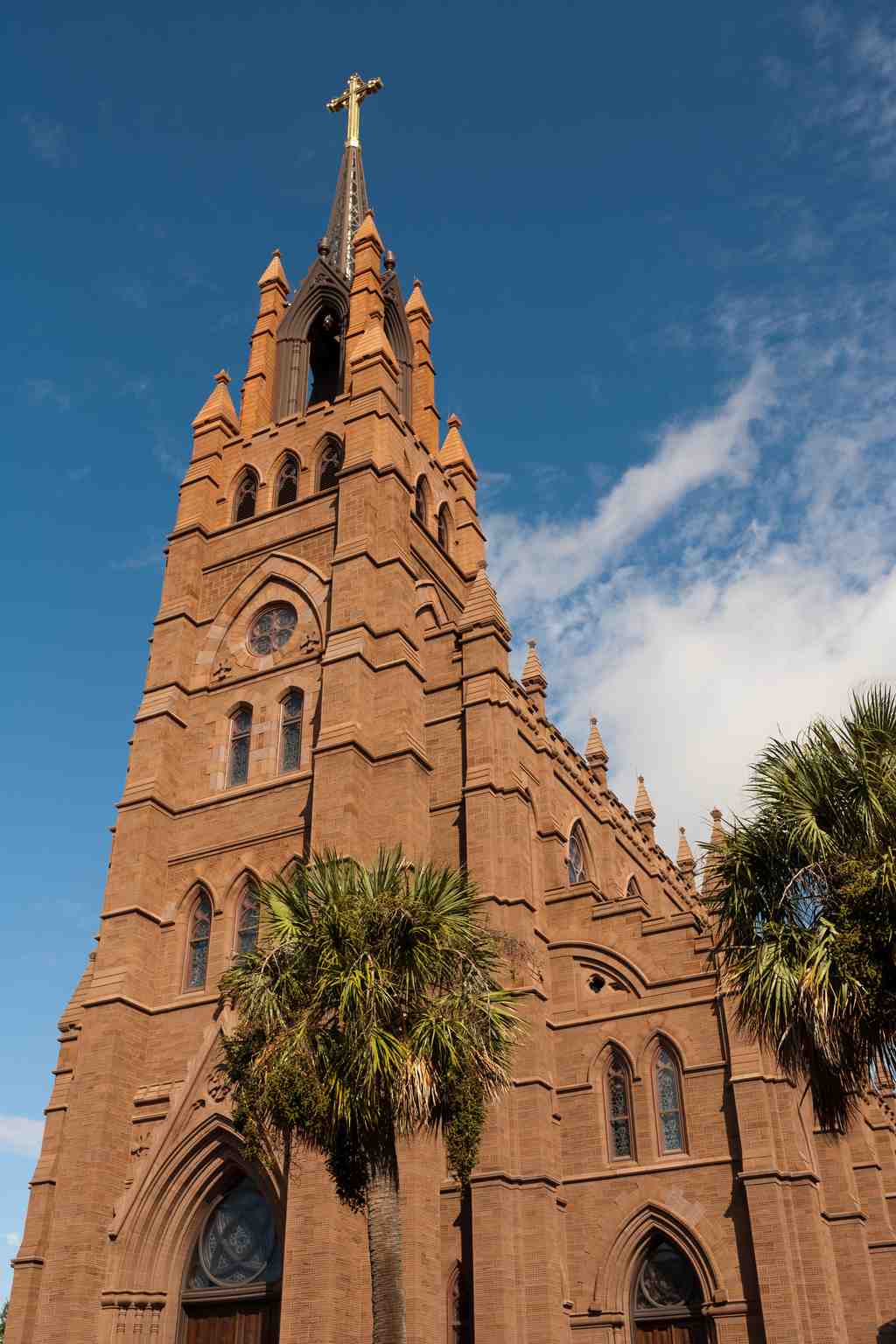
If you look up just ahead, you’ll spot the Cathedral of Saint John the Baptist-it’s the tall, reddish-brown Gothic building with sharply pointed towers and a golden cross glittering atop a narrow copper spire, rising proudly above the palm trees.
Now, let me set the scene: imagine yourself standing here in Charleston over 150 years ago, smoke filling the sky as fire races down Broad Street. In 1861, as people tried desperately to save what they could, the original Cathedral of Saint John and Saint Finbar and the neighboring St. Andrews Hall were completely consumed by flames-leaving only haunted ruins and a long wait for something new to rise from the ashes. This very spot sat empty for decades, a scarred reminder of the devastating fire and the struggles following the Civil War. Funds were low, spirits lower-but Catholics in Charleston weren’t about to give up.
Fast forward to 1890: the city buzzed with excitement as Cardinal James Gibbons arrived to lay the cornerstone for a new Cathedral-this one, designed by Patrick Keely, an architect from Brooklyn who seemed to have a knack for making Gothic dreams come true. Picture the sound of mallets striking stone, the dizzying sight of scaffolding against the South Carolina sky as workers raised walls of Connecticut brownstone and carved intricate details-think of it like building a sandcastle, just a little heavier and much less likely to wash away at high tide.
For years, the new cathedral stood proud, but if you squint at the steeple, you’ll notice: it’s not quite what Keely first imagined. Originally, there wasn’t enough money for a towering spire. It wasn’t until 2010-over a century later-that the steeple, topped with a dazzling 16x9 foot gilded copper Celtic cross, finally crowned the structure. And if you’re here at just the right time, you might hear the cathedral’s three bronze bells-cast in France-chiming clear and sweet in an E major chord across the city.
Step inside-well, in your imagination for now-and sunlight pours through stained glass windows shipped all the way from France. Try to picture it: 14 glowing two-light windows showing scenes from Christ’s life, 28 saints shining in the upper nave, and a kaleidoscope of colors pouring down on pews carved from Flemish oak. Over the altar, there’s a copy of Leonardo da Vinci’s The Last Supper, done up in colored glass, and a rose window showing John the Baptist, the cathedral’s patron, baptizing Jesus with angels ringing the scene. It’s a little like walking into a jewelry box full of light.
With four chapels-one containing a crypt where Charleston’s first five bishops rest-the cathedral is not just a place of worship but a treasure chest of stories. There’s the Sacred Heart Chapel holding a statue of Jesus with hands extended in blessing, the Blessed Virgin Mary Chapel with a unique marble Madonna and child, and the main lower church, Our Lady of Grace Chapel, which welcomes overflow crowds and once hosted daily mass.
You might even hear a note or two from the cathedral’s mighty Bedient pipe organ-it journeyed all the way from Christ Church Episcopal in Louisville, Kentucky before making Charleston its home. This pipe organ isn’t just for show; it’s used to fill the space with music and the occasional grand entrance by the cathedral choir.
Over the years, the cathedral has weathered renovations, repairs, and more than a few design tweaks. In 2007, those priceless stained-glass windows were carefully refurbished, making sure that each detail still shone as brightly as when they first arrived. The doors now welcome you beneath rose windows bearing the coat of arms of the city, the state, and Pope Pius X-so you get a little bit of South Carolina, a dash of Rome, and even a sprinkle of papal flair.
So, as you stand here today, surrounded by that beautiful brownstone and those sky-reaching spires, remember: this place is more than a building. It’s a living story of resilience, patience, and a community that refused to let disaster be the final word. And hey, with all that history and heavenly music, I bet even the angels would have to admit Charleston knows how to bounce back-and maybe even hit a high note along the way.
For a more comprehensive understanding of the exterior, chapels or the stained-glass windows, engage with me in the chat section below.


