
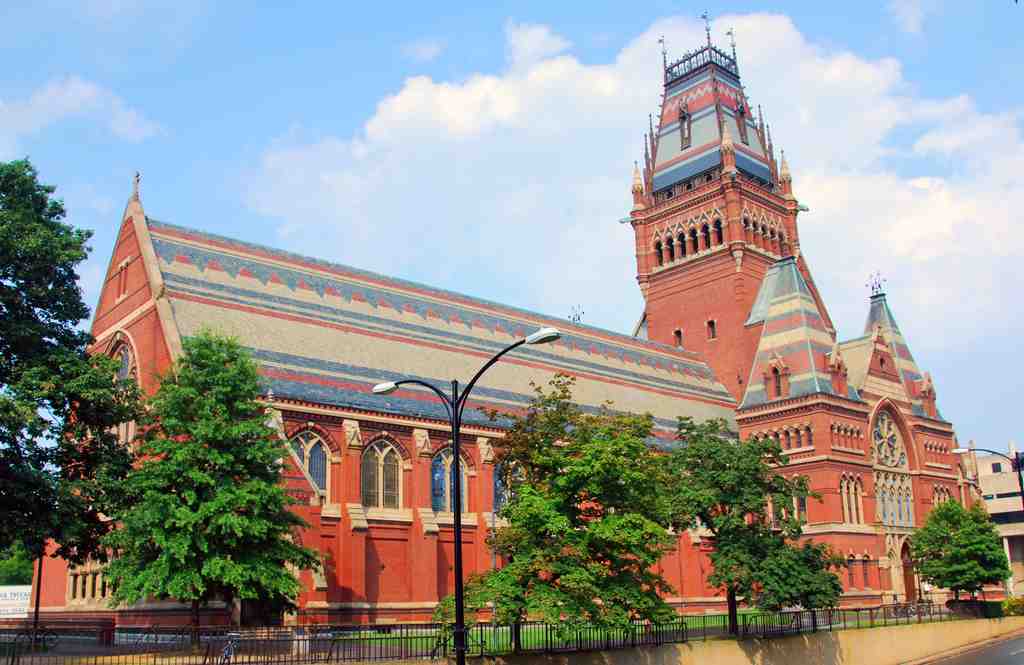
To spot Memorial Hall, just look ahead for the giant red-brick building with its dramatic pointed tower, castle-like rooflines, striped slate tiles, and rows of tall, stained-glass Gothic windows rising above the treetops-trust me, you can’t miss it!
Now, while you’re taking in this towering masterpiece, let’s step back in time and set the scene: imagine the dust of a former ball field-the Delta-settling as a crowd of townsfolk, artists, and scholars gather in the shadow of what would soon be one of the grandest buildings Harvard had ever seen. Memorial Hall feels as if it leapt out of a fairy tale, boldly declaring Harvard’s devotion to the heroes of the American Civil War. If Hogwarts and a heroic cathedral had a baby, this would be it. Back in 1865, grief and pride swirled through the country, and here in Cambridge, a group called the “Committee of Fifty” got busy raising what amounted to one-twelfth of all Harvard’s money at the time-nearly $370,000. Their goal was to create something magnificent in memory of the 136 Harvard men who gave their lives to defend the Union and fight against slavery. That’s why, if you listen closely, this place almost hums with history and hope.
They didn’t just want a solemn hall-they cooked up a vision that would inspire every student, graduate, and honored guest who wandered its corridors. The design competition was fierce, but two Harvard grads, William Robert Ware and Henry Van Brunt, took home the blue ribbon with their wild High Victorian Gothic dream. With turrets, arches, and a roofline that reaches for the sky, they wanted the building to look imposing: a steadfast memorial to bravery and sacrifice, a symbol of Boston and Harvard’s fiery abolitionist heart.
And what a building! Henry James, the novelist, once described it as “one of the finest buildings in America,” divided into three enchanted realms. First, there’s Sanders Theatre-a glorious space inspired by Sir Christopher Wren’s Sheldonian Theatre over in Oxford, England. Imagine rows and rows of wooden seats, golden light pouring through John La Farge’s stained-glass “Athena Tying a Mourning Fillet.” If you sat in the audience, you just might have heard the mighty voices of Winston Churchill, Theodore Roosevelt, Martin Luther King Jr., or even Mikhail Gorbachev. The theater is also famous for its perfect acoustics. Harvard’s very own Wallace Sabine would even haul hundreds of red seat cushions out of Sanders Theatre each night-in the dead of winter!-for science experiments. He’d sneak them into lecture halls to absorb sound, so the scientific unit of sound absorption, the “sabin,” is practically named after a Sanders cushion.
Next, there’s Annenberg Hall, which once echoed with formal dinners and, eventually, the rhythmic clatter of cutlery as thousands of hungry undergrads stampeded in right at one o’clock for lunch. Students in the 1880s would literally race across the yard to snag a seat-perhaps the original fast food. The immense wooden trusses overhead, walnut paneling, and blue-stenciled ceiling give it a sense of banqueting like old Oxford. During World War II, you might catch the strange smell of army boots and oatmeal as Divinity School chaplains marched in pre-dawn calisthenics, or hear mysterious noises from the secretive basement science lab. Harvard even installed a rifle range for a while. The hall’s since been transformed and is now where freshmen get their first taste of Harvard dining in true Hogwarts style.
Between them is the Memorial Transept: a soaring hallway glowing with stained glass and stone, where the names of those 136 fallen sons are etched in white marble. As you walk there, imagine solemn footsteps on the black walnut floor, and let your eyes climb up the 60-foot-high arched ceiling, as light from enormous stained-glass windows colors the air. With every step, your feet trace the path of memory-past names like Peabody, Revere, Bowditch-their legacy lasting longer than even the thickest granite.
Now, look up at that massive tower! It used to have a clock so loud it could wake the dead-or at least, keep the students from sleeping in. In 1932, someone mysteriously lowered the 155-pound bell clapper over 100 feet to the ground without being seen-legend says Yale students were getting payback for a missing bulldog. The second clapper disappeared the same way, so the rivalry is as old as the bricks here. Later, in 1956, the tower’s upper half burned, but was gloriously restored in 1996 to its original look.
All around, don’t miss the window art by Louis Comfort Tiffany and John La Farge, and the statues of great orators keeping silent watch. But really, Memorial Hall is more than just grand architecture-it’s a living monument, a place where hope, history, and a bit of college mischief all come together. So, take your time, and let yourself be swept up in its unique magic-just don’t try sneaking out with any clock clappers, or Yale might come looking!




