
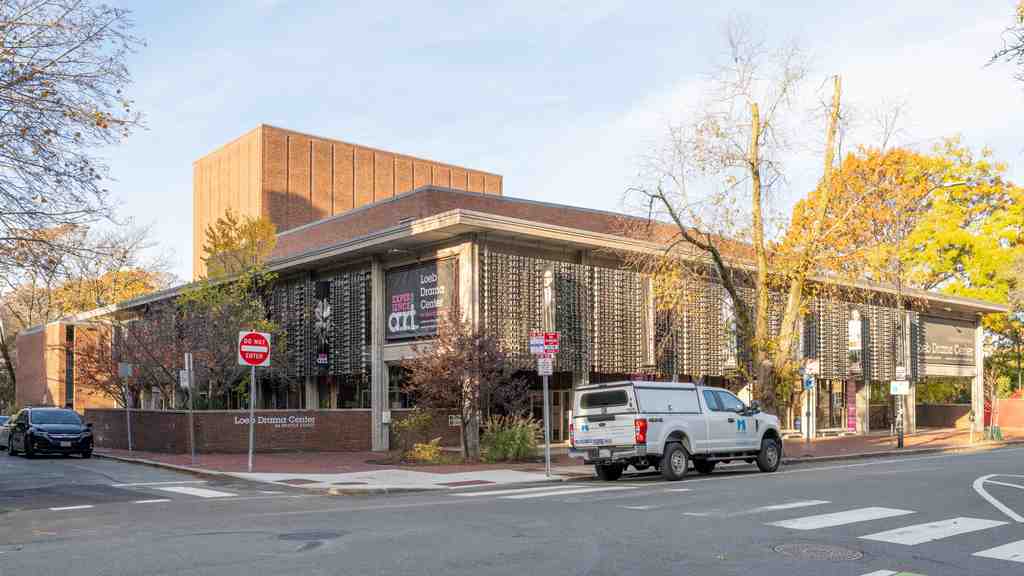
To spot the American Repertory Theater, look for a modern, low-rise building with large glass windows, a flat overhanging roof, and a distinctive pattern of hanging brick screens; it sits right at the corner under the banner that shouts “Experience A.R.T.”
Welcome to the American Repertory Theater, or A.R.T. if you want to sound like an insider. Right now, you’re standing at the crossroads of Cambridge culture-where brick meets glass, and where wild imagination has been taking center stage since disco was king. Picture this: it’s 1979, Harvard’s campus is buzzing, and Robert Brustein, a theater visionary, decides he’s going to shake up the drama scene for good. This place isn’t just any old playhouse. No, it’s a launchpad for playwrights, actors, and directors to dream big, break rules, and sometimes even drum on a few tables-literally.
Imagine yourself stepping back to the early days: Harvard students and professional actors, side by side, breathing life into the classics while also daring to create something new. The scent of sawdust, the sharp snap of stage lights, and the nervous energy-the kind you can almost taste when opening night is a gamble. Here’s where the ghost of Hamlet shares the hallway with a robot from Death and the Powers: The Robots’ Opera. That’s right-a robot! The A.R.T. has always been on the edge, premiering over 250 new plays and making sure at least half the time, nobody in the audience knows exactly what’s about to happen.
Look around: this glassy, modern Loeb Drama Center houses not just the A.R.T., but also students of the Harvard-Radcliffe Dramatic Club. Over the years, major American and international theater artists have brushed elbows in these very wings. They’ve staged musicals, operas, classics, and even wild reimaginings-if the theater were a kitchen, this would be the chef’s counter where all the unpredictably spicy dishes get served up first.
The story doesn’t stop at bold productions. In 1987, the A.R.T. founded the Institute for Advanced Theater Training-a five-semester, high-octane MFA program. Here, young actors still head off to study at the Moscow Art Theatre School. Imagine traveling from wintery Cambridge straight to a Russian snowstorm-all in pursuit of the arts. Imagine the drama students with frozen eyelashes, learning Stanislavski by day and sampling borscht by night. Harvard students even take undergraduate classes from working professionals, meaning you could be taking Dramatic Literature from someone who was just on Broadway.
A.R.T. has always taken risks-sometimes they pay off in a big way. The theater’s trophy shelf is running out of space: a Pulitzer Prize in 1982, a Tony Award in ’86, the Jujamcyn Award in ’85, and 18 Tonys in total! And just to keep things spicy, Time Magazine even called them one of the top three theaters in the U.S. in 2003.
Robert Brustein handed over the director’s baton to Robert Woodruff in 2002, who brought a taste of the Bay Area’s bold playwrights. Then, in 2008, enter Diane Paulus, a Harvard grad herself, with a magical bag of ideas. Her mission? She wanted the audience to feel as much part of the story as the actors-suddenly, the fourth wall wasn’t just broken, it was thrown out entirely! Shows like Sleep No More and The Donkey Show-imagine Shakespearean disco-turned theatergoers into dancers, detectives, and even unwitting stagehands. If you see someone in bell-bottoms wandering out, it might just be opening night for a new immersive hit.
Push your ear closer to the brick and glass: you might hear echoes of famous names-Alanis Morissette’s Jagged Little Pill started here before heading to Broadway, as did the Tony-winning Once, Pippin, and All the Way. And the creators behind the curtain? Legendary directors, writers, poets, and visionaries-from Zadie Smith to Dave Malloy. Maybe you’ll meet a future star today that you’ll recognize on your next Netflix binge.
This is more than just a theater. It’s living, evolving proof that the performing arts can connect campus and city, youth and sage, tradition and innovation. So, next time you pass this corner, look for the laughter on the sidewalk, the hush before curtains rise, and listen for the applause echoing around the Loeb-it’s always showtime at the A.R.T.
Fascinated by the productions, notable collaborators or the educational institution? Let's chat about it




