
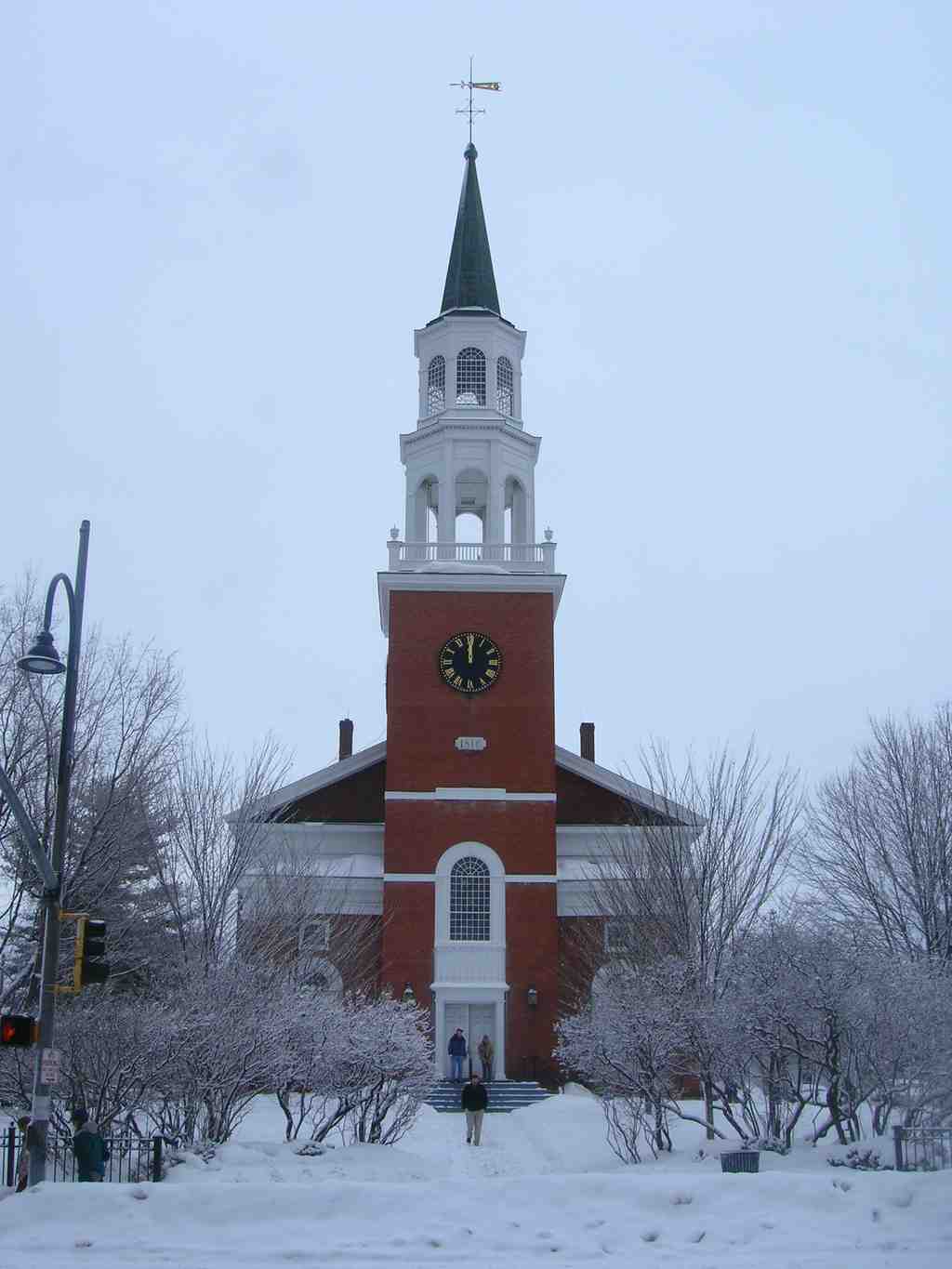
Look to your right for the stately red brick meeting house, defined by its tall, tiered white wooden steeple and the prominent clock face mounted directly above the main entrance.
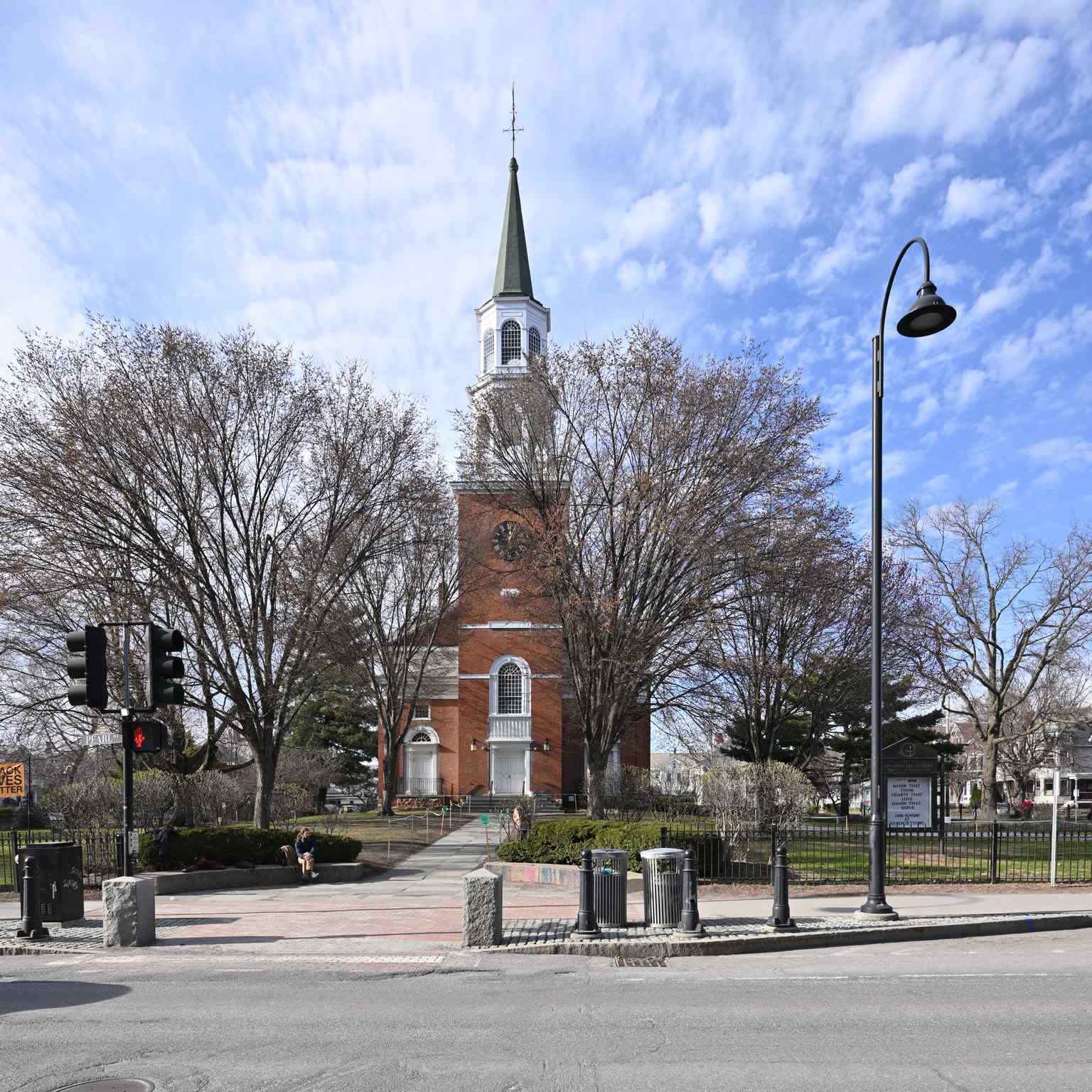
This is the Unitarian Universalist Meeting House. It is the oldest remaining place of worship established by European settlers in this city. Built in 1816, its very presence dictated the layout of the town. Standing right at the head of the avenue, this single building gave the marketplace its name. If you check your screen, you can see how it stands as a historic sentinel over the area.
But the creation of this congregation was born from intense division. In the early eighteen hundreds, the local Congregational society split over theology. One side embraced the Trinitarian view, a strict Calvinist belief in the holy trinity and predetermined salvation. The other faction, the Unitarians, rejected those rigid doctrines in favor of a more liberal approach. The theological rift was so tense that the community's first minister resigned rather than choose a side.
The Unitarians pressed forward, hiring an English architect to design a masterpiece. The community rallied to build it. They hauled massive timbers from a nearby river valley, fired the bricks right here in Burlington, and hammered every nail by hand. The total cost was around twenty-three thousand dollars, which translates to roughly half a million dollars today. They even brought an organ all the way from Boston by sleigh.
The original bell hanging in that tower was cast by the famous patriot Paul Revere. Unfortunately, it cracked twelve years later during a particularly vigorous ringing. The congregation had to send it to New York to be melted down and recast. Decades later, the town purchased the cracked bell metal for about five hundred and ninety dollars, roughly nineteen thousand dollars today.
The building you see today has survived over two centuries of change, testing the congregation's spirit time and again. In 1954, lightning struck that soaring white steeple, causing hidden dry rot that eventually tilted the spire dangerously to the east. It had to be demolished. But during the Great Depression, the Works Progress Administration, a federal relief program, had sent architects to meticulously document the church's dimensions. Thanks to those exact drawings, the city was able to reconstruct the steeple precisely as it was, reinforcing this new version with a modern steel frame.
As the physical structure adapted, so did the people inside. In 1845, the church quietly removed a segregated seating sign from its balcony, taking a definitive early step toward racial integration. Today, that drive for inclusivity continues. Each June, they host a Flower Communion. Congregants bring a flower to the service and leave with a different one, a beautiful ritual celebrating human diversity and theological pluralism, the idea that multiple different belief systems can peacefully coexist. It is a powerful reflection of a community that has constantly reshaped itself to become stronger and more united.
If you happen to be walking by between Tuesday and Thursday midday, their doors are typically open for a few hours. When you are ready to continue, let us walk toward another congregation that has adapted through the centuries, the First Methodist Church, located just a seven-minute walk away.


