
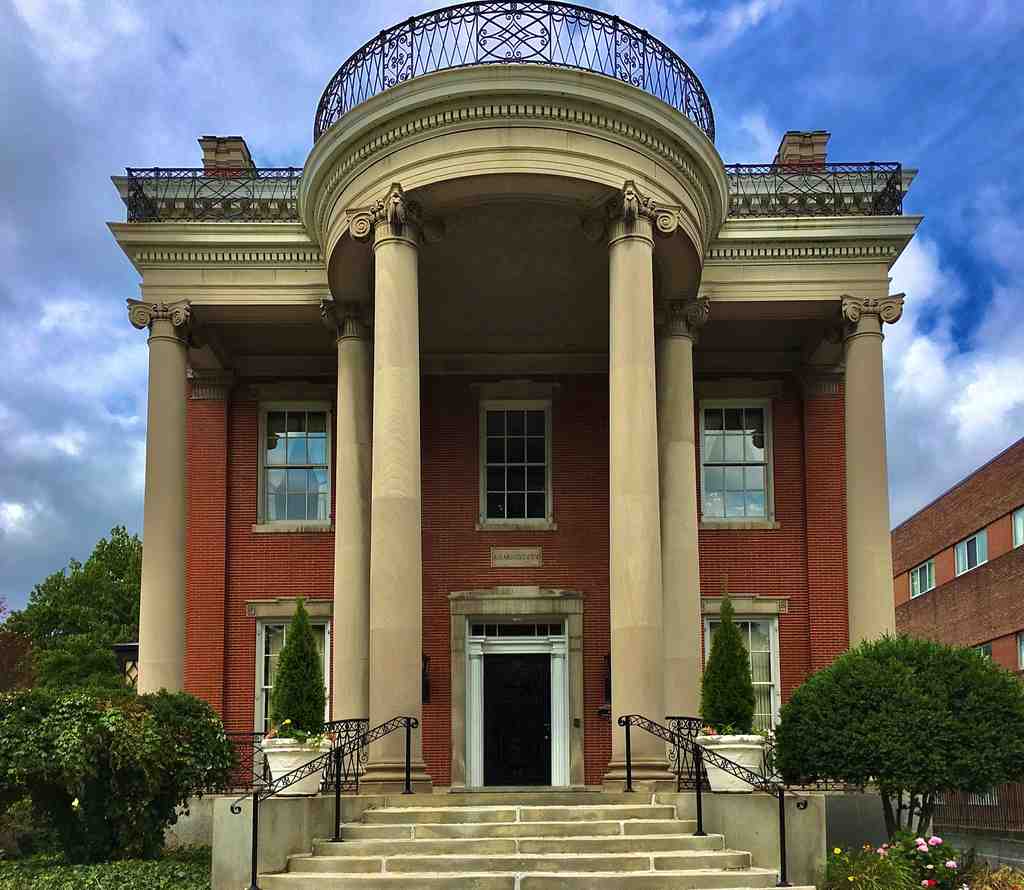
Look for a grand red-brick mansion with towering cream-colored Ionic columns out front and an impressive sweeping staircase-if you see a two-story porch with ornate iron railings above, you’ve found the Williams-Pratt House!
Alright, time to stretch those legs and senses. Take in the sight of this stately mansion, its bold red brick glowing against the Buffalo sky, flanked by columns that look like they could double as launch pads for very refined rockets. Now, imagine it’s the late 1890s. The chill of Buffalo air swirls around fancy carriages on Delaware Avenue, as Charles Howard Williams and his wife Emma eagerly watch their lavish new home rise-designed by none other than Stanford White, the superstar architect from New York’s McKim, Mead & White. They spared no expense, bringing in iron railings from August Feine & Sons, fencing from John H. Williams Iron Works, and finishing touches destined to make everyone’s jaws drop-think gilded walls, glowing crystal sconces, and fireplaces so intricate you’d swear they were sculpted by elves.
But every grand tale requires a little drama! In 1900, only a year after moving in, disaster struck. Imagine the panic: thick smoke creeping from Charles’s bedroom as fire devours the carved woodwork, embers scattering across those elegant floors, heat and chaos threatening the stately calm of this mansion. It wasn’t a total loss, but it left a literal scorched mark on the Williams-Pratt story (and Charles probably had a few sleepless nights).
Now, fast forward! After Charles and Emma passed away, their daughter Jeannie and her husband Frederick Pratt moved in, and the place transformed into party central. The Pratts threw legendary bashes, but none topped the 1926 “Oriental Ball.” Picture this: every inch of the house and even the portico cloaked in rich, exotic fabrics; one room turned into a mystical Egyptian lounge for dancing, the other into a smoky East Indian den for well-dressed partygoers. The energy must have practically buzzed in the air-flappers and jazz, glittering gowns, maybe the occasional Charleston being attempted by a guest in an elaborate turban.
Of course, every fortune has its twists. When the Depression hit, Jeannie lost much of her wealth, and after Frederick’s death, the house fell on hard times too. In 1938, the city took over for back taxes, and you might say this stately home went from champagne to hardtack sandwiches. But those veterans from the Grand Army of the Republic and the Spanish-American War wouldn’t let its history go quietly. They moved in, turning grand halls and marble staircases into meeting rooms (and, probably, the world’s most intimidating storage space).
Even in the face of greedy developers in the 1950s, the house stood firm-veterans and city folk united to fend off demolition. The Williams-Pratt House refused to become just another gray office block, stubbornly insisting on dressing up in its three-story grandeur. In the late 20th century, businessman Paul Snyder took over before the house finally found new life as headquarters for the LiRo Group.
So, as you stand before those stately columns, imagine the laughter, the music, and the echo of footsteps-some in silk slippers, some in boots, and all layered with the memories of a house that just refuses to be forgotten. Welcome to a piece of Buffalo’s living history!


