
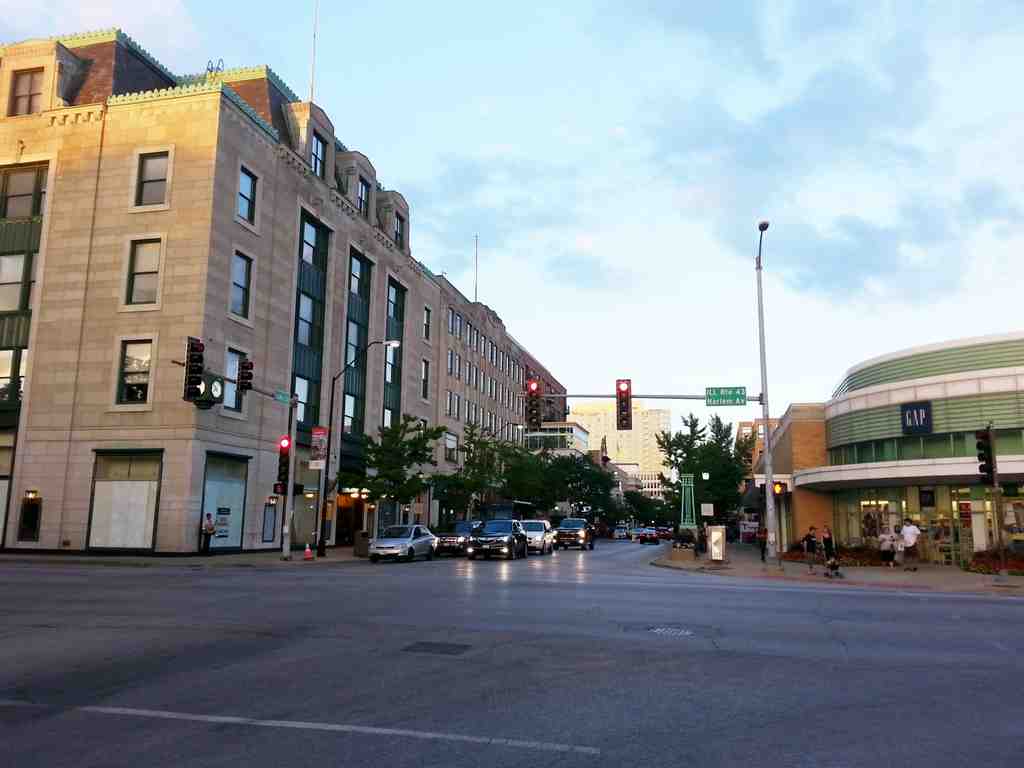
To spot Oak Park, just look ahead for the striking corner where a grand, stone-clad building with distinctive green detailing meets a modern, rounded shopfront with wide glass windows-right at the busy intersection of Lake Street and Harlem Avenue, where you’ll see lots of people and cars buzzing about.
Welcome to the beating heart of Oak Park, a village with as many stories as there are bricks in these stately buildings! Imagine the air full of distant city sounds as bustling Chicago once inched ever closer-Oak Park taking shape on the edge of wild prairie land, farmers’ boots crunching on gravel roads. In 1835, Joseph and Betty Kettlestrings rolled in from Yorkshire, England, staking out a farm that became the nucleus of the village. Their story is practically a sitcom: they moved closer to Chicago for schools, only to return and build an even bigger homestead in Oak Park. At first, the place went by all sorts of names-Oak Ridge, Harlem, even Kettlestrings Grove-before finally settling on Oak Park because, believe it or not, “Oak Ridge” was already taken by another post office. What are the odds?
Fast forward to the 1850s, and things really started to shake. With the Galena and Chicago Union Railroad slicing through the area, the population ballooned-Chicago's smoke and energy lured folks west after the Great Chicago Fire of 1871. Oak Park’s own depot meant residents could hop on trains to downtown, soon joined by the clickety-clack of streetcars trundling along Madison and Lake Streets. By the early 20th century, Oak Park had become the “World’s Largest Village,” home to nearly 65,000 people-and, perhaps even more impressively, an absolute legend of architecture: Frank Lloyd Wright.
Wright settled here with his wife in 1889, leaving his creative fingerprints everywhere. Prairie-style homes still dot the streets, while the Unity Temple stands as a testament to both architectural innovation and stubborn Midwestern spirit-after all, where else would you find entire districts preserved on purpose? That’s right: Oak Park folks love their history almost as much as a good Fourth of July fireworks show (and yes, the football stadium packs out every summer for the big celebration).
The village isn’t just about stunning buildings and famous residents-though Ernest Hemingway’s birthplace is right up the street, and the guy who invented Tarzan once lived here, too. Oak Park is a social experiment that worked: in the 1960s, as neighboring areas were torn apart by panic, steering, and resegregation, Oak Parkans instead voted for the Open Housing Ordinance, determined to keep the community integrated. It wasn’t always easy-sometimes it probably felt like trying to hold back Lake Michigan with a shovel-but through tough talks and even a ban on “for sale” signs, the town kept changing while keeping its promise of diversity and neighborly cohesion.
Everywhere you look, there’s a sign of Oak Park’s bold, creative soul: theaters, galleries, music wafting through coffee shop doors, and an arts district that’s small in scale but big on heart. And what about the quirks? Well, once upon a time you couldn’t legally grab a beer after mowing your lawn-Oak Park only loosened up its alcohol laws in the ‘70s and 2000s. Now, it’s hard to stroll through downtown without spotting a lively restaurant or cocktail bar.
Transportation is still Oak Park’s lifeblood: the Green and Blue Line “L” trains hum through, linking everything back to Chicago. Cyclists zip down tree-lined streets, tapping into a deep tradition of outdoor play. At every turn, you’ll sense Oak Park’s layered past-the whispers of prairie grass, the clang of railways, and the vibrant chorus of voices that still make this village far greater than the sum of its parts.
If you're curious about the geography, demographics or the arts and culture, the chat section below is the perfect place to seek clarification.




