
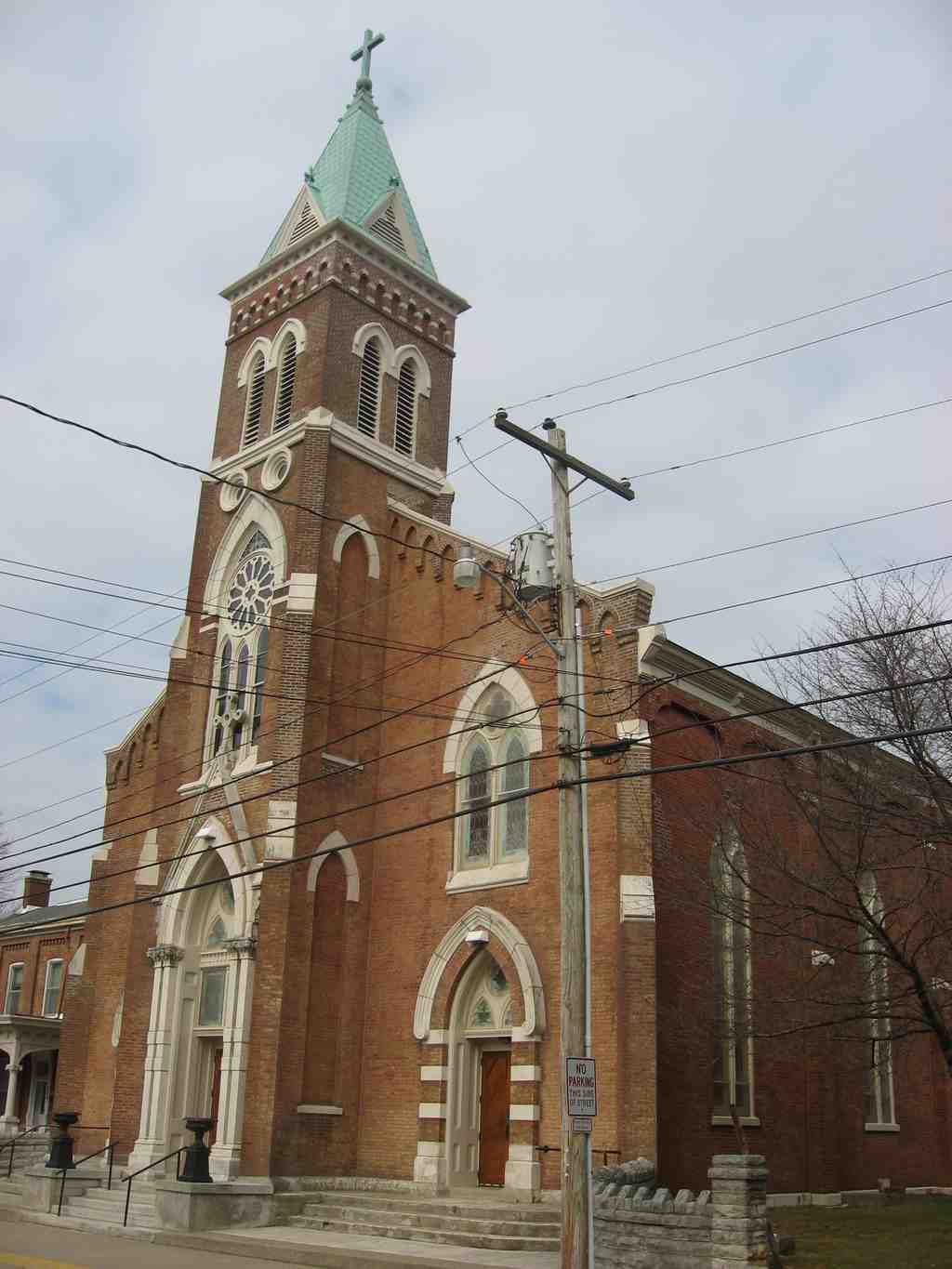
On your right, look for the tall red-brick church with white stone trim and a green, pointed steeple topped by a cross.
This is St. Joseph’s Catholic Church, sitting here at 434 Church Street like it’s been patiently holding its spot in Bowling Green forever… because, in a way, it has. The parish’s story really kicks off in the 1850s, when a young seminarian named Joseph DeVries was sent here to keep a growing Catholic mission from fizzling out. He was only about twenty-two when the request came down from the bishop in Louisville, which is a pretty strong vote of confidence… or a very polite way of saying, “Good luck, kid.”
By 1859, the community put up a small frame building meant for a boys’ school, but on Sundays it pulled double duty as a place for Mass. The deed was clear: this church was for the Catholic people of Warren County. And then came the bigger dream-this brick sanctuary you’re looking at, designed and built under Francis Leopold Kister, a master German architect. Construction didn’t exactly go smoothly. The Civil War interrupted the work, and early on the walls weren’t even plastered when Easter Mass was celebrated. Nothing says commitment like worshiping in a building that’s still basically under construction.
A serious, tangible symbol of that determination arrived as a bell-six hundred pounds of it-cast all the way up in Troy, New York, then hauled down to Kentucky and blessed in 1863. That’s not a casual online order. And originally, the steeple shot up to about 142 feet, the tallest in the city at the time-an architectural way of clearing your throat and saying, “We’re here.”
The early years weren’t gentle. Father DeVries died unexpectedly, and he was buried under the main altar-marked by a marble slab in the sanctuary. Then in 1902, a fire badly damaged the church. Out of that came something beautiful: fresco paintings added to the interior, created by Charles and Guido Leber from Louisville. Even disaster, apparently, couldn’t resist redecorating.
The parish put down deeper roots in 1912 by opening a school next door, staffed by the Sisters of Charity of Nazareth for fifty-five years. During World War I, the community raised aid by selling handmade paper carnations made by disabled veterans-about twenty-five cents each, roughly eight or nine dollars today-red if your mother was living, white if she’d passed. A small flower carrying a lot of weight.
And then, because history loves drama, a cyclone in 1923 tore down the steeple. What you see now is the replacement: that pyramidal top rising to around 87 feet-practical, sturdy, and still handsome.
In 1975, St. Joseph’s landed on the National Register of Historic Places for its architectural and historical importance. Inside, the parish once noted the original 1898 organ was still intact-white quarter oak casing, eighteen ranks of pipes-because of course a place like this keeps its voice.
When you’re ready, the Eloise B. Houchens Center is a 14-minute walk heading southeast.


