
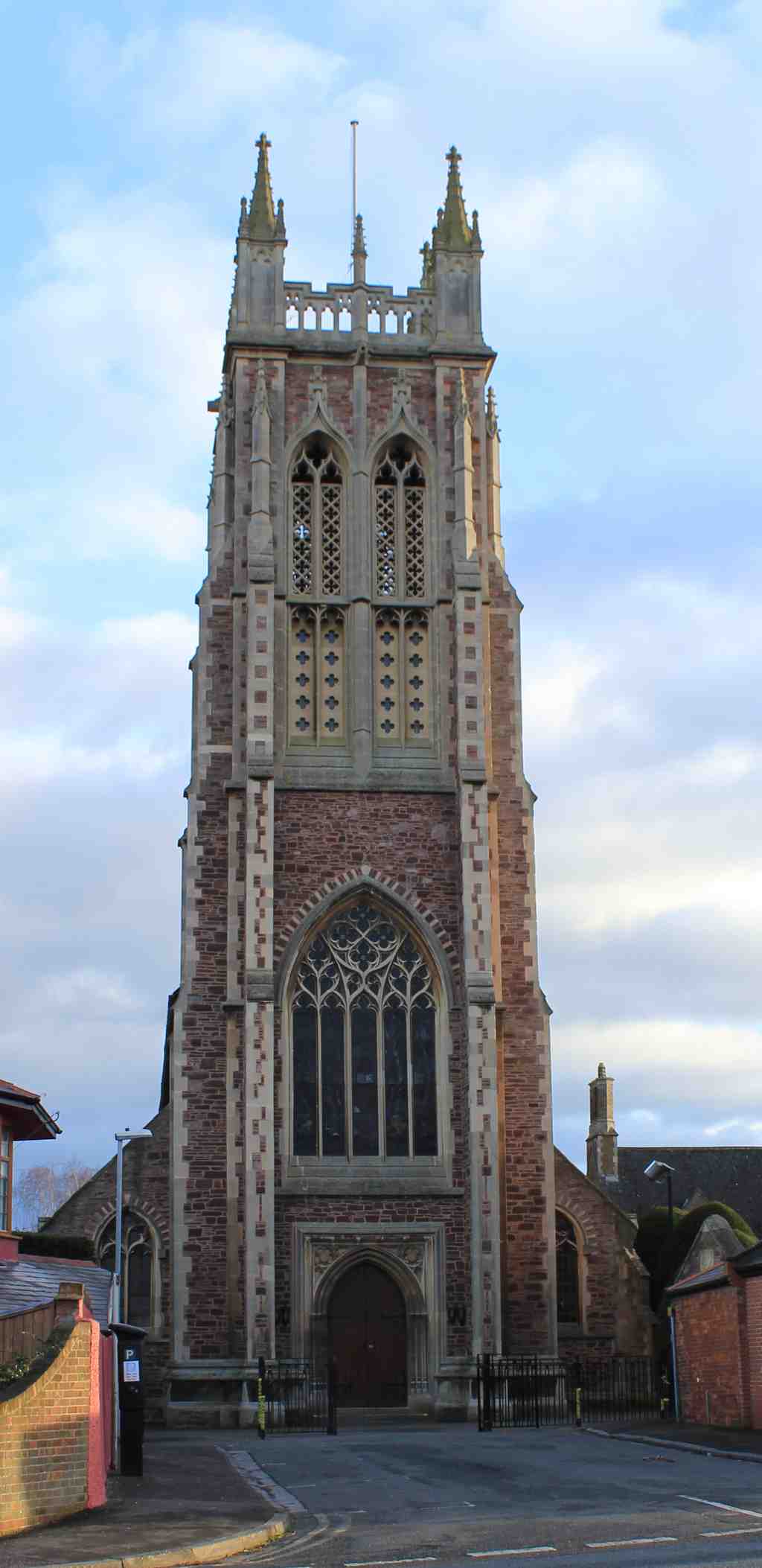
To spot St George’s Roman Catholic Church, just look ahead for a tall, dramatic red stone tower with pointed turrets and grand arched windows-the impressive Gothic Revival structure rises steeply above Billet Street and leaves no room for doubt!
Now that you’re standing here, imagine yourself stepping back to the 1800s-Taunton’s streets bustling with carts, horses, and the clatter of boots. There’s a scent of fresh stone in the air, and excitement, too, as something monumental is taking shape on this very spot. Now, you might look at the church and think, “Towering. Grand. Surely always the home of a lively Catholic congregation?” But just two centuries ago, Catholicism in Taunton had nearly faded away after the Reformation. In the late 1700s, local legend claimed “there were no Papists in Taunton!” An exaggeration, but not too far off-by 1787, just a handful of dedicated Catholics quietly met in a small chapel registered on Canon Street.
By the 1850s, that secret community had grown bolder-and a little too big for its boots, or at least, too big for tiny St George’s Chapel! Can you picture it? Families crammed shoulder-to-shoulder in a chapel meant for 200, the windows foggy with breath, the air thick with whispered prayers and hope. Something had to change, and in a twist of historical generosity, the nearby Franciscan Convent bought up a plot of land, right on the edge of town. They offered it up-imagine the cheers!-for a new, proper church, a rectory, and even a school.
Enter Reverend John Mitchell, a man with grand ideas-and, as it turns out, big shoes to fill. He dreamed of a church with a spire to rival Salisbury’s famous cathedral. Rather optimistic, some might say! Fundraising began with all the drama of a village fair: a bazaar here, a lottery there (until the police caught wind and said, “Hang on! No gambling, please”). Still, nothing stopped the determination. On a bright summer’s day in August 1858, the Bishop of Clifton laid the first stone; the townspeople gathered around, excitement humming in the air like a plucked violin string.
So, as you stand before this tower built from red Monkton stone, trimmed with pale Bath stone, you’re looking at the Gothic Revival in full swing-pointed arches, ornate windows, those proud stone turrets. Nikolaus Pevsner, an expert in architecture, called it a “competent imitation” of the grand Somerset towers that dot the county, though this church’s details twirl with a more playful, flowing style than the strict old Perpendicular Gothic.
Funny thing, those grand plans for a towering spire-well, the spire never did happen. They built a stout tower up to 89 feet, and the rest… remained in dreams and sketches. Blame it on funds, time, or maybe a little bit of Somerset practicality: the wind up here can be fierce, after all. Still, the church continued to grow, year by year. In 1860, the doors swung open for the first grand Mass. Can you imagine it? The bells ringing, crowds gathering, even three visiting bishops preaching long and pious sermons.
But construction wasn’t all singing and incense. Buildings take time, money, and-sometimes tragically-sacrifice. In 1876, poor George Toller, one of the builders, fell from the scaffolding, a somber note in the church’s lively story. Families whispered prayers for him and pressed on.
By 1912, after endless little improvements, additions, and fundraisers (no lotteries this time!), the church was finally consecrated-an event so grand it took 24 priests to assist the Bishop of Clifton in the ceremony! Memorials have accumulated here, too: a stained glass window commemorates Canon James O’Shaughnessy, beloved rector, added in 1928.
And what about that sturdy, storybook rectory down the side? That’s no afterthought-it’s an architectural treat in late medieval style, wandered straight from another century, with its patterned slate roof and noble porch.
Just think: while other churches stood empty or silent after the Reformation, the community here kept building, dreaming, singing and learning. Today, St George’s stands tall as one of two Catholic churches in Taunton, serving thousands, its walls thick with the laughter and whispers of schoolchildren, the drama of bazaars, the silent prayers of generations. Not bad for a town where Catholics were once nearly invisible!
So while you gaze up at those dramatic arches and windows, let yourself listen for the echoes: the chisel’s tap, the clatter of construction, laughter across the garden hall, and the stubborn, joyful heartbeat of a community refusing to vanish. This is St George’s-a church that’s had its share of mischief, miracles, and more than a few surprises. Shall we head on to our next stop?




