
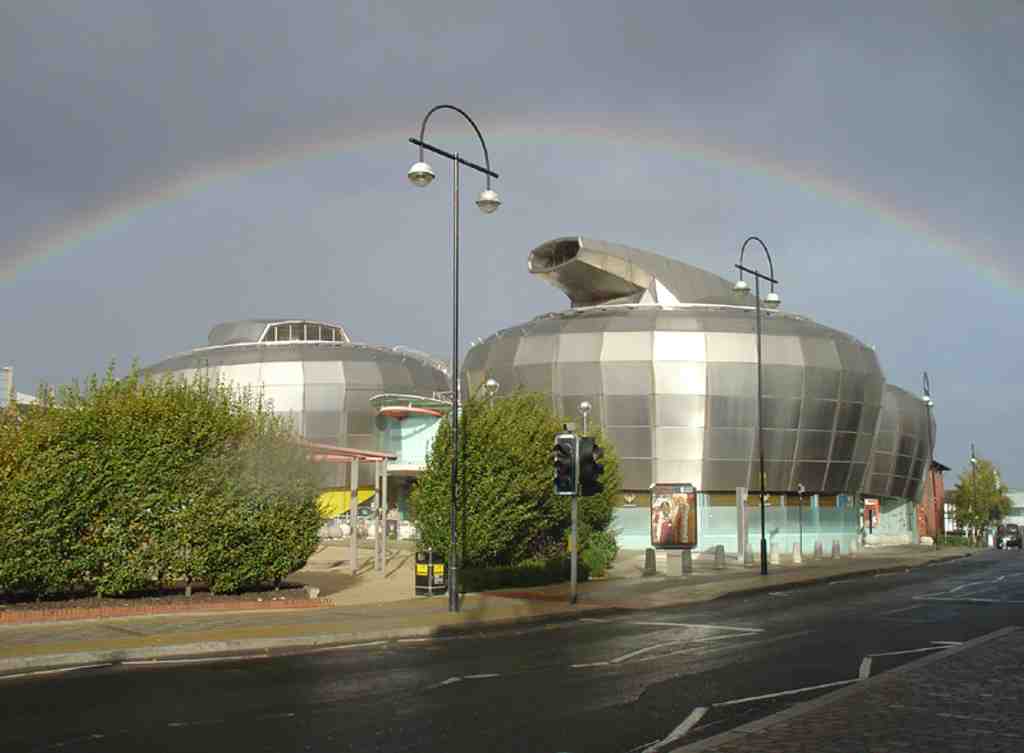
Take a look in front of you-see those four gigantic, shiny, metallic drums? They look a bit like enormous silver soup cans from the future, don’t they? With their curvy sides and the odd nozzle-like structures on top, they’re hard to miss! Walk a little closer and you’ll notice how the sunlight bounces off the stainless steel panels, making the whole building feel a bit like a spaceship has landed here in Sheffield. If you spot the roof turrets gently moving, that’s not your imagination-they were actually designed to turn with the wind.
Welcome to the former National Centre for Popular Music-Sheffield’s bold leap into the world of pop, rock, and all things musically eccentric! Imagine it’s 1999: -the city is buzzing with hope. Inside these drums, people wandered through exhibitions on music legends and high-energy gigs. The top floor, surrounded by that glassy roof, would flood with light, as if pop stardom was shining down just for you.
But the story here isn’t just glitz and glam. The Centre was dreamed up in the 1980s, way before “Cool Britannia.” It opened as part of Britain’s Millennium celebrations, a £15 million project with help from the National Lottery. Everyone expected fans to flood in, with ticket prices fit for a family adventure. There were bustling bars, a quirky shop, a buzzing café, and even free exhibitions on the ground floor. But as the months rolled by, the crowds just didn’t flock here as expected.
Behind the scenes, the tension was growing-the Centre was short on visitors and soon, the administrators had to be called in. There was a desperate struggle to keep the dream alive, from star-studded events featuring Madness and Paul Carrack, to last-ditch rescue relaunches. Imagine the echo of music from that final big gig-75 prizewinners in the audience, all hoping this was the moment things would turn around. But, in June 2000, the music faded and the lights went out.
Afterwards, the building became a hub for live music before being taken over by Sheffield Hallam University as the students’ union, filled with laughter, debate, and a new kind of rhythm. As you stand here today, who knows what the next chapter will be? The drums are still standing, defiant as ever. Maybe one day, someone will bring the beat back.
So, next time you see a giant tin can, remember: it just might have a story worth millions, whether it hits the charts or fades to a quiet outro. Now, let’s keep on rocking-on to our next stop!
Wondering about the building, closure or the subsequent use? Feel free to discuss it further in the chat section below.




