
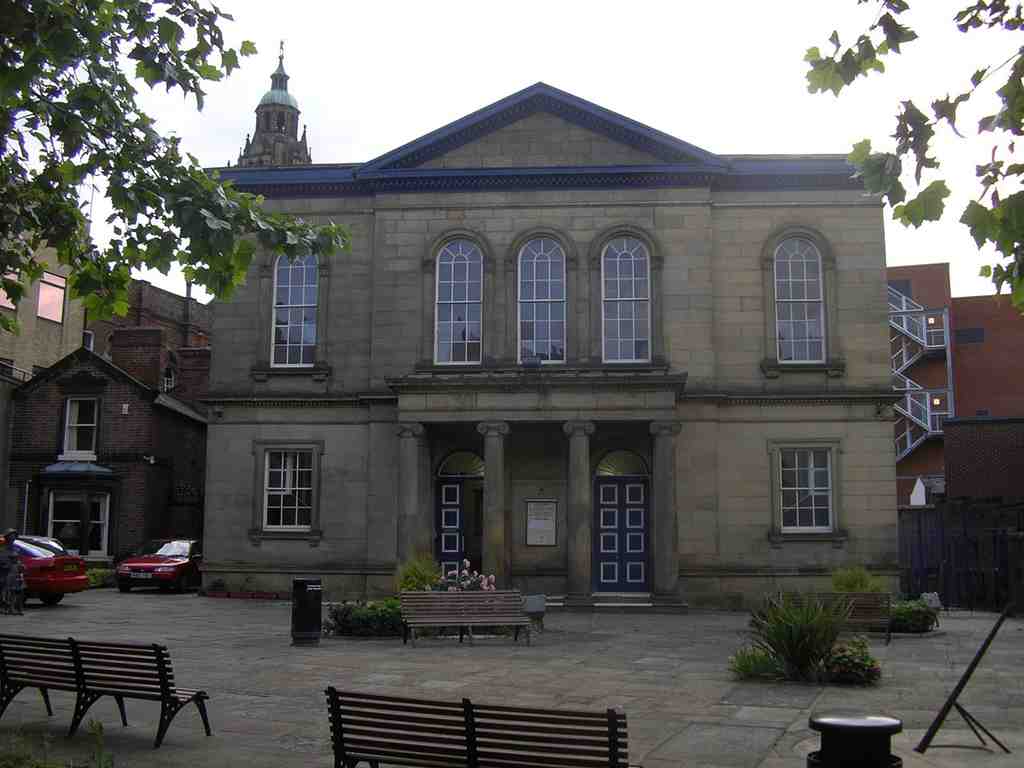
Look for a plain red-brick chapel with a simple classical front, a triangular gable, and a small forecourt marked by bronze sculptures.
Step into that little forecourt if you can... it tells you a lot about this place. Upper Chapel looks restrained, almost politely quiet, but its roots are anything but timid. This congregation began with James Fisher, the vicar of Sheffield Parish Church, now the cathedral. On the twenty-fourth of August, sixteen sixty-two, the state told ministers to sign the Act of Uniformity, a law forcing worship to follow Church of England rules. Fisher refused, was thrown out in the Great Ejection, and many of his parishioners went with him. That is one way to found a movement... by declining to fill in the paperwork.
The people who followed him were called Dissenters, or nonconformists, meaning Christians who would not conform to the established church. By the sixteen nineties, the strongest group here gathered around Timothy Jollie, and in seventeen hundred his congregation raised this chapel, first called the New Chapel. It became Sheffield’s first purpose-built nonconformist place of worship. If you look at the picture in the app, you can get a sense of how the later front wraps around something older: the brick side walls from seventeen hundred still survive inside the present building line.
What you see from Norfolk Street is largely the chapel’s nineteenth-century reset. In the eighteen forties, people turned the building around to face this way, raised the roof, and rebuilt the interior with a gallery, a kind of upper seating level. John Frith finished that work in eighteen forty-eight. By then, the congregation had serious weight. Early on, around one thousand people worshipped here, roughly one sixth of Sheffield. For a town this size, that is not a fringe gathering. That is an alternative civic engine.
And that spirit spilled beyond worship. The Shore family, founder members and pew-holders here, helped give this chapel its reforming backbone. Samuel Shore supported abolition, helped set up branches of the Society for the Abolition of Slavery, and through this chapel met William Smith of Clapham. In seventeen seventy-nine, they formed a committee to fight the Test Act, which barred people outside the established church from public life. So this was not just where Sheffield’s reforming merchants prayed. It is where dissent in Sheffield learned to organize itself.
Even the forecourt keeps that human scale. George Fullard’s bronzes stand here: Mother and Child, Running Woman, and Angry Woman, all given by his widow Irene in nineteen eighty-five. They make this little space feel less like a threshold and more like a pause in the city.
Walk up Norfolk Street and across - Carver Street is two minutes away, and that’s where Methodism met the cutlery quarter head-on. We will swing toward Castlegate next, and if you want to return later, the chapel is generally open from half past eight until five every day.




