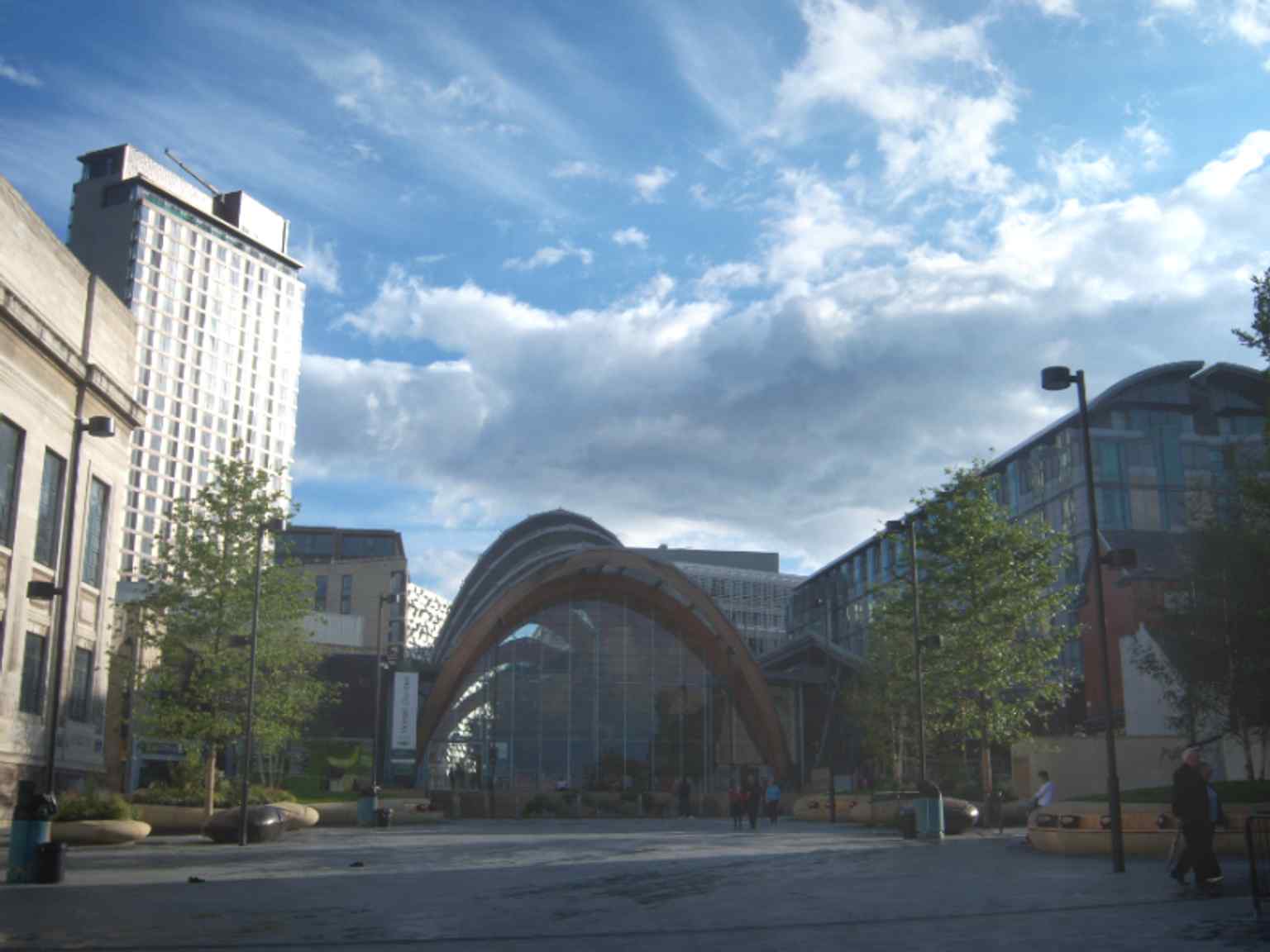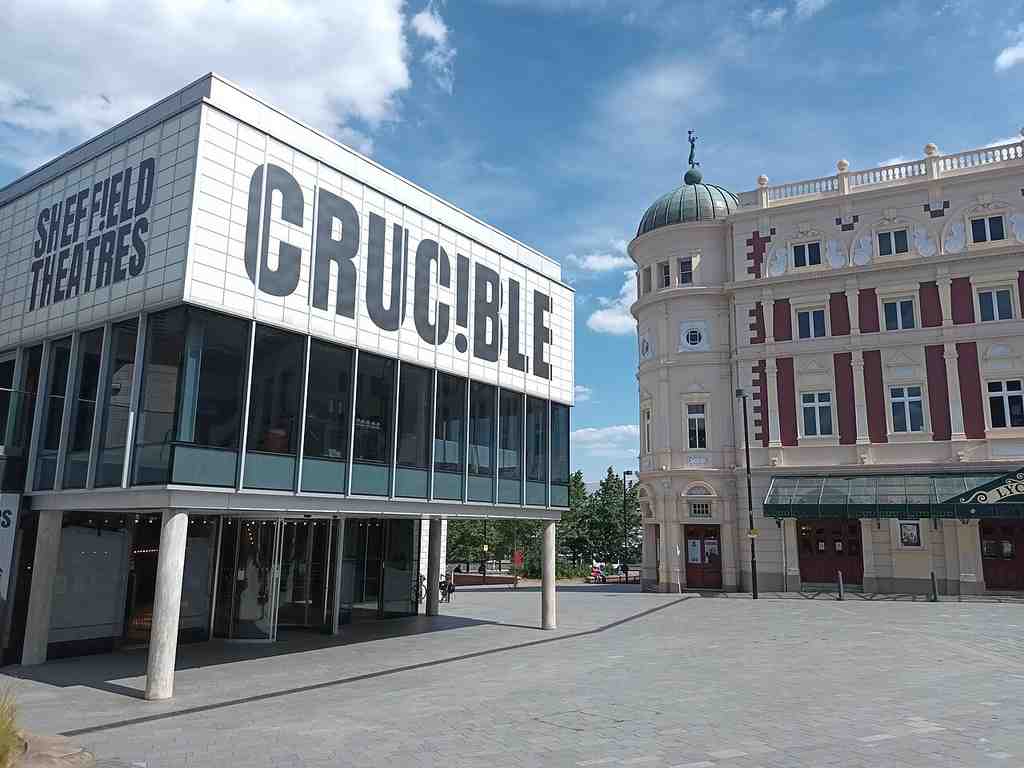
On your right, Tudor Square opens as a broad stone-paved plaza, framed by the curved concrete-and-glass face of the Crucible and the ornate cream-stone frontage of the Lyceum.
This is Sheffield’s Theatre Land: one of the biggest concentrations of theatres outside London, with the Lyceum here, the Crucible opposite, and more stages tucked along Surrey Street. If you want the full picture, take a quick look at the app image showing both main theatres facing the square.
The Lyceum on your left carries the confidence of eighteen ninety-seven, the same year Sheffield opened the Town Hall. Architect W. G. R. Sprague designed it, and this is his only surviving theatre outside London. That is no small thing. Sprague shaped theatre design in the late Victorian years, and the Lyceum still preserves one of the few intact examples of his style beyond the West End.
Across the square, the Crucible speaks a different language: nineteen seventy-one, sharper lines, less ornament, more steel-city plain speaking. And the name was deliberate. A crucible is a clay pot used in a furnace. In the eighteen hundreds? No, earlier than that: Benjamin Huntsman developed the process in the seventeen forties, heating blister steel in covered clay pots over coke fires for hours until it turned into cast steel. Each pot held about thirty-four pounds. A working city looked at its proud new theatre and named it after workshop kit. Honestly, that feels very Sheffield.
That name also reaches back to Castlegate, where those underground cellars hinted at the gritty, physical trade beneath the city’s streets. Here, the same industrial life gets turned into drama, music, and, since nineteen seventy-seven, snooker under bright lights at the World Championship.
Tudor Square itself only truly became a public square in nineteen ninety-one, when the council transformed a half-forgotten car park and open space for the World Student Games. In two thousand and ten, another four million pounds modernized it again, alongside the Crucible’s major refurbishment.
Now walk to the Surrey Street side; the Central Library and Graves Gallery are next, the most generous private gift in Sheffield’s working-life story.