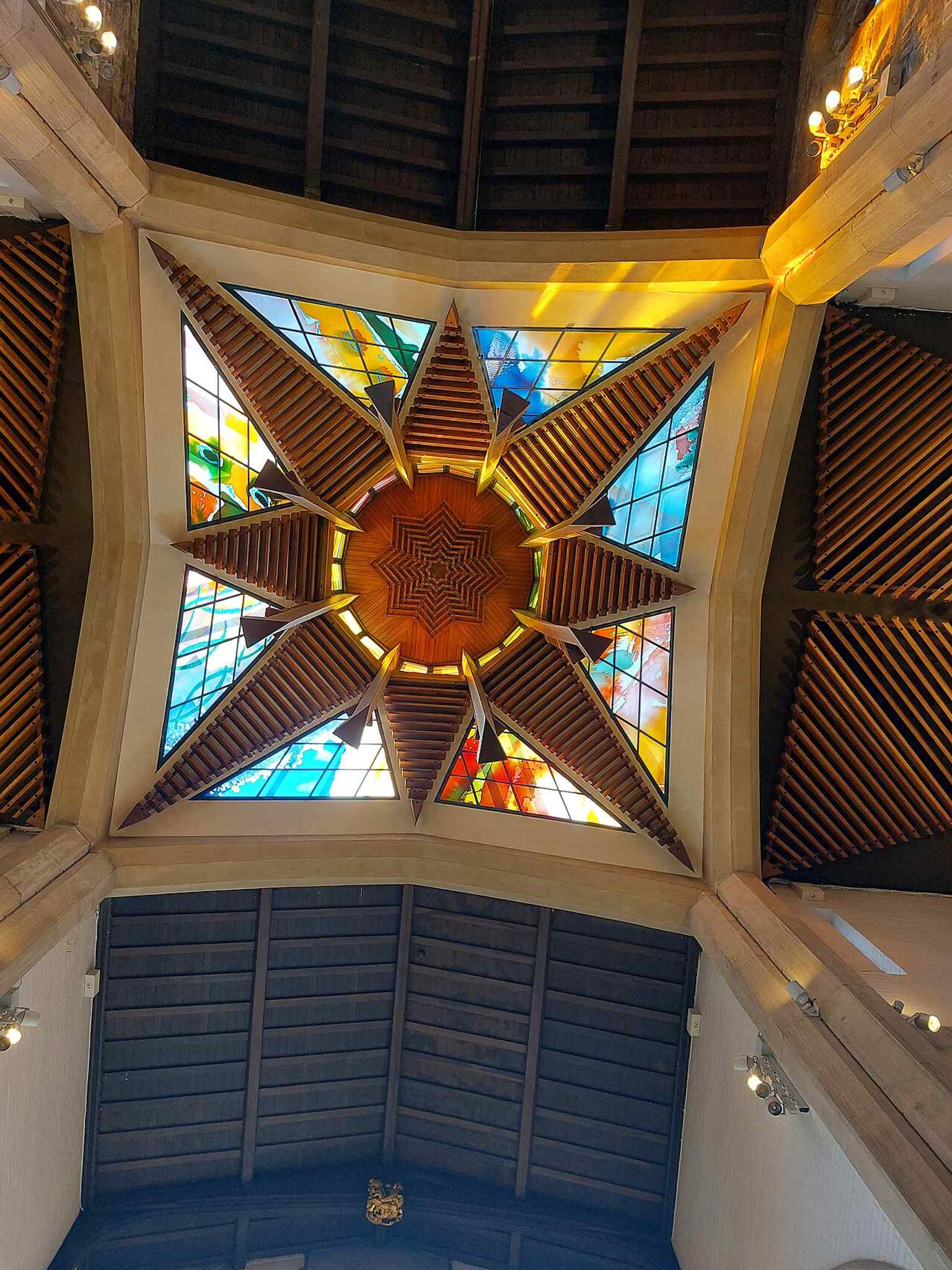
Look for the long pale-stone church, the pointed Gothic windows, and the square lantern tower rising above the roofline.
Right here in the precincts stands James Montgomery, and he is exactly the sort of man Sheffield likes to keep close: a working printer, a stubborn journalist, and a poet who managed to annoy authority for a living. In seventeen ninety-four, he took over William Gales's newspaper, renamed it the Sheffield Iris, and edited it for the next thirty-one years. Twice the government jailed him for sedition - that is, for printing words the authorities thought might stir political trouble. The first time, in seventeen ninety-five, he printed a poem celebrating the fall of the Bastille in France. The second, in seventeen ninety-six, he criticized a magistrate for breaking up a political protest in Sheffield. Journalism... with consequences.
And yet he came back, carried on editing, wrote hymns sung across England, and campaigned to abolish slavery and to stop the use of child chimney sweeps. His bronze statue, designed by John Bell in eighteen sixty-one, first stood over his grave in Sheffield General Cemetery. In nineteen seventy-one, the city moved it here, which feels appropriate. Montgomery belongs in the middle of public argument.
He also belongs to Sheffield's dissenting and reform tradition. By "dissenting," people meant Protestants outside the established Church of England. In sixteen sixty-two, James Fisher got ejected from the parish church and founded Upper Chapel. On the fifteenth of July, seventeen seventy-nine, John Wesley preached in Paradise Square, and in eighteen oh five Carver Street Methodist Chapel opened with room for eleven hundred people. Those chapels taught Sheffield's cutlers to read, to organize, and, eventually, to vote.
Now turn your attention to the cathedral itself. Before it became a cathedral, this was Sheffield's parish church, and it kept that role for centuries. When the Diocese of Sheffield was created on the twenty-third of January, nineteen fourteen, the church got promoted. Same building, larger job description. Parts of it reach back to around twelve hundred, while the expanded west end arrived in nineteen sixty-six, so the whole place is a slightly awkward but rather handsome conversation between medieval stonework and modern ambition. If you glance at the image on your screen, you can see how different the old parish church looked in eighteen nineteen, before later rebuilding changed its shape.
Inside, the Chapel of Saint George keeps one of the cathedral's most Sheffield objects: a screen made from swords and bayonets, presented by the York and Lancaster Regiment after it was disbanded. Steel, in this city, rarely stays quiet for long. Take a look at that image if you like; it is church furniture by way of the workshop and the drill yard.
When you're ready, walk round the cathedral and head up Campo Lane into Paradise Square; the square behind it is where Sheffield's working life met John Wesley and the Chartists, and from there Cutlers' Hall is only about a minute away. If you want to come back inside later, check the current opening hours before you go.