
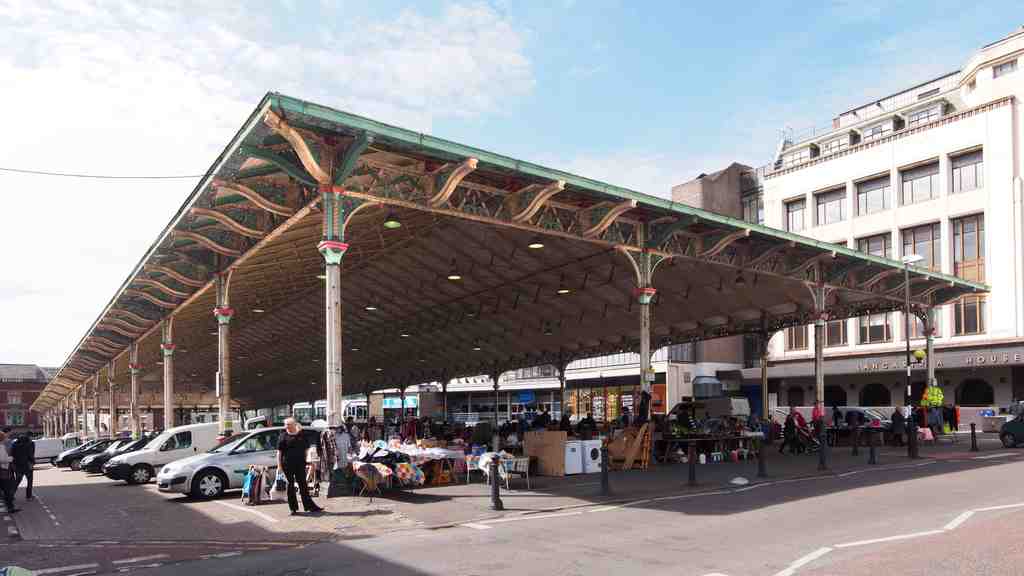
Look just ahead-you’ll spot the Covered Market by its expansive, pointed roof stretching far and wide, held aloft by delicate cast iron pillars and decorated with intricate latticework, making it look almost like a giant’s elegant picnic shelter.
Now that you’re standing outside Preston’s legendary Covered Market, let me whisk you back through the years-because, honestly, this place has more drama than a soap opera set in the Victorian era! The air here might still hum with the echoes of bustling traders from over a century ago, voices calling out the day’s best bargains, the creak of carts, and the sweet and spicy aroma of fresh produce and street food wafting under that magnificent roof.
This shelter above you is no ordinary canopy. Built between 1870 and 1875, it’s a true marvel of Victorian engineering, with towering cast iron pillars and a roof that reaches nearly ninety feet across without a single pillar cluttering the middle. Those iron supports don’t just look pretty-they cleverly double as pipes, quietly sipping up the Lancashire rainwater through concealed gutters that drain down through their hollow centers. The roof slopes gently from Lancaster Road down to Market Street, a deliberate design meant to keep the rain off both traders and shoppers, whether they were haggling over onions in 1880 or picking up gadgets today.
But, let’s rewind a bit-because if you think constructing a market was a simple affair, oh no! Like many epic stories, this one starts with big dreams and no money. The good folks of Preston began thinking about a covered market way back in the 1830s. They squabbled over where to put it-east of here, on Lune Street, at “the Orchard”-but each time, the purse strings snapped shut and the dream had to wait. Several generations of city officials tried again and again, with the project abandoned in 1842, then again in 1848, and put aside once more in the early 1850s, all because the town couldn’t scrape together enough cash. I suppose some dreams take longer to cook than a Sunday roast!
Everything finally started rolling in the 1860s. By now, Preston was a booming industrial town, choked with blocks of buildings and desperate for more space to trade. Enter: Edward Garlick, the Borough Treasurer and Surveyor. He toured the country, sizing up markets from Norfolk to Nottingham, and then drew up plans for Preston’s own. His design was ambitious, and after no fewer than ten tenders, a local foundryman named Joseph Clayton won the contract. Clayton promised to deliver “a commodious market without excessive cost,” but he clearly hadn’t read the script that called for disaster.
Construction started in early 1870, but delays mounted-Clayton insisted he had to cast every last bit of iron at his foundry before building anything on site. The Council got nervous, and just when it seemed things could not get stickier, disaster struck. On a quiet Saturday morning in August 1870, as the sun peeked above Preston and ten men worked away, the entire half-built roof suddenly gave way. With a sound that probably woke up everyone from the Earl of Derby to the ducks on the Ribble, the roof crashed down in a mess of splintered beams and twisted iron. Miraculously, most of the workmen escaped unharmed except one, Thomas Bateson, who was rushed off to recover.
Imagine the chaos; piles of broken metal where there should’ve been apple stalls! Panic spread, fingers pointed-was it the design, the builder, the lack of larch poles for scaffolding? Clayton and the Council bickered all the way to the trade press. In the end, Clayton left, his reputation dented, and two more contractors tried and failed, one refusing even to start because he didn’t trust the safety of the plans.
Finally, in 1872, William Allsup, a determined local builder, took up the challenge. He finished the roof in splendid Victorian style in just over three years. Since then, the place has undergone many face-lifts-the fish market got its own roof in 1924, the cobbles gave way to concrete in the 1950s, and the market hall had a big makeover in the 2010s, even making room for cinema and restaurants.
As you stand here now, listen for new laughter and stories-they say Wallace and Gromit themselves, immortalised in bronze, now greet visitors at the entrance, reading the paper and keeping an eye out for mischievous pen thieves. Over nearly 150 years, this market has survived misfortune, arguments, and even architectural drama. Yet, here it stands-waiting for the next chapter, and, who knows, the next great deal or the odd mystery runaway cheese wheel!
Eager to learn more about the description, early proposals or the planning begins? Simply drop your inquiries in the chat section and I'll provide the details you need.




