
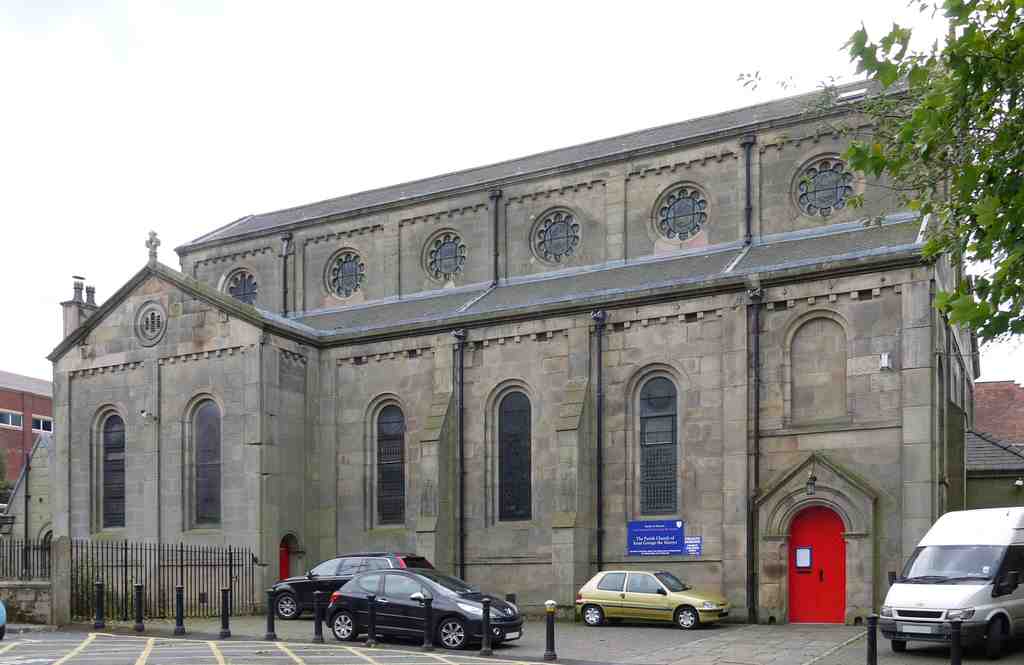
On your right, you'll spot a grand stone church with striking round windows high along its upper level and an eye-catching bright red door-just look for the sandstone building lined with circular and arched windows.
Welcome to the Church of St George the Martyr! Now, this isn’t just any old church hiding behind a fancy red door. Step a little closer and you can almost hear the echo of nearly 300 years’ worth of footsteps outside-this place has stood on George's Road since 1725! Back then, Preston was a much smaller, noisier market town and this church first opened its doors as a “chapel of ease”-which, funny enough, doesn’t mean it was an easy place to nap, but rather that it was built to help out its big sister, St John’s Church, because the town was growing too fast for one church to keep up.
By 1799 the place was bulging at the seams. Folk must have been elbow-to-elbow at Sunday service, so they decided to expand, likely adding the big arms on either side you see today-called transepts. The church grew and changed like a person, getting a stone jacket in 1843 and a brand new parish identity the very next year. But the upgrades kept on coming. In 1848, the chancel at the far end, with its rounded apse, was drawn up by the talented Lancaster architect, Edmund Sharpe.
Imagine the hazards and jokes those builders would’ve had-“Don’t drop that stone! It rolls for miles!”-but all their hard work means you can now see a sandstone marvel blending a Georgian base with Romanesque flair. The windows mostly have elegant round heads, but peep at the west end for a surprise-a big wheel window in the old baptistry sends colored light spinning into the church on sunny days.
And if you could tiptoe inside, you’d step under dramatic stone arches that seem to reach for the heavens, supported on pillars as round and solid as old tree trunks. Look around-the walls once echoed with the gentle hum of organ pipes, first played by the famous W. T. Best and moved twice by determined organ builders. Pipes aside, the church is a museum of wonder, decorated with vibrant paintings and stained glass by Carl Almquist of Shrigley and Hunt. You can almost hear the, surrounded by memorials remembering centuries of Preston’s families.
Don’t forget to look up-the tower’s corners are topped with tiny stone pinnacles, and, if you’re very quiet, you might just imagine the wind swirling round them, telling tales of the many people who’ve passed through here to celebrate, mourn, or simply search for peace. If these walls could talk, they’d have stories to rival any novel-and maybe the odd joke about who can ring the bell the loudest!




