
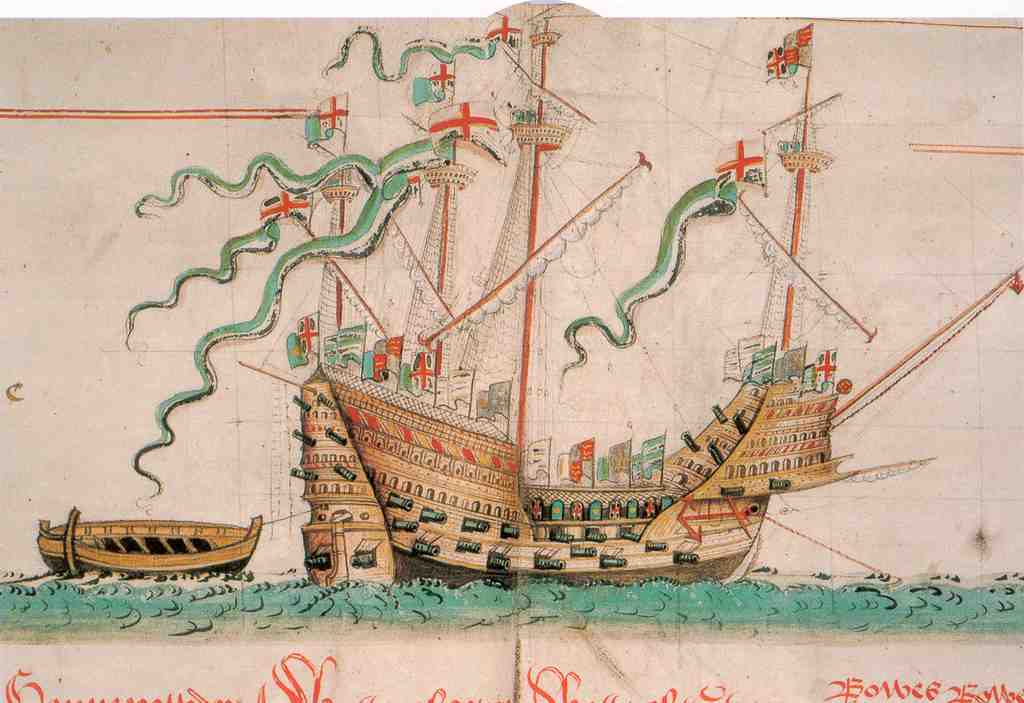
To spot the Mary Rose, look ahead for a massive, high-sided wooden warship with towering masts and colorful flags trailing in the wind-she looks almost like a fortress afloat and is proudly sitting at the heart of the museum near the Historic Dockyard entrance.
Welcome to one of the most dramatic places in maritime history: the Mary Rose! Imagine yourself now, it’s the early 1500s, the smell of sea salt is thick in the air, and the cries of gulls cut through the wind. Here stands the pride of Henry VIII's Tudor navy-a ship built from the timber of around 600 mighty oaks, as grand as any castle and bristling with the power of new-age cannons. If you listen closely, you might just catch the bustle and clatter of a crew of four hundred bustling above and below deck, never knowing just how famous their ship would become.
The Mary Rose was one of the very first purpose-built warships of her time, a beast that could fire heavy new bronze cannons right through sturdy, freshly-invented gun-ports. Talk about firepower-her broadsides were enough to make any enemy tremble! She was launched in 1511 and became the "rock star" of the Tudor navy, leading attacks against France, Scotland, and Brittany. In fact, she once outsailed every ship in a race off the coast of Kent; her captain called her the "noblest ship of sail... in Christendom." But with all her fame and fortune also came trouble.
Her decks were stacked not just with sailors, but with archers wielding hundreds of longbows, soldiers holding axes and pikes, and gunners ready at the enormous bronze culverins. Life was crowded and often not for the faint-hearted-especially if you were a "powder monkey," scurrying with bags of gunpowder during the heat of battle! Below, surgeons worked in a cramped room and the cook churned out meals from deep in the hull.
After 34 years weathering war and storm, she met her tragic fate on July 19, 1545. Picture the tension: the Mary Rose leading the charge against a looming French invasion fleet, her King watching from shore. Suddenly, disaster struck. Exactly why she sank is still shrouded in mystery-perhaps a gust of wind tipped her as cannons fired, perhaps overloaded, or maybe the chaos of battle played its part. In minutes, the pride of the navy slipped beneath the waves of the Solent, taking most of her crew with her.
The Mary Rose lay lost for centuries, her secrets guarded by shifting silt and dark water. It wasn’t until 1971 that she was found again, lying on her starboard side. In 1982, after one of the most ambitious salvage operations in history, the remaining section of her hull rose into the daylight for the first time in over four hundred years-a heart-pounding, nail-biting moment for millions watching around the world! Now, the remains of the hull and an enormous treasure trove of artifacts let us peek into Tudor life: longbows and arrows, musical instruments, fine leather shoes, cannons, and even the skeletons of the men who sailed her. If you’ve ever dreamed of a real-life time machine, this is it.
Today, the Mary Rose is a proud time capsule, where every wooden beam, rusty arrowhead, and battered helmet tells its own story. Her museum stands as a monument not just to a ship, but to an entire era-the hopes, ambitions, and dangers that made Tudor England roar into history. And if you hear the whistles and shouts of a busy deck echoing through the museum... well, that’s just the Mary Rose, still bursting with life after all these centuries!
Intrigued by the historical context, construction or the design? Make your way to the chat section and I'll be happy to provide further details.




