
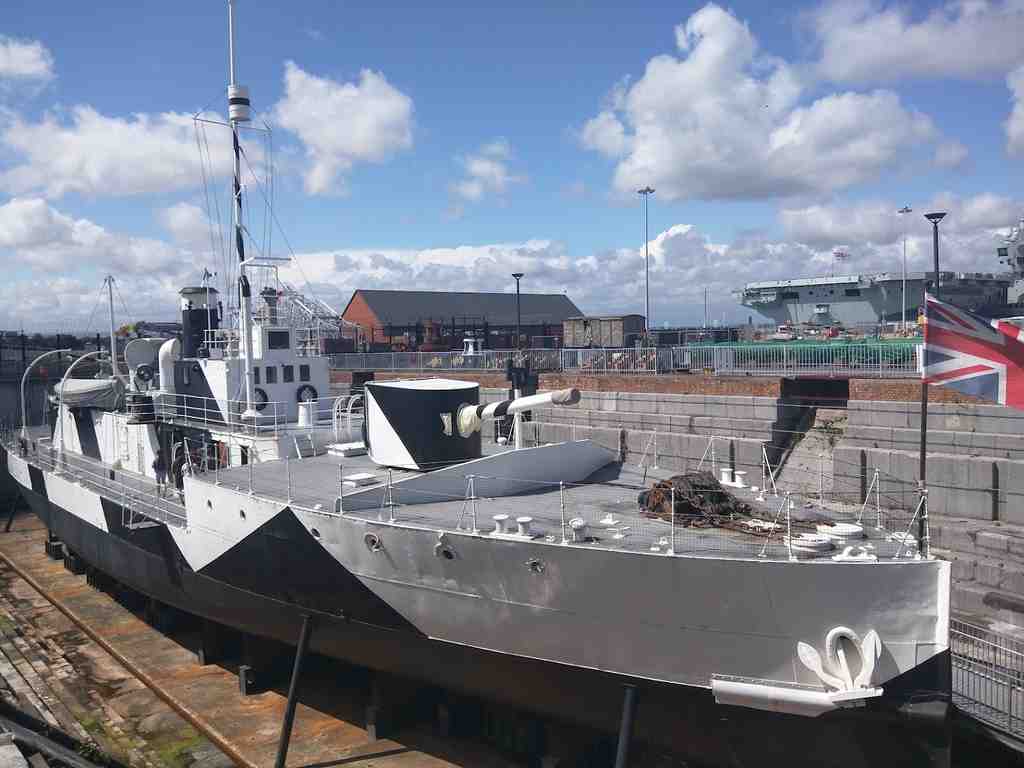
To spot the HMS M33, look down into the dry dock just ahead of you-she’s a striking warship with sharp black-and-white “dazzle” camouflage stripes, a squat superstructure, and two big guns jutting out above her deck.
Now, get ready to step back in time-because you’re standing in front of a true survivor of two world wars, the HMS M33. She’s not the biggest ship in the yard, but don’t let her size fool you: this unassuming monitor has stories tougher than her steel hull. Imagine it’s 1915, the First World War is roaring and shipyards like Harland & Wolff in Belfast are scrambling to build new warships as fast as humanly possible. The order comes in for M33 in March, and-hold onto your hats-she’s launched just two months later, and commissioned by June. That’s faster than most of us can finish assembling flat-pack furniture!
Now picture her in the warm haze of August 1915, the salty air thick with smoke and the thunder of heavy guns. M33 is packed with a nervous but determined crew, ready to support the British landings at Suvla Bay during the infamous Gallipoli Campaign. With her shallow draft and twin six-inch guns, she’s able to sneak close to shore and pound enemy targets, right at the heart of the action. The deck would rumble as her guns let loose, shaking both ship and soul. M33 stands her ground through chaos and confusion until the very end-outlasting the carnage, and remaining off Gallipoli until the evacuation.
The war isn’t done with her yet; she’s a floating patchwork of stories-bursting shells, salt-crusted decks, hope and exhaustion. By 1916 she’s helping seize the Greek fleet in Salamis Bay, a scene full of tension, as British sailors prepare for anything-will the Greeks fight or comply? After that, M33 sails into a new chapter far away: the snowy riverbanks of North Russia in 1919.
Imagine the freezing winds off the Dvina River, where everything is crusted with ice and the crew, noses red as signal flags, are trying to maneuver up the river to save allied troops retreating under fire. When water gets so shallow her propellers almost stick in the mud, the crew pulls off a bizarre scene: removing the guns and hauling them overland by cart, all hands crammed to the stern to tip the ship just enough to wriggle through-no one ever said naval service was boring! While M25 and M27 are scuttled behind her, M33 limps home, battered but safe, earning her legend as the little ship that could.
M33 doesn’t retire to a golden sunset-oh no, she changes identities more than an undercover spy! She becomes HMS Minerva, teaching crews the secret tricks of mine-laying. She transforms again into Hulk C23, a boom defence workshop and floating office, doing everything but serving tea. By the 1940s, imagine her as a humble but hard-working office barge, with creaking floorboards and the constant thrum of workmen’s boots.
It isn’t until the 1980s that preservationists swoop in, recognizing her unique value: a real, tangible connection to heroes of the past. Carefully hoisted out, painted in her distinctive dazzle colours, M33 is restored inside and out. Towed home to Portsmouth, she returns full circle, eventually joining the National Museum of the Royal Navy fleet for all to see. Today, she stands as one of only three British WWI warships left-and the only Allied survivor from Gallipoli.
Take a moment to look at her honest lines, battered but proud. If M33 could talk, she’d have tales of war, survival, and “office life”…but luckily, you’ve got me! Thanks for joining this epic journey through Portsmouth’s maritime past-I hope you enjoyed our voyage. If you listen closely, maybe you’ll hear echoes of her guns and the laughter of sailors who called her home.
Intrigued by the construction, first world war or the russian intervention? Explore further by joining me in the chat section below.




