
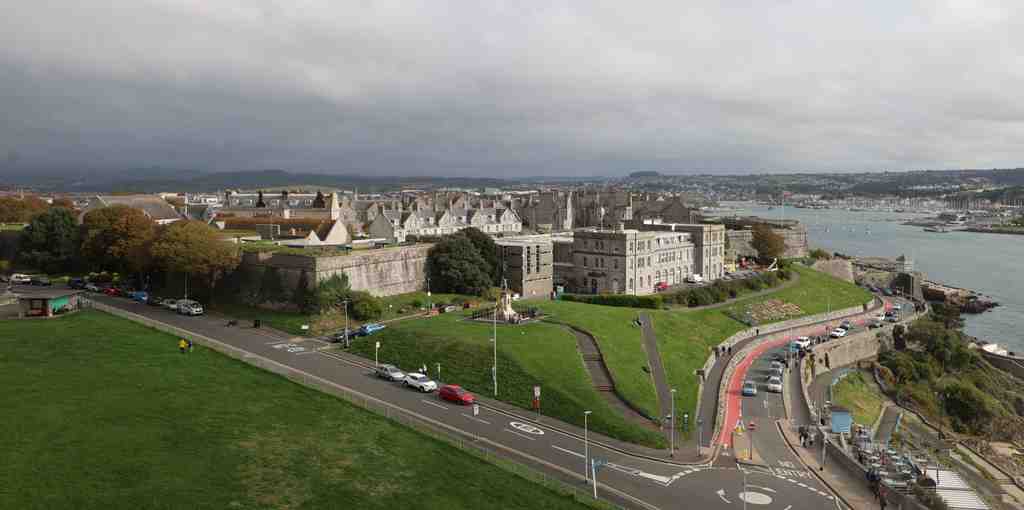
To spot the Royal Citadel, just look up from the grassy expanse of Plymouth Hoe-those towering grey stone walls and dense cluster of historic buildings make the Citadel stand guard right beside the water, with an unbeatable view across Plymouth Sound.
Now, let’s imagine you’re standing here in the salty breeze, the gulls wheeling above you, outside the mighty Royal Citadel. Can you feel the ghost of Sir Francis Drake itself, checking his watch and muttering about deadlines? Back in 1590, Drake was given a task fit for a pirate-hero: protect Plymouth’s bustling port from pesky invaders. First, he threw together some temporary artillery batteries-think “DIY for National Defence”-but soon realized, that approach was as effective as trying to stop a tidal wave with a tea towel. He lobbied Queen Elizabeth I for real funds. She agreed, but with an Elizabethan twist: the locals had to pay a special ‘fish tax’ for every barrel of pilchards they exported. Ah yes, nothing says “national security” quite like a pilchard levy!
Eventually, after years of slow progress and last-minute labourers hustled in (imagine the sound of picks and shovels echoing across the Hoe ), the original fort was completed in 1596. The fort bristled with bastions to the north and protected previously established gun batteries, peering down over the Cattewater like a stern headmaster over his pupils. On the southeast corner was Fisher’s Nose Blockhouse, dating back to around 1540-proof that Plymouth was serious about its seaside security. Elizabeth’s Tower, another stout structure, stood to the west, eying the horizon for threats, or perhaps just for the next fleet of pilchards.
Now, fast-forward nearly seventy years. It’s the 1660s, King Charles II is back on the throne, and there’s a new threat: the Dutch. Enter the Royal Citadel, designed by the master military architect Sir Bernard de Gomme-though, Samuel Pepys, the famous diarist, later called the design “very sillily” done! De Gomme’s original plan was a tidy five-bastion fortress, but the king’s advisors decided to repurpose Drake’s old fort, baking it into the new castle-custard. The result? An irregular shape and a design some called questionable-but what fortress would be worth its salt without a bit of controversy?
By 1666, the first Earl of Bath laid the foundation stone-still somewhere in these formidable walls, distinctly marked with his name and the date. It must have been quite a sight, watching the navy blue uniforms, the limestone blocks stacking up against the sky, and the English Baroque gateway rising in dazzling white Portland stone, once crossed by a drawbridge over a now-dry moat.
For over a century, this fortress was Britain’s Number One seaside bouncer. Seventy-foot-high walls, bristling with 113 cannons at its peak in the 1750s, made it clear: Plymouth wasn’t going gently into any night, Dutch or otherwise. Even in the Victorian era, the Citadel buzzed with the sound of Royal Garrison Artillery recruits drilling-probably daydreaming about shooting cannonballs at bad cooks in the mess hall.
Wartime, naturally, brought more drama. During World War II, it was the headquarters for the Coast Artillery Training Centre. Afterward, it merged with the Royal Coast Artillery School, keeping Plymouth’s big guns in fine fettle until 1956-no more coast artillery, but plenty of history echoing through the echoing chambers. Today, if your timing’s right, you might just see members of the 29 Commando Regiment of the Royal Artillery going about their secret squirrel business-though if you want to peek inside, you’ll need to book a rare guided tour.
Let’s not forget its quieter moments: the Royal Chapel of St Katherine-upon-the-Hoe, first stood here in 1371 and rebuilt when the Citadel was new. It’s seen everything: solemn blessings before battle, weddings, the odd royal visit (King George V popped by in 1927), and surely, a few panicked confessions from soldiers who’d “borrowed” the officer’s last biscuit.
And finally, if you heard the sounds of singing echoing off these ancient ramparts in 2011, it might have been the Military Wives Choir. This place is woven into the lives, dramas, and songs of Plymouth.
So, as you stand here, imagine sturdy walls bracing against salty winds, artillery drills, secret fish taxes, and, maybe, echoes of laughter from centuries of soldiers. Oh, and do watch out: with all those cannons, the fortress could point its guns at the sea… or the town, just in case the locals got too cheeky! Shall we carry on to our next stop?
Seeking more information about the based units, royal citadel in the media or the visitor access? Ask away in the chat section and I'll fill you in.




