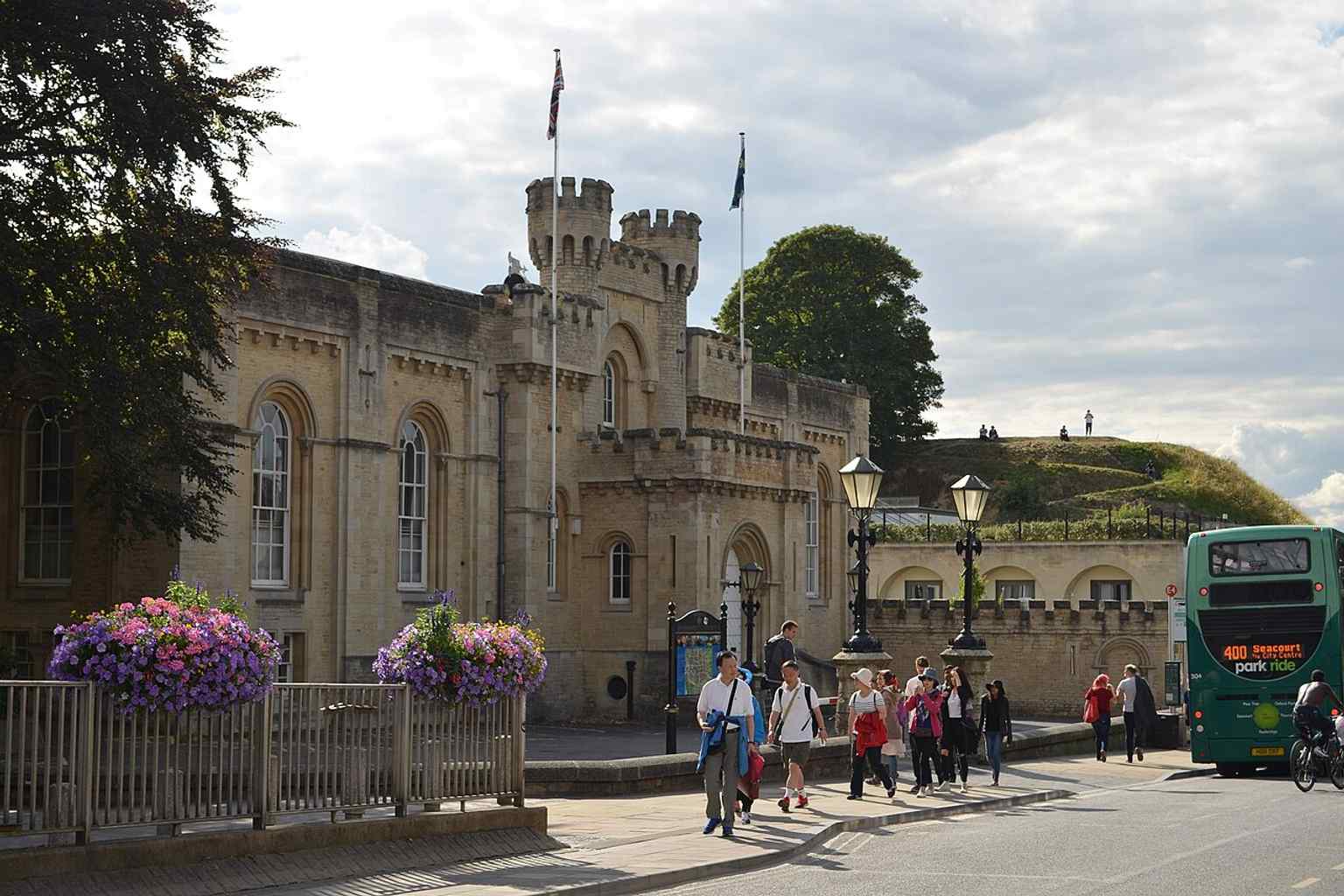
Look for a broad straight roadway edged by pale stone and brick civic buildings, with a rounded castle mound rising beside it and bits of battlement-like crenellation giving the whole stretch a faintly fortified look.
New Road sounds practical, almost boring... which is unfair, because the ground beside you is ridiculously old. Oxford Castle took shape here between ten seventy-one and ten seventy-three, when the Norman baron Robert D'Oyly the elder planted his fortress on the edge of the city. But the oldest standing fabric is older still: St George’s Tower, probably late Saxon, from around ten twenty, a watch tower guarding the west gate. If you want a quick visual, have a look at the mound on your screen in image five. That great earth hump is the surviving motte, the raised mound of a Norman castle. In eleven forty-two, during King Stephen’s siege, Empress Matilda escaped from here across the frozen Castle Mill Stream. English history does enjoy an implausible getaway.
New Road itself arrived much later, in seventeen sixty-nine to seventy, when builders drove a new turnpike through what remained of the castle’s outer ramparts and ditch. Christ Church chose to preserve the old mound as what it called a venerable monument of antiquity. Meaning: perhaps do not flatten the thousand-year-old hill.
After the Civil War, Oxford Castle served primarily as the local prison. In seventeen eighty-five, the Oxford County Justices bought it and brought in the London architect William Blackburn to rebuild punishment on a more systematic Georgian scale. In eighteen eighty-eight, national prison reforms renamed it H-M Prison Oxford. In a city famous for scholarly gowns, this was the county-justice machinery that kept order for the wider town... grim, practical, and very much not on the prospectus.
Until the mid-nineteenth century, executions here were public, ticketed spectacle. On the twenty-fourth of March, eighteen sixty-three, William Calcraft hanged Noah Austin on the gatehouse roof before nine to ten thousand spectators: Oxford’s last public hanging. Calcraft gets remembered. The bricklayers who dug out the gallows, and the people who cleaned up afterward, mostly do not.
Then, on the tenth of August, nineteen fifty-two, a short squat man stepped off the train from London at Oxford Railway Station. His name was Albert Pierrepoint, the executioner. Two days later he entered the condemned cell with the prison governor and the chaplain. The two guards who had remained with Oliver Butler all night held his arms while Pierrepoint strapped his wrists. Butler was twenty-three. Rose Meadows, whom he had killed, was twenty-one.
The prison closed in nineteen ninety-six. The former cell blocks reopened as the Malmaison hotel in two thousand and five, and the heritage site followed in two thousand and six. You can see that afterlife on your screen in image three. So as you leave, keep two people in mind: the unnamed guards who held Butler through the night, and the chambermaid on D-wing today. Same building, same truth... places like this run on hidden labor. When you’re ready, continue on to Oxford, about five minutes away.