
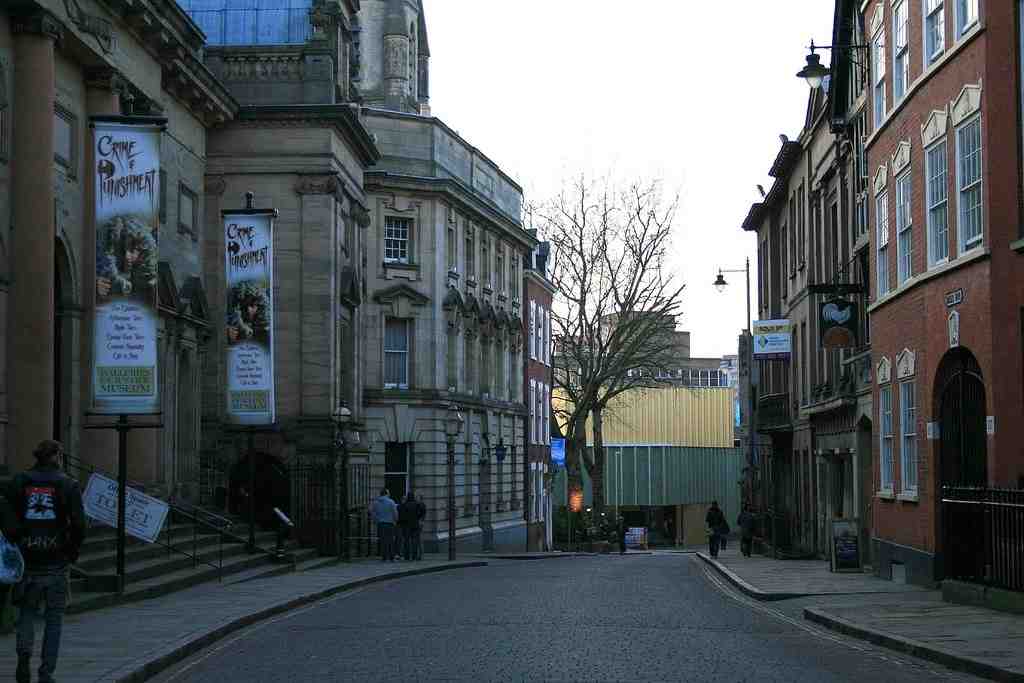
Ah, here we are at High Pavement, my friend! This street is one of the oldest and most charming in Nottingham. It's like stepping back in time with its beautiful listed buildings.
Back in the day, around 1681, a row of houses was built on the south side of St Mary's Churchyard, but they were eventually torn down in 1792 when the street was widened. Fun fact: a new wall was constructed along the south side of the churchyard during this time!
In the Georgian era, High Pavement was the place to be for the fashionable residents of Nottingham. They knew how to live the high life here, quite literally!
But let's not forget about some interesting events that took place on this street. In 1819, a gas lamp was installed at the top of Drury Hill, replacing the old whale oil lamps. Progress, am I right? And on August 10, 1864, the last public hanging in Nottingham was held here. It's a bit macabre, I know, but it's a part of our city's history.
Now, let's take a look at some of the notable buildings on High Pavement. We have the Lace Museum, housed in the Urquhart House, which was once a grand residence. And then there's The Living Room, a trendy bar created by the developer George Fish. Perfect for a little pit stop, don't you think?
We also have a shop that was rebuilt by the famous architect Watson Fothergill in 1898. His work always adds a touch of uniqueness. And just down the street, you'll find a house rebuilt by another talented architect, George Attenborough, in 1877. Did you know it was occupied by Renshaw, Shelton and Co in 1832? Quite the impressive tenant!
Oh, and keep an eye out for number 23, County House. It has quite the history, once owned by Thomas Hutchinson and even briefly inhabited by Princess Louise, Duchess of Argyll. Talk about royal connections!
Next, let's make our way to the Nottingham Crown Court, an important stop on our tour. Ready to continue our adventure? Follow me!
The next stop on our tour is Nottingham Crown Court. Let's make our way there, shall we?




