
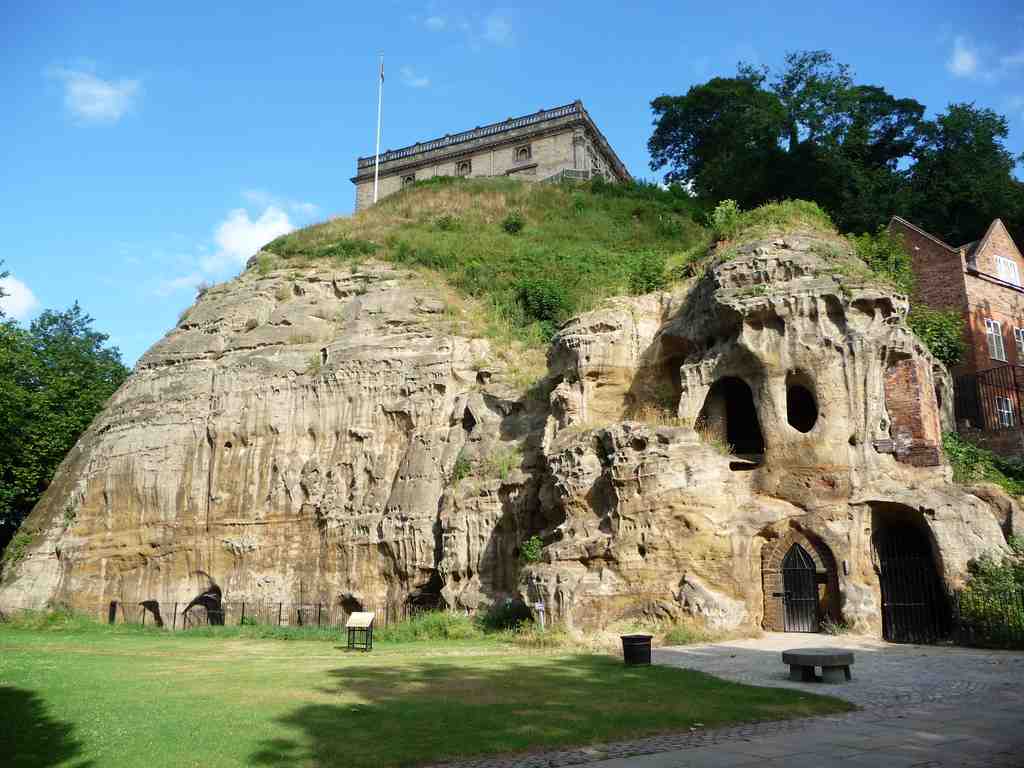
Ah, welcome to the hidden depths of Nottingham, my fine friend!
Before you lies the entrance to the City of Caves. When coming towards this landmark, look for a subtle entrance tucked away, often marked with signage leading the way down into the underworld of sandstone wonders. Not very conspicuous, it may look like a mere doorway or small building access; thus, it's easy to miss if one isn't paying close attention. Instead of a grand façade, its entrance might resemble the discreet doorway to a secret hideout-quite fitting for an outlaw like myself, wouldn’t you say?
Now, let's venture into this underground marvel! The City of Caves is quite the historical gem. Imagine, if you will, a sprawling network of caves carved into the soft sandstone beneath Nottingham. Over the centuries, these caves have served various purposes-a tannery, pub cellars, and even an air raid shelter during the dark days of the world wars.
Known as the Caves at Drury Hill by Historic England, this labyrinth was initially buried beneath the medieval streets, now replaced by the Broadmarsh Shopping Centre. Ah, but the name City of Caves is quite fitting, as there are hundreds of such man-made caves beneath Nottingham, used for over a thousand years. These caves are carved with simple tools, turning the soft stone into dwellings, cellars, and workplaces.
Interestingly, the caves were so integral to the lives of the people that in Old Brythonic, Nottingham was called "Tig Guocobauc," meaning "place of caves." How fitting that even the Welsh Bishop of Sherborne Asser named it so in the 9th century! The pottery found in these caves dates them back to 1270-1300, showcasing their ancient use until the St. Mary's Nottingham Inclosure Act of 1845 banned their use as homes for the poor.
Throughout history, there have been more than 800 catalogued caves beneath this city, including 200 rediscovered since 2016 by the city archaeologist Scott Lomax. The construction of the Broadmarsh Shopping Centre in the 1960s threatened these historic treasures, but public outrage and efforts by the Nottingham Historical Arts Society helped preserve them for our enjoyment.
Speaking of noteworthy discoveries, you’ll find an underground tannery-the only known one in Britain-hidden within these caves. The Pillar Cave, carved in the mid-13th century and later transformed into part of the tannery in the 15th century, is a testament to the resourcefulness of the Nottingham populace. The historical use of these caves for crafting small animal hides and even as water sources adds layers to their storied past.
Finally, these caves also served as air raid shelters during the bombings of World War II. Imagine families huddling together in these sandstone sanctuaries, just like the many who found refuge in Sherwood Forest in my day.
So, step inside, my friend, and let the walls whisper to you their ancient tales. Perhaps you'll feel a bit like an outlaw yourself, exploring the hidden heart of Nottingham.




