
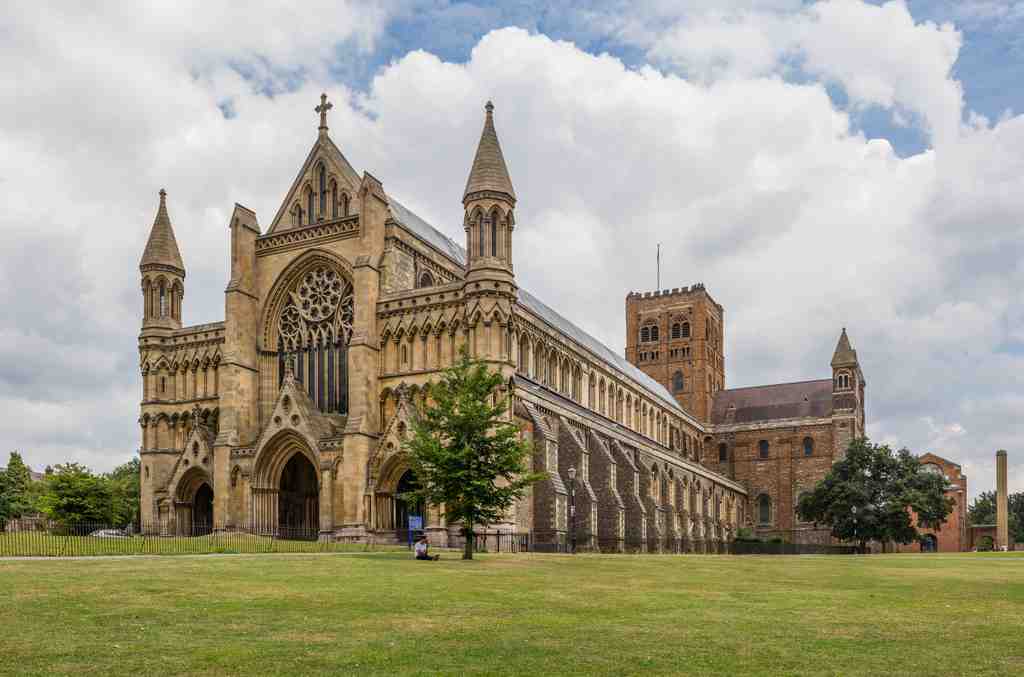
In front of you stands St Albans Cathedral: look for its grand, creamy stone façade with two striking turreted towers flanking a pointed central gable, and the impressive long nave stretching out behind it, capped by a massive square bell tower of mismatched, ancient brick.
Imagine yourself stepping into the windswept fields of Roman Britain, where a quiet man named Alban once lived - right here, in the shadow of Verulamium. Back in the 3rd or 4th century, Roman soldiers were hunting for Christians; Alban, moved by the courage of a fleeing priest named Amphibalus, risked his life to shelter him, then traded places to be captured instead. As he marched to his execution, legend says he crossed a river - believed to be the River Ver - and, thirsting on the climb up this very hill, knelt and prayed for water: a spring burst forth at his feet. This became the place of his martyrdom, marked for centuries as holy ground, and the cathedral stands close to where Alban’s head is said to have rolled down and a well gushed up where it stopped.
At first, there was just a simple shrine; slowly, through Saxon times, it grew into a mighty abbey, with each era layering another story, stone by stone. In the 8th century, King Offa of Mercia founded a double monastery here, following the strict Benedictine rule. But the abbey saw hard times: attacks by Vikings left it empty for decades, and later, desperate monks scavenged Roman bricks and tiles from the ruins of Verulamium to patch the walls. If you look closely at the flint and brick in the older sections, you can almost see the patchwork-a literal recycling of the past.
When the Normans arrived, Abbot Paul of Caen began a colossal transformation. Imagine the clang of hammers on stone and the shouts of masons as the abbey rose ever higher, especially the massive central tower that still stands, a square giant looming at 144 feet. This tower alone weighs over 5,000 tons, its Norman arches still visible under the crossing, evidence of nearly 1,000 years of endurance.
Mishaps were common-earthquakes shook the church in 1250, collapsing parts of the nave, and reconstruction raced to match the grandeur of the past. There was extra drama when in the 14th century, a clever abbot called Richard of Wallingford designed a clock so astonishing in its time, people traveled days to see it. Though the clock is long gone, stories linger in the stones.
Through the Middle Ages, pilgrims flocked to Alban’s shrine, monks hand-copied illuminated books like the famous St Albans Psalter in candlelit scriptoria, and craftspersons added Gothic windows and glowing stained glass. In the 16th century, the abbey’s peace was shattered by the Dissolution of the Monasteries; treasures were ripped away, monks pensioned off, and the great church sold for £400 to the townsfolk-barely enough to cover repairs. Graves were opened in search of lost gold, and for 200 years, ruins and brambles claimed most of the grounds.
The cathedral’s survival was often on a knife’s edge: storms shattered windows, walls leaned dangerously, and once, a scheme nearly succeeded to demolish it altogether in favor of a cheaper church. In the 19th century, a series of passionate, sometimes eccentric restorers made their mark. The architect George Gilbert Scott spent years stabilizing the fabric, sometimes jacking the whole nave wall straight in just three hours. His successor, Lord Grimthorpe-a man both admired and loathed-rebuilt the west front himself, ignoring critics to push through his own bold Victorian vision. Even now, engineers occasionally return to fix the damage from his over-strong cement.
Today, St Albans Cathedral holds a special record: at 85 meters, its nave is the longest in England. Walk inside and you’ll notice a blend of Norman arches, medieval paintings, 19th-century decoration, and even 21st-century statues-telling a continuous story of faith, survival, and community. It still rings with music during the famous organ festival, and the bells-some centuries old, others cast as recently as 2010-sound out across the city, just as they have done for generations.
Every stone has a secret to share, and every corner has watched rebels, monks, townsfolk, kings-and you-wander by.
Yearning to grasp further insights on the britain's first christian martyr, modern times or the dean and chapter? Dive into the chat section below and ask away.


