
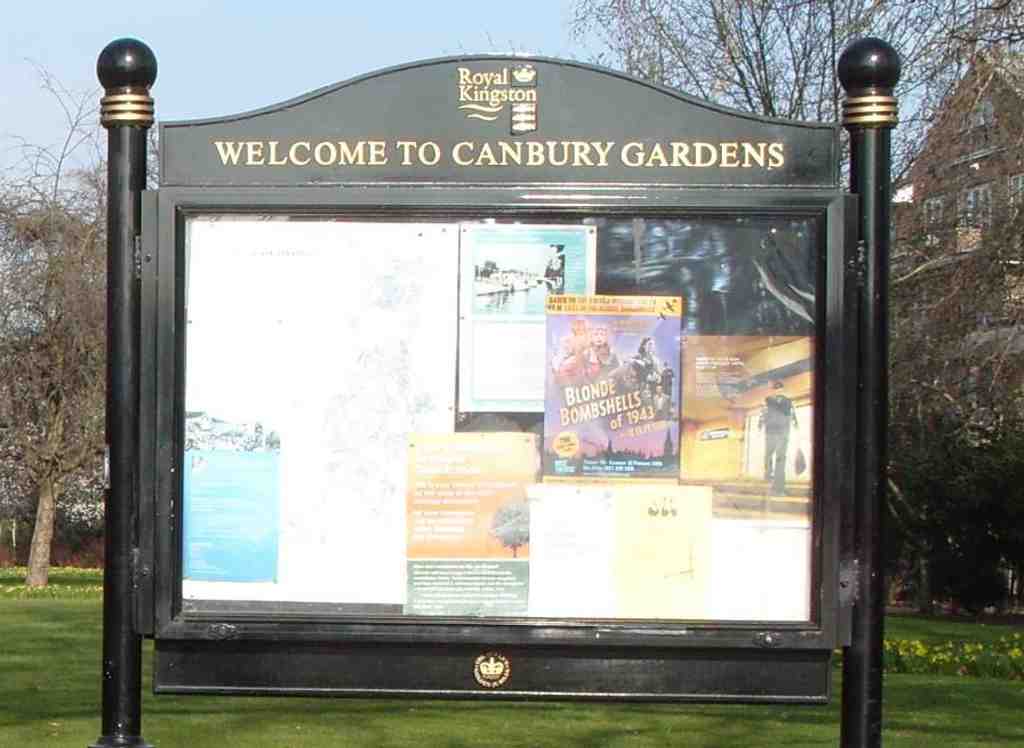
Look ahead for a big black sign with gold letters that say “Welcome to Canbury Gardens”-it’s standing right by the path, with trees and grass stretching behind it.
Alright, adventurer, you’ve made it to Canbury Gardens-a 14½ acre oasis where the River Thames laughs past and the grass underfoot has secrets to whisper! Breathe in deep; today, you’ve got open lawns ahead, a bandstand waiting for music, and the distant sound of splashing oars. But this peaceful spot wasn’t always this lovely: once upon a time, it was more “muddy boots” than “floral scents.” Long ago, locals used to graze their cows here and chop firewood. Then, in the 1800s, the earth itself was taken-gravel pits were dug all over, turning the place into a patchwork of holes. Trust me, it was no picnic, unless your sandwich came with a side of dirt!
By the late 1880s, Kingston’s town folks decided enough was enough. They wanted the riverside to become a place people actually liked to look at, not something to hurry past! So in 1890, out of all those muddy pits, a miracle appeared-neatly trimmed lawns, winding paths, and even a shiny new bandstand. That bandstand, by the way, was paid for by Charles Nuthall, a sweetshop-owning mayor who loved his music almost as much as his confectionery.
But drama didn’t stop there. Fast forward a hundred years, and a row of tall, proud poplar trees along the garden’s edge sparked a full-on eco showdown. Imagine people camped up the trees, 17,000 signatures, and a £500,000 police operation to bring the branches down-now that’s what I call “going out on a limb!”
The gardens went through more changes-the thump of Kingston Power Station working behind the scenes, and eventually, its silent demolition. Today you’ll spot kids laughing in playgrounds, tennis balls bouncing, and people chilling beneath the bandstand (hopefully not afraid of sudden musical outbreaks). The old toilet block? Sneak in for a snack at the ‘Canbury Secret Café’-it’s the only loo that turned into somewhere you’d actually want to eat!
Now, as you gaze towards the river, notice the memorial for Rosie Mitchell near the Rowing Club-a poignant reminder of a life cut short but a community held close. If you listen carefully, you just might catch a jazz riff from the Boater’s Inn, the soundtrack to Kingston’s green, beating heart.
Canbury Gardens isn’t just a park-it’s Kingston’s living memory, where you can sit, wander, or just watch the passing boats and imagine all the stories still hanging in the air.


