
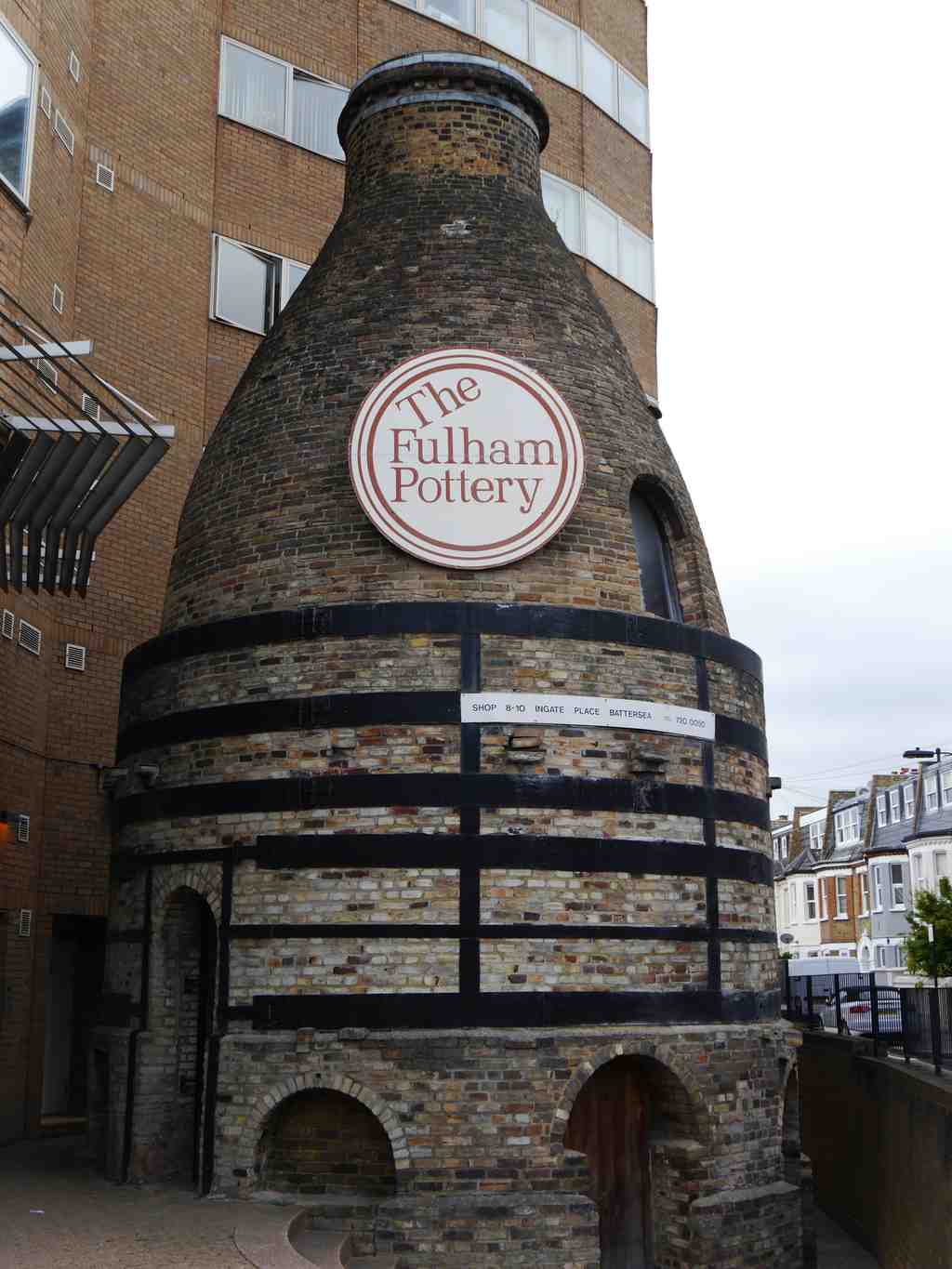
To spot Fulham Pottery, just look ahead for a big, round, bottle-shaped brick kiln with a wide base, black stripes, and a large sign overhead reading “The Fulham Pottery”-it’s tucked right up against the modern building, so you can’t miss its old-fashioned, squat silhouette.
Step closer and imagine yourself three centuries back, standing in the bustling heart of the pottery yard. This place was once filled with the clatter of tools and the scent of wet clay. The year is 1672, and you’d be dodging workers carrying lumpen balls of clay while John Dwight himself hurries past, his Oxford education tucked beneath a streaky apron. There’s an air of excitement-after all, he’s just set up England’s most ambitious pottery workshop at the junction of New King’s Road and Burlington Road, just a stone’s throw from the river and not far from Putney Bridge.
Now, here’s a twist: Dwight wasn’t your average mud-slinger. He once worked with the famous scientist Robert Boyle and loved experimenting. His goal? Elevating English pottery to something that could rival Germany and even China! Dwight’s kilns here roared day and night as he tried to perfect the mysterious art of porcelain-a mission so complex that he kept careful, coded records, as if he were working with secret formulas. Imagine the crackle and roar as he lifted another test piece, wondering if he’d finally created something worthy of a king. Long before Spode and Wedgwood, Dwight was sneaking little trial pots into the flames, working by candlelight. Here, brown and white salt-glazed stonewares piled up, with rough, German-inspired jugs beside smooth, Chinese-inspired vases.
But pottery’s not all work and no play. Dwight was quite a sentimental chap at heart. Picture a family scene: he calls in a sculptor to create life-sized busts of his wife or tiny, hand-modeled statues of gods. The Victoria and Albert Museum even has a somber memorial statue of his daughter Lydia, made after she died tragically young. You can almost feel the hush and reverence as he places her likeness-full of love and sadness-into the flames to fire.
After Dwight’s death in 1703, things got a bit more down-to-earth. His family kept the fires going, but suddenly Fulham Pottery was all about bottles, mugs, and jugs-the sort of sturdy fare you’d find in a noisy tavern. The walls echoed with laughter and the thud of tankards, and popular designs included hunting scenes and cheeky mugs decorated with scenes from William Hogarth’s “Midnight Modern Conversation”-sort of like the eighteenth-century version of a pub cartoon, really.
Competition heated up, too! The Dutch Elers brothers set up just down the street, quickly giving Dwight a run for his money before heading off to revolutionize Staffordshire pottery. In the 1800s a young John Doulton, destined to become a pottery mogul, finished his apprenticeship here, learning how to throw enormous pots (and, I imagine, probably smashing a few in the process-oops).
By the Victorian era, the old pottery was crumbling. Then along came C.J.C. Bailey, like the pottery world’s own superhero, swooping in to revive it with fresh ideas and swanky architectural ceramics. But the most impressive survivor is this gigantic bottle kiln-now Grade II listed and as stubborn as stone. From the flicker of candlelight and the clang of clay, Fulham Pottery pressed on, creating salt-glazed masterpieces until the 1950s.
Even after the ovens fell quiet, artists kept sneaking in to fire new creations. You might’ve caught a whiff of excitement in the 1980s, with modern artists like Quentin Bell popping in to try their luck in the ancient kiln. If these oven-bricks could talk, they’d have thousands of stories-of vision, rivalry, heartbreak, and resilience-baked deep into their walls.
So, as you stand beside this mighty bottle kiln, remember: you’re not just looking at a big old chimney. You’re standing where centuries of craftspeople dreamed, toiled, laughed, and sometimes wept, all in pursuit of turning simple clay into something magical. And hey, for all we know, one of those ancient experimental mugs might just be sitting in a London museum right now, with a bit of Dwight’s spirit still inside!


