
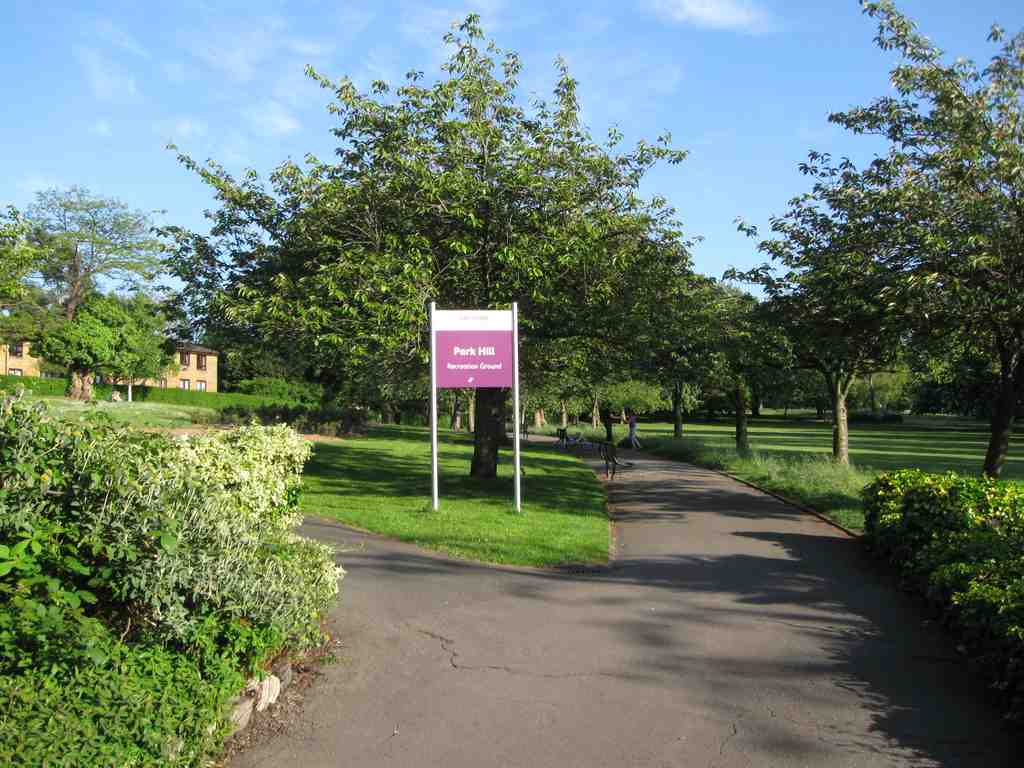
To spot Park Hill Recreation Ground, look for the wide curving pathway lined with well-kept green bushes, leafy trees, and a large maroon-and-white sign that welcomes you right at the entrance-just ahead and slightly to your left.
Welcome to Park Hill Recreation Ground! It's not just a patch of grass in Croydon-oh no, this is fifteen acres of living history, a hillside playground with secrets tucked under every tree and bush. Close your eyes for a second and picture this land in its wilder days: back in the 14th century, this whole area belonged to the Archbishop of Canterbury and stretched for more acres than you can count on your fingers and toes. Wild deer may have grazed where you'll see people picnicking today, and in 1382 a certain Sir William Walworth-whose claim to fame was probably not the world's best archery aim-was appointed the keeper of this enormous park.
But nothing stays the same forever, and by the 1800s, these rolling fields were chopped into farms and even barley. Fast forward to November 1850, and here comes another twist-right beneath your feet, a massive brick reservoir was built, like a secret swimming pool for Croydon's water supply, covered with so much earth you'd never guess what was lurking below. The opening ceremony was quite an event: imagine a crowd led by the 71-year-old Archbishop of Canterbury, bravely climbing down into the dark, echoing reservoir, guided only by the glow of candlelight. Cheers erupted as the first water whooshed in, promising fresh supply for thirsty families all around Croydon.
Of course, water’s a tricky thing to keep, and people used so much that by 1866, the poor old reservoir-though able to hold 900,000 gallons-was running low, barely managing to reach the highest houses. They had to impose rationing; only certain times a day did water flow! As with all things, another reservoir eventually took over, and this one became redundant-though during World War II, its leaky depths were kept filled, just in case the fire brigade needed emergency reserves.
And that big mound you might spot near the trees? It hides what’s left of that enormous underground tank. The roof became unsafe and had to be demolished in the 1970s, but it’s all still waiting there under the earth, holding its own mysteries.
Now, have you noticed the odd, castle-like tower poking up from the middle of the park? That's Croydon's Water Tower, built in 1867 in a dramatic Norman style with red and brown bricks. Its job was to pump water up to the highest points in Croydon, with a remarkable 40,000-gallon wrought iron tank at the top that could make even the biggest water bottle jealous. In the late 1800s, you could pay a penny and climb for a view that probably made hearts pound-that is, if the stairs didn’t get you first! Sadly, the tank and the old steam engine that powered it are gone, and though the tower is Grade II listed, it’s closed to the public. Legend says if you listen quietly, you can almost hear the clang of the old machinery and the laughter of visitors who braved the steps on a summer day.
All of this grassy land became your recreation ground after some serious council arm-wrestling in the 1880s. Croydon Council bought eight acres and set strict rules: the park had to be open to the public forever and well looked after. By July 1888-mark that date-they held the grand opening, and soon everyone was coming here for walks, picnics, football, and fresh air. There’s even a tale that a bandstand was donated in 1889, so if you listen very quietly, who knows-maybe you’ll catch a distant brass note or the echo of children’s laughter swirling around the trees.
If that’s not enough, the grounds of Coombe Cliff, once home to the famous Horniman Tea family, were added in 1930, making the park even bigger. And if you wander all the way to the top, you can peer down a winding drive to Coombe Road, spotting the old gatehouse-a grade II listed building now used as a private home.
People have always loved this park: writer Malcolm Muggeridge remembered deciding the fate of the world (or at least of tea and politics) with his father here. The next time you relax on the grass or wander through the gardens, just imagine all the footsteps-famous or not-echoing before yours.
So take a stroll, enjoy the fresh air, and remember: every hill, tree, and even the strange lump under the ground has a story hidden inside it, waiting for someone with a little curiosity-like you-to listen.


