
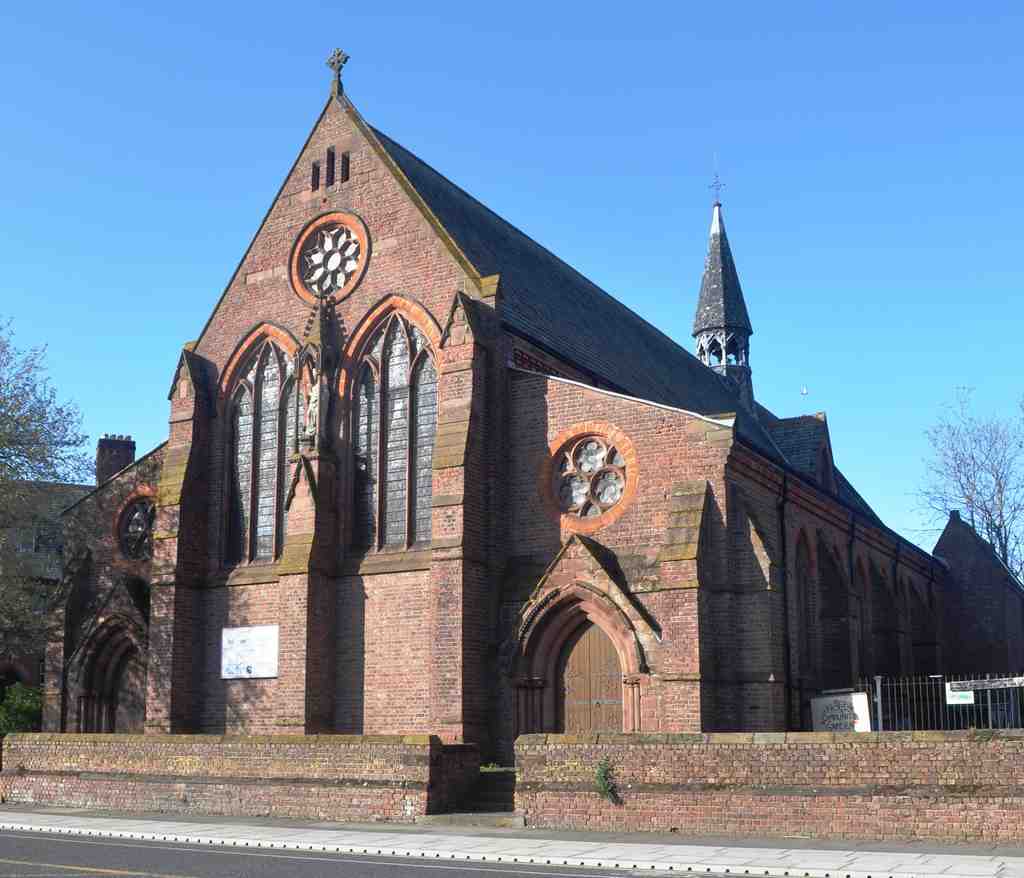
To spot the Church of St Margaret of Antioch, just look ahead for a bold, sturdy building of rich brick, standing tall with a broad triangular roof and two big arched windows at the centre, like a pair of old eyes watching over Prince’s Road. On either side, you’ll see round rose windows peering out, and right in the middle above the door, there’s a statue of St Margaret herself keeping an eye on things. If you see a brick church with a strong square shape and a little wooden bellcote poking out near the roof, you’re in the right place!
Take a step closer-feel the past press in around you. The year is 1869. Liverpool is alive with industry and hope, and a local stockbroker named Robert Horsfall has spent his fortune to build what would become the centre of Anglo-Catholicism in the city. Imagine the smell of wet brick and fresh slate as the builders hurry to finish before winter sets in.
At your feet stands a church built strong, in thick red brick with bands of stone. Look up to spot the canopied statue of St Margaret, set above a line of arched windows, as if she’s keeping watch for lost souls or drivers who can’t park straight! The great round window above her catches the shifting Liverpool light and floods the church with colours.
Once inside, people would have seen the marble piers striping the interior like a candy cane-stand at the entrance and picture it: the marble pillars, the iron gates guarding the raised chancel, and glimmers of gold from the saints on the pulpit. Maybe you’d smell the polish on the wooden pews, or hear the distant warble of the pipe organ, built in 1869 and still determined to rattle a few windows on Sundays.
This place wasn’t always peaceful. In the 1880s, the vicar, James Bell Cox, caused such a stir with his high church rituals that he ended up in prison! For a while, coming here was almost as daring as sneaking into a secret club.
Don’t forget to look for the rose windows on each side. After the war, stained glass from Gerald Smith and H. L. Pawle replaced what was lost to bombing raids, casting new colours across the old stones.
If you take a walk around to the north, you’ll see where the Jesus Chapel was added in the 1920s, beautifully decorated, with an altar screen that almost bursts with painted colour.
By now, you might notice how surprisingly quiet and calm it feels out here, even with the city buzzing not far away. That’s the charm of St Margaret’s-an oasis of calm that’s seen Liverpool change all around it, but still stands, patient as ever, rain or shine. Now, on to our next stop!


