
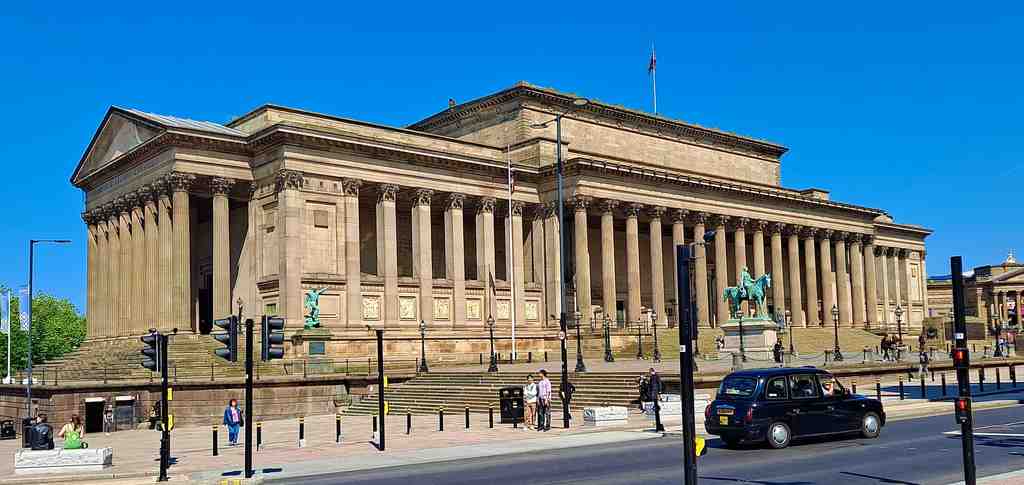
Directly ahead, you’ll spot St George’s Hall by its grand row of towering columns-just look for the massive stone steps and the classical Greek façade stretching wide along the street, almost seeming to glow golden in the sunlight.
Now, take a deep breath and imagine-right where you’re standing, there was once no magnificent hall at all, but Liverpool’s very first infirmary. By the early 1800s, Liverpudlians loved their music festivals so much that they started dreaming of a concert hall fit for thousands, mixed with a dash of serious business-like court cases and formal dinners. So, in 1838, when Queen Victoria grabbed her crown, the city laid the first stone for what would become St George’s Hall, kicking off a contest for the best design. The winner? A young London upstart named Harvey Lonsdale Elmes, barely 25, who thought, “Why not combine music and law under one colossal roof?” I’d say that’s multitasking, Victorian style.
Walk up the steps, and you’re retracing the path of Victorian judges-and maybe a few folks hoping their singing was better than their alibi. The Hall opened in 1854, but tragedy struck before Elmes could see it finished. The baton was passed to a series of architects (and probably a few stressed engineers), all determined to make this hall “surpass most public buildings in the country.” In the end, it cost over £300,000-a princely sum back then, unless you’re shopping for a London flat today. Inside, you’d find yourself under a soaring arched ceiling inspired by the Baths of Caracalla-Romans knew how to do grandeur, and so did Liverpool.
Picture this: the Great Hall, glittering with over 30,000 tiles beneath your feet, the air fresh and warm thanks to Britain’s first ever public building air conditioning system. Yes, in the damp north! The heating system was so complicated you’d need a team of workers opening and closing flaps to keep the temperature just right. Instead of just music, the Hall witnessed everything from Charles Dickens’ dramatic readings to jury deliberations in murder trials, and even epic banquets for 800 local VIPs. They say the organ here was once the biggest in the country-and nothing says “welcome to court” like a thunderous pipe organ solo.
The outside is packed with stories too. Peer up at those sixteen Corinthian columns and imagine statues of Queen Victoria and Prince Albert keeping watch over St George’s Plateau, where thousands gathered during the First World War to see Lord Kitchener’s rally. Sometimes, over 30,000 men enlisted for the army right where the taxis gather today. The Plateau has also seen the wild homecomings for Liverpool’s football teams, emotional memorials for John Lennon and George Harrison, and even Ringo Starr drumming on the very roof to launch Liverpool’s Capital of Culture year. Now, that’ll wake the pigeons up!
One of my favourite quirks: the Hall claims the honor of being the world’s first air-conditioned building, long before anyone could complain about the humidity on Twitter. And if the walls feel like they’re watching you, maybe they are-over the years, St George’s Hall has been a courthouse, a filming location for everything from “Peaky Blinders” to “The Batman,” and even centre stage for Eurovision’s semi-final draw in 2023.
Every bit of this colossal place-from its lost sculptures of Britannia, to the tales of rallies and concerts, to its secret tunnels and grand jury rooms-feels like it’s bursting with drama, artistry, and Liverpudlian pride. So, take your time, let your imagination stretch-right here, you’re not just outside a building, you’re at the heart of Liverpool’s living story. And if you ever feel a sudden chill, don’t blame the ghosts-maybe it’s just that famous Victorian air conditioning kicking in again!
To expand your understanding of the structure, events held at the building or the organ and organists, feel free to engage with me in the chat section below.


