
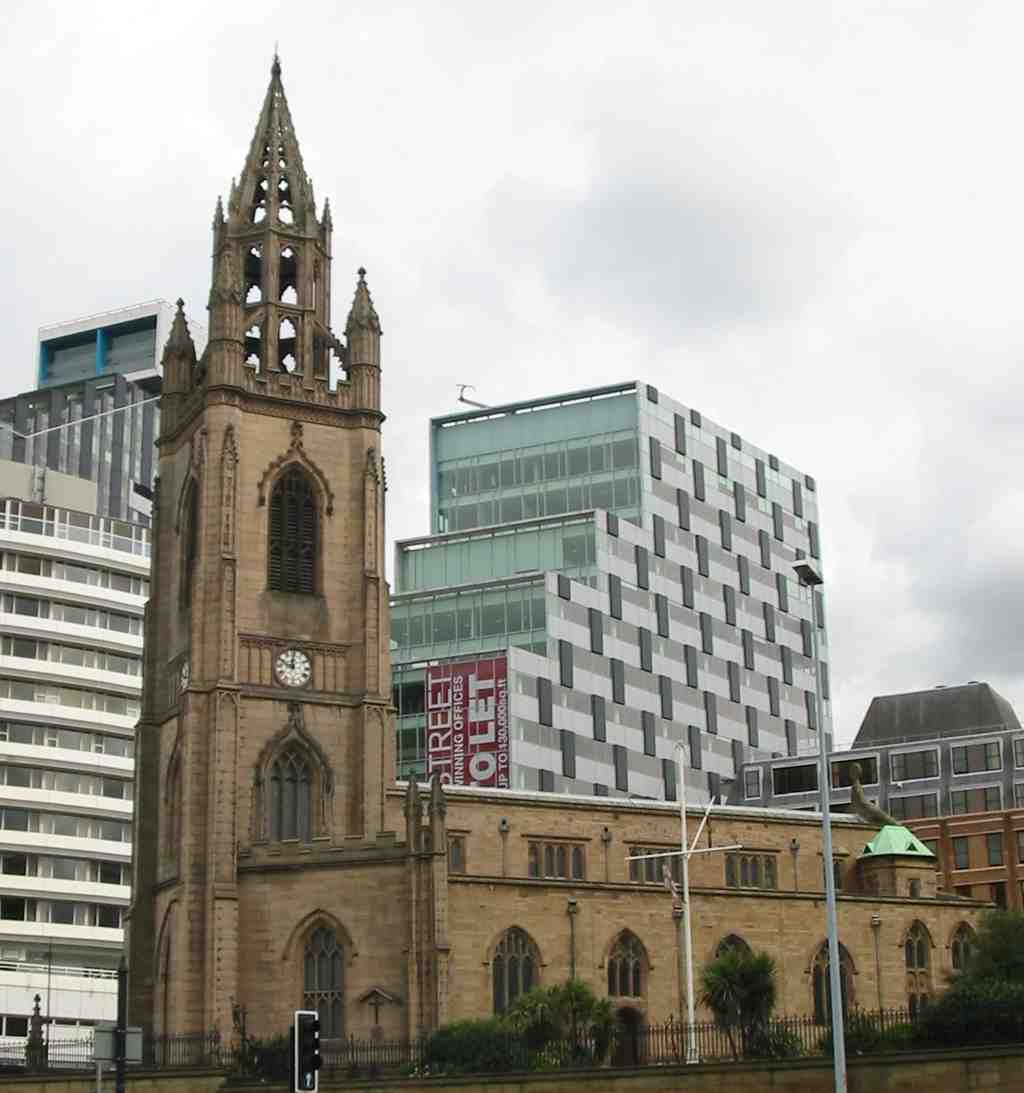
To spot the Church of Our Lady and Saint Nicholas, look for a tall, sand-coloured stone building with an intricate, openwork spire towering above the modern glass offices nearby-its clock-faced tower stands proudly, making it easy to pick out against the city skyline.
Welcome to the Church of Our Lady and Saint Nicholas-known lovingly as “St Nick’s” by locals. As you stand here beside its impressive tower, picture yourself centuries back, with the salty air of the Mersey river swirling around you and ships creaking at their moorings where the river once lapped right up to the church garden walls. This site has been watching over Liverpool’s sailors and townsfolk for nearly 800 years. That’s longer than football’s been around-imagine having to explain offside to someone from 1250!
Back in medieval times, this spot hosted St Mary del Quay-a humble stone chapel built by the 1250s. It looked down onto a busy river quay, playing host not just to prayers, but to the hopes and worries of a little town on the rise. As Liverpool’s fortunes boomed and ships crowded the Mersey with cargoes of cotton and sugar, the chapel quickly outgrew itself. By 1355, Liverpool’s people needed more space for their worship, so construction started on what would become our current church, dedicated to both the Virgin Mary and St Nicholas-the patron saint of sailors. You can almost imagine the anxious loved ones craning to catch sight of returning ships, whispering prayers under this ever-watchful spire.
Through plague, prosperity, and storm, this church stood its ground. In 1361, as plague swept Liverpool, the churchyard was the city’s main burial ground. By the late 15th century, the church was twice the size it had been, with special chapels supported by wealthy patrons, each lighting a candle for their soul. If walls could talk, these would whisper tales of seafaring and survival, of prayers for safe voyages and safe returns.
Come the Reformation, things changed: the ornate chapels for private prayers vanished, and the church, like the country, adapted to new ways of worship. By the 18th century, Liverpool’s population was exploding-hardly surprising considering this chaotic port city was humming with news, trade, and travelers. St Nick’s had to add galleries for all the newcomers squeezed into its pews, each family paying rent to sit beneath this roof. And around 1746, the crowning glory: the now-famous spire topped by a gleaming golden ship-shaped weather vane. It’s Liverpool’s answer to a “missing ship” joke-more on that in a moment!
St Nick’s didn’t just live through history; it sometimes felt it crashing down. On a February morning in 1810, as congregants gathered and bells chimed, the spire came tumbling down onto the nave, killing 25 people-most of them children from a local charity school. Imagine the shock and heartbreak as the smoke and dust cleared, and the city came together to rebuild, refusing to let this church’s story end in ruins. By 1815, a new tower and lantern stood firm, their bells pealing once again above the river.
During World War II, the story took another dramatic twist. German bombs fell on Liverpool, flames gutted the main body of the church, and once again only the determined sandstone tower remained, silent but unbowed. Rebuilding was slow, but by 1952, a new and very different church opened its doors. Architect Edward C. Butler dared to place the altar at the western end-a little Liverpool twist on tradition! The nave soared taller than before, the sanctuary crafted with wood carvings of vines, and beautiful stained glass bathed the inside in gentle color.
Inside you’ll find touches from every era. There’s a stunning war memorial for the Cunard Steamship Company, the Maritime Chapel with its bronze statue of Our Lady aboard a boat, and a cross made from the charred timbers, a reminder of the resilience to rebuild after wartime destruction. Tucked away in the north corner is the Book of Remembrance, listing mariners lost at sea-fitting for a church that’s long watched over Liverpool’s sailors.
Ah, and that weather vane atop the tower? It’s shaped like a ship and part of local legend. People jest, “I’ll be waiting till Dick docks,” meaning never-referencing the ever-absent Richard Donnelly, a ship no one can quite recall seeing in port. Though history sleuths say the ship never truly existed, the city prefers its myth. After all, every good port city needs a tall tale or two.
So as you look up at the lantern spire-still pointing skyward despite all its trials-imagine the prayers, laughter, and stories that have swirled around St Nick’s for almost eight centuries. It’s Liverpool’s steadfast guardian, watching over the river, the city, and generations of dreamers headed for land or sea.
Wondering about the st mary del quay, reformation and beyond or the fatal accident? Feel free to discuss it further in the chat section below.


