
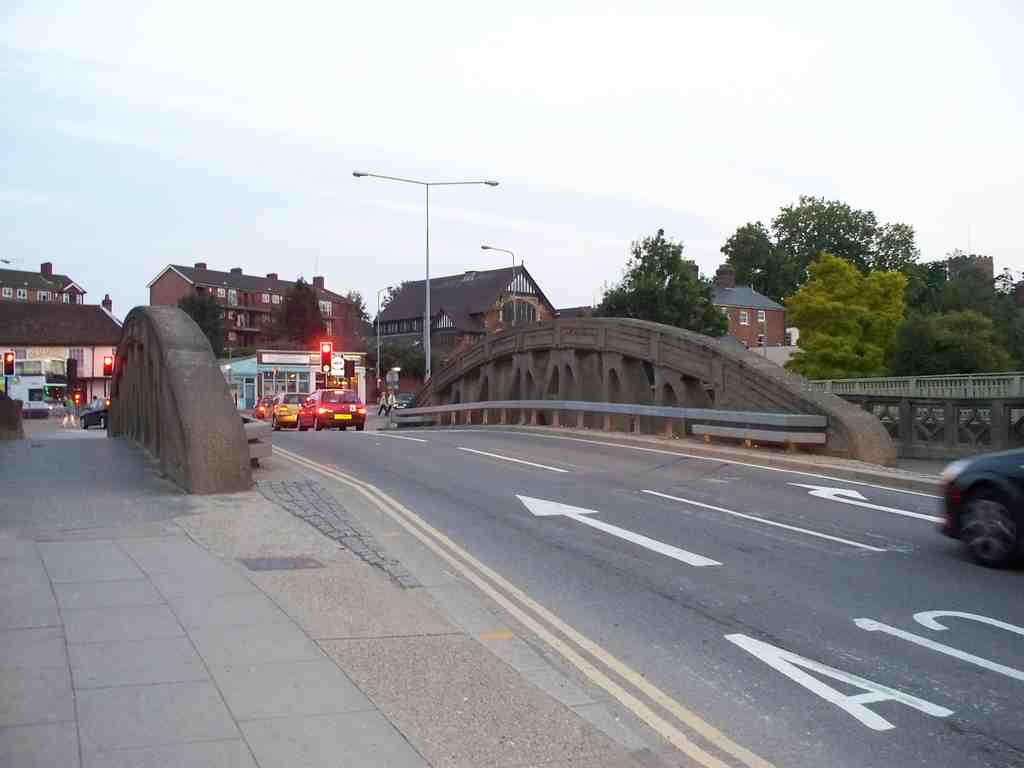
On your right, you’ll spot Stoke Bridge as a pair of chunky, arched concrete spans carrying the road over the river, with low parapets and traffic lights marking the climb onto it.
This is one of Ipswich’s most practical pieces of drama: it sits right where the River Gipping officially turns into the River Orwell… which is a very polite way of saying the river changes its name and keeps on doing river things. The bridge pulls traffic in from Over Stoke and, because the water down there is tidal, it’s always had to deal with moods-calm one hour, bossy the next.
There are records of a bridge here back in the late 1200s, and even earlier hints suggest people were crossing here long before that. It’s close to an old ford-basically the “cheap option” crossing-and down by Stoke Quay archaeologists have found signs of Saxon life. So yes, folks were picking this spot for centuries because it was the sensible way into town.
In Elizabeth the First’s day, the town hauled 28 loads of timber from Whitton to build or repair the bridge-imagine the squeal of carts and the kind of mud that steals your shoes.
But the wildest chapter is 12 April 1818. After days of heavy rain, the whole valley flooded so badly it looked like one huge lake. Three men stood here watching the torrent… and the bridge gave way. Two were pulled out. One wasn’t, and was found days later. Engineer William Cubitt improvised a temporary floating bridge, then his firm put up a cast-iron replacement-iron shipped in sections from Dudley, sent by canal, then by sea, like a grim little Meccano set.
What you see now is newer: concrete from the 1920s, with a second span added in the early 1980s, and it stayed the southernmost crossing here until the Orwell Bridge arrived.
When you’re set, St Peter’s Church is a 3-minute walk heading north.




