
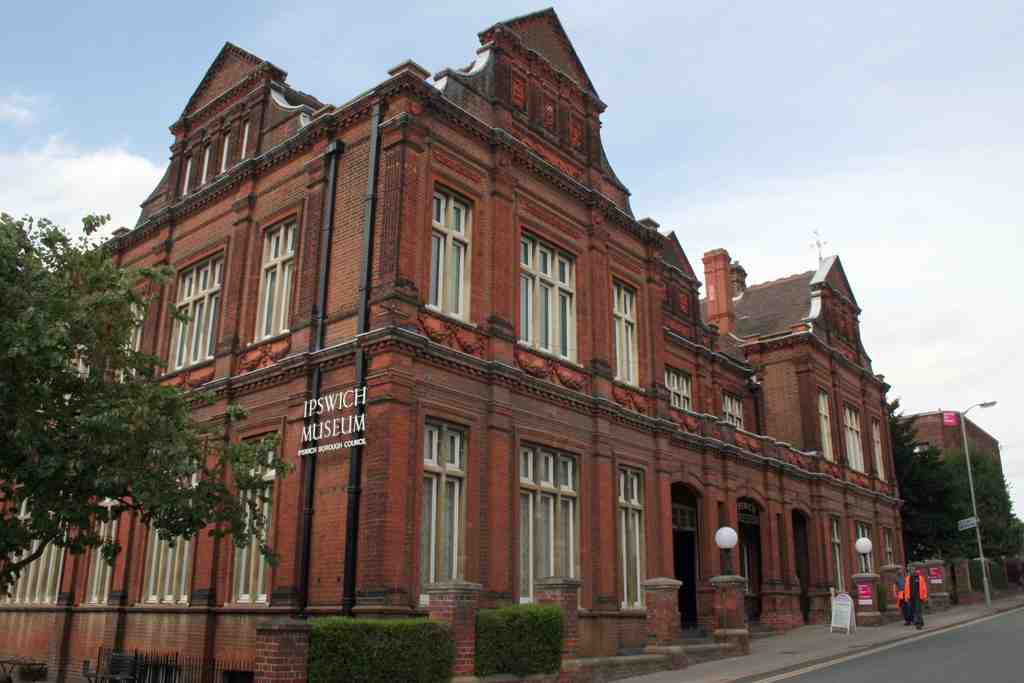
On your left, look for the big, confident red-brick Victorian building with tall cream-trimmed windows and the words “IPSWICH MUSEUM” fixed to the corner wall.
Alright, you’ve made it to Ipswich Museum… and it looks exactly like a place that would keep a giraffe in a glass case and call it “education.” This Grade II star listed building has been one of the town’s great knowledge-hubs for well over a century, sitting here on High Street like it’s quietly daring you to learn something.
The story starts earlier, though. Ipswich’s first museum opened in 1847, originally over on Museum Street, built with a pretty clear mission: teach working people about the natural world. Not with lofty speeches, either… with real specimens, cabinets, and open evenings where ordinary folks could come in after work and look science straight in the eye.
The first president was William Kirby, an insect expert-so yes, Ipswich began its museum life with a man who took beetles seriously. The driving force behind the whole project was George Ransome from the Quaker Ransome family-industrialists who helped power Ipswich’s growth. What’s striking is how broad the support was: people across politics got behind the idea that a museum could be a tool for social improvement. That’s a very Victorian sentence… and a very Victorian plan.
Then comes a name with real weight: Reverend Professor John Stevens Henslow, president from 1850 to 1861. He was Charles Darwin’s mentor at Cambridge, and under Henslow the museum gained national attention. In 1851, when the British Association for the Advancement of Science met in Ipswich, Prince Albert himself inspected the museum and approved of it. Nothing says “legitimate” like getting a royal nod while everyone tries to stand up straight.
But the museum nearly fell apart financially in 1852. The town held a vote in 1853, and people overwhelmingly agreed to fund it through public rates under the Public Libraries Act. In other words: Ipswich decided this place mattered enough to pay for it together. That’s civic pride you can actually measure.
By 1881, the collections had outgrown the old building, so the museum moved here-into a new home shared with the town’s Schools of Art and Science. Public subscriptions helped fund it, with major backing from Sir Richard Wallace of Sudbourne Hall. And later expansions, plus the clearing of the borough’s floating debt, were boosted by gifts-especially from Mrs Margaret Ogilvie of Sizewell Hall, who put her money behind the museum in appreciation of the curator’s work.
Inside, the museum became famous for its natural history displays-many set up just before Darwin’s ideas changed how people understood life on Earth. It also grew into archaeology in a big way, tied to Suffolk’s crucial role in understanding deep human prehistory. And if you’ve heard of Sutton Hoo… yes, Ipswich Museum is part of that story too. Basil Brown, working under the museum’s guidance, helped begin the investigation that led to the ship burial discovery in 1939. Not bad for a local museum.
In 2007, Ipswich’s museum service merged with Colchester’s to form Colchester + Ipswich Museums-shared staffing and support, but Ipswich keeps ownership of this building and its collections.
And as you’re standing here now, there’s one more modern twist: the museum closed in October 2022 for a major refurbishment expected to take about three years, with a budget of £8.7 million-roughly $11 million today. There’s been some debate about how “Victorian” the interior should stay… which is a very Ipswich problem to have.




