
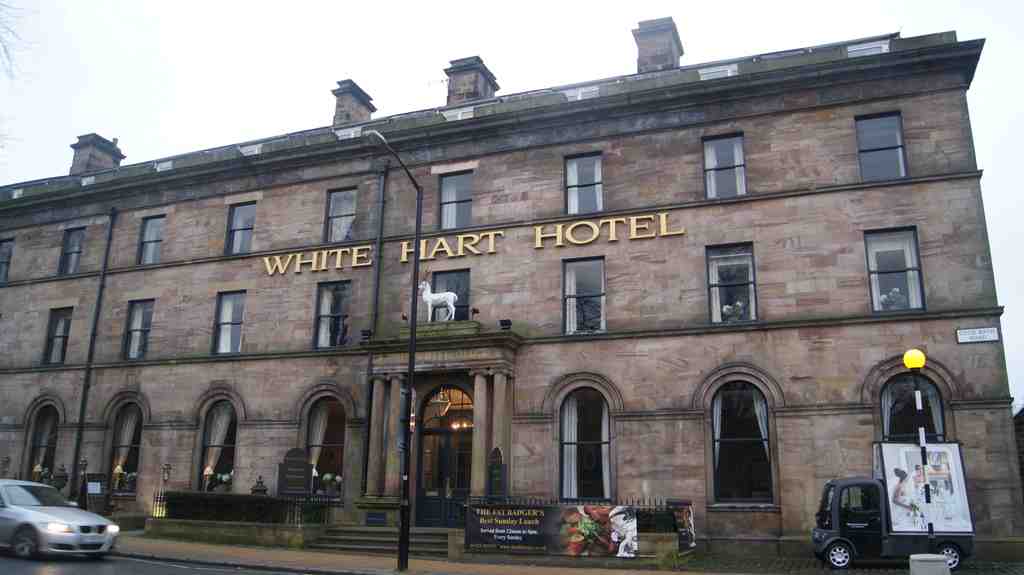
To spot the White Hart Hotel, look for a grand stone building with bold golden letters spelling “WHITE HART HOTEL” across the front and a white stag statue perched right above the entrance-if you’re on Cold Bath Road, you can’t miss it!
You’re now standing before the grand old White Hart Hotel, but don’t let those fancy golden letters and elegant columns fool you-this place has seen just about everything over its 250-year history. Picture yourself here in 1765, when the York Courant newspaper was bustling with gossip and mystery. The hot news? Someone at the White Hart had misplaced a dappled grey mare and was desperate enough to offer a reward for her safe return, right here in Low Harrogate. I bet the horse just wanted a spa day, like everyone else coming to town!
Back in those early days, the White Hart was the go-to spot for visitors hoping to “take the waters” at the nearby sulphur wells. Imagine the tangy smell of sulphur in the air and carriages clattering up outside, dropping off fancy folks with big hopes for good health. People came from all around to bathe in Harrogate’s famous cold water at the bottom of what is now Cold Bath Road. If you were thirsty for excitement-and maybe a bargain-the White Hart was your place! By the late 1700s, the building was bubbling with life as a venue for lively property auctions and as a welcome coaching stop for weary travellers.
Now, here’s a fun bit: the open land to the south of the hotel, called “the Stray,” wasn’t always so neat. It was once practically a swamp! By the end of King William IV’s reign, poor drainage had turned it into a giant pond. Coaches would arrive, splashing through puddles with ducks and geese exploding in all directions. That must have been a sight-a proper comedy show for the locals, I imagine!
The arrival of the Victorian age brought even more excitement. Harrogate became a hotspot for the health-obsessed and the wealthy, thanks to hydrotherapy and the brand-new railway-lucky for the White Hart, which sat right on the path to both. Business boomed, and in 1846, the old White Hart was replaced by the majestic building you see now, thanks to architect George Townsend Andrews. Even the strict Professor Nikolaus Pevsner, a famous architecture critic, called it “the best building in Harrogate,” though he assured us it wasn’t flashy. Well, except the white stag-he does like to stand out!
Fast-forward to the 20th century, and the White Hart was still at the centre of things. Picture the 1936 Jarrow Crusade arriving out front, greeted warmly by townsfolk gathered right where you stand. Just a few years later, with the outbreak of World War II, this place was taken over by the government-first the Air Ministry, then the Ministry of Works-its elegant halls echoing with the sound of official business instead of clinking glasses.
After the war, there was even talk of turning the White Hart into an art school or a hospital extension for rheumatism research. But life had other plans. It became the NHS’s one and only conference centre for years, before finally returning to its roots as a hotel in the late 1980s.
Now, the White Hart is a stylish hotel and conference centre again, with a popular restaurant, tearooms, a pub for the locals called The Fat Badger, and much more. The air today is just scented with good food, coffee, and laughter. Who knows what stories you might add to the White Hart’s long, lively history?
Interested in a deeper dive into the victorian redevelopment, 20th century or the present day? Join me in the chat section for an insightful conversation.




