
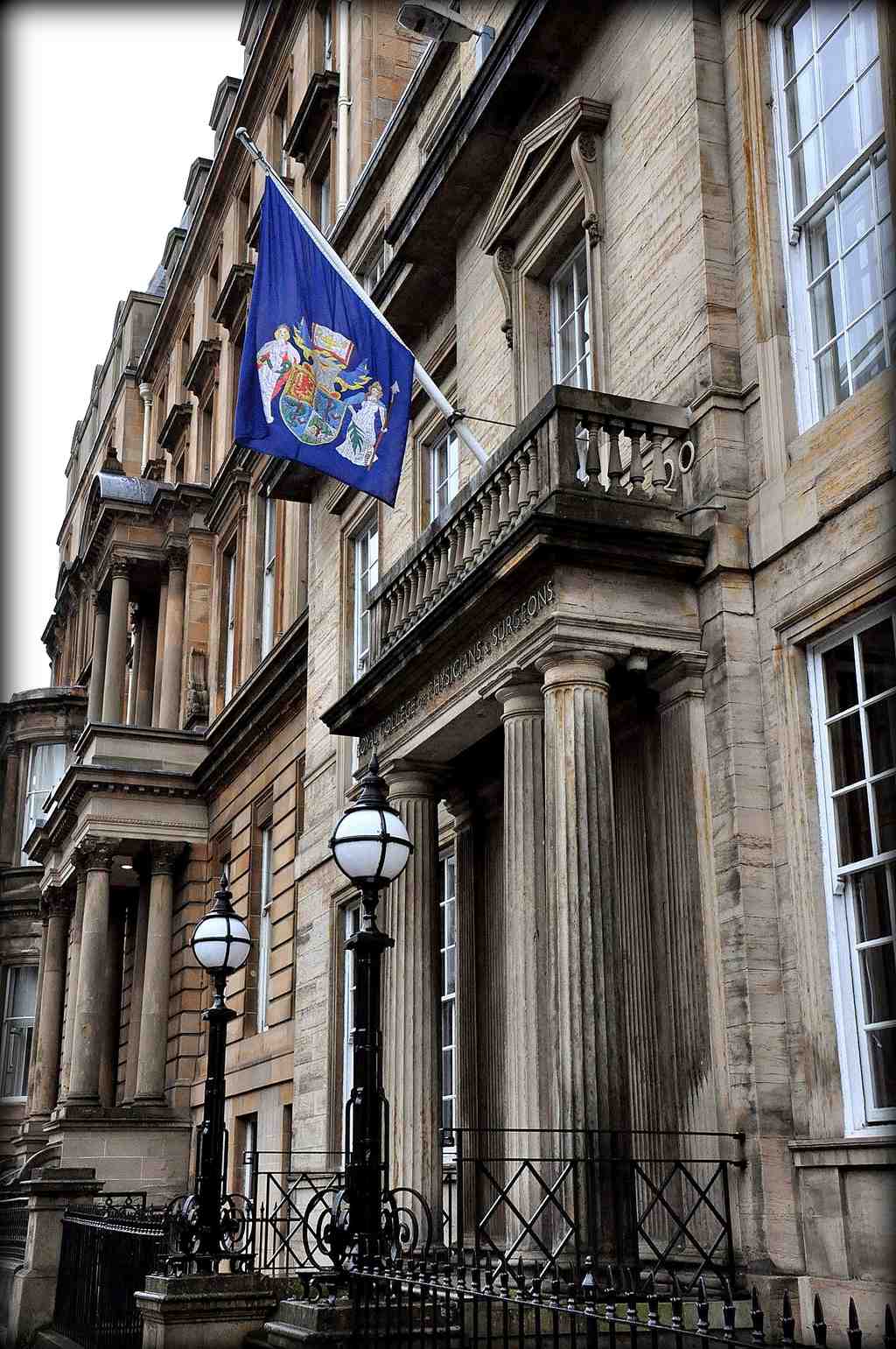
On your right, look for the grand sandstone building with tall classical columns over the entrance, a small balcony above, and a bold blue flag hanging out front.
You’re standing beside the Royal College of Physicians and Surgeons of Glasgow-one of those places that sounds like it should come with a Latin spell and a stern handshake. And honestly, it kind of does. This institution traces its roots back to 1599, when King James VI granted a royal charter to a man named Peter Lowe, a surgeon trained in France who also wrote a no-nonsense surgical manual with the wonderfully blunt title The Whole Course of Chirurgerie. Lowe teamed up with a Scottish physician, Robert Hamilton, and together they set out to solve a pretty basic problem: if someone in Glasgow said they were a doctor, how could you be sure they weren’t just confident?
Back then, “medical regulation” wasn’t a buzzword-it was survival. The charter even names an apothecary, William Spang, and gives him authority to inspect and control what drugs were being sold in town. Picture it: seventeenth-century Glasgow, muddy streets, crowded closes, and Spang popping into shops like an early version of a health inspector, except with more plague in the background.
The College-first known simply as “the Faculty”-was unusual from the start because it didn’t just cover physicians and surgeons. It also included barbers and apothecaries. That’s not a joke: barbers were doing minor surgical work, and if you’ve ever wondered why the barber pole looks vaguely medical, well, there you go. But the harmony didn’t last. By the early 1700s, barbers and surgeons had fallen out badly enough that they split in 1722, like a messy band breakup-only with scalpels.
The institution moved around the city as it grew: a property on the Trongate in the late 1600s, then a purpose-built hall there in 1698-the same year the Faculty Library began. Later came St Enoch Square, and finally this current home on St Vincent Street in 1862, part of the city’s smarter “New Town” development. The building fits the part: solid stone, disciplined lines, and just enough grandeur to suggest, politely, that standards matter here.
Names changed as prestige piled up. In 1909 it gained the right to call itself “Royal,” and in 1962 it became the Royal College of Physicians and Surgeons of Glasgow-the only multi-disciplinary medical royal college in the United Kingdom. For a long stretch, it helped provide a key route into practice through Scotland’s “Triple Qualification,” a joint diploma with Edinburgh’s physician and surgeon colleges-an alternative to university degrees that survived into the late 1990s.
These days the focus is postgraduate education: exams and training that lead to Memberships and Fellowships for doctors, surgeons, dental surgeons, and even podiatrists-plus specialist diplomas in fields like dermatology, child health, travel medicine, and more. It’s still, at heart, an engine for professional standards-just with fewer barbers.
And if you like milestones: the College awarded its first female fellow in 1912, appointed its first female president in 2019, and more recently has taken on issues like climate and health through a sustainability group.
Ready for Theatre Royal, Glasgow? Just walk east for about 12 minutes.


