
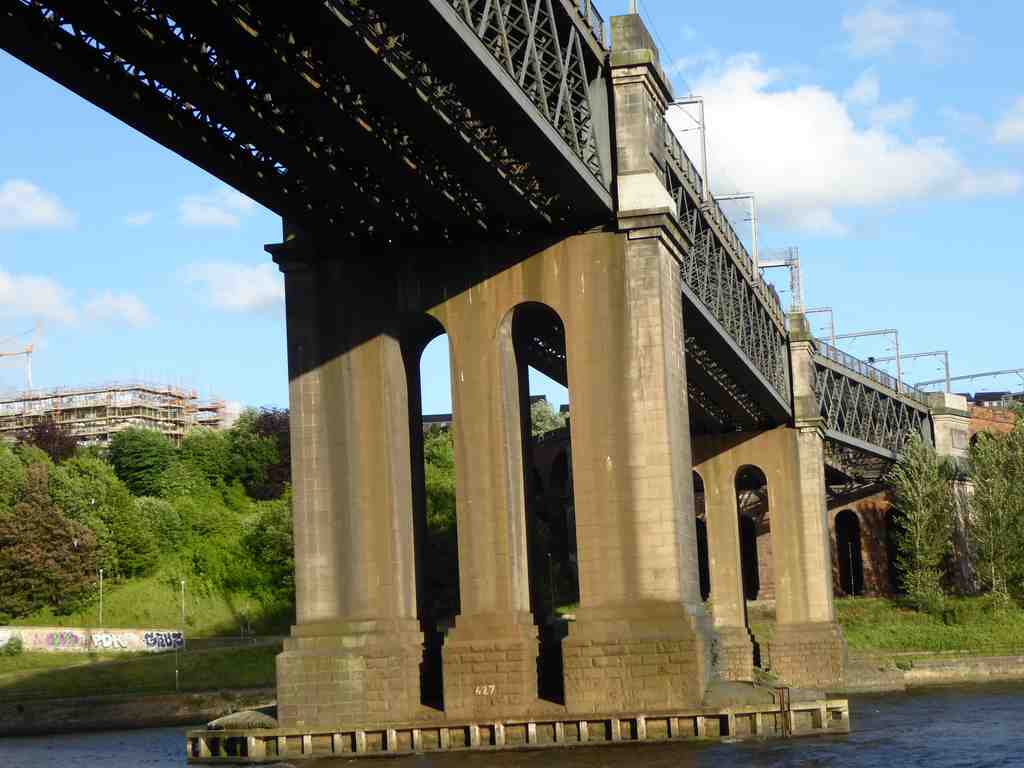
Look ahead for a long, dark metal bridge stretching over the River Tyne, supported by tall, solid stone pillars with cutaway arches-just follow the sound of trains rumbling overhead and you’ll spot it directly in front of you.
Let’s take a moment to stand here and imagine you’re back in the early 1900s, when crossing the Tyne wasn’t just as easy as strolling over-oh no, it was a major feat of imagination, engineering, and, let’s be honest, a bit of sweaty grit. The King Edward VII Bridge wasn’t just the latest railway crossing; it was hailed as Britain’s last great railway bridge. Standing here now, the four giant steel lattice spans above us look almost elegant, but picture dozens of workers in flat caps and suspenders, tools clanging, rain splattering off steel-a time when building something like this was as exciting as launching the latest smartphone is today.
Back in the day, the High Level Bridge-just up the river-was the only way for trains to get to Newcastle station. But here’s the thing: trains had to reverse out, like a stagecoach stuck on a one-way street. By the 1890s, this became such a headache that if you listened closely, you might’ve heard stationmasters pulling their hair out in frustration. With up to 800 train and engine movements each day, that old bridge was groaning under the pressure. Something had to be done before the whole of Newcastle’s rail traffic ground to a halt!
Enter Charles A. Harrison, chief engineer of the North Eastern Railway. Now, Harrison had bridges in his blood-his uncle, Thomas Elliot Harrison, had helped design the High Level Bridge itself, so you could say bridge building ran in the family like a well-worn railway track. Harrison dreamed up a new bridge right here, but as with all good dramas, he quickly discovered an obstacle: abandoned coal workings at both ends of the proposed span. It’s like laying your picnic rug down, then finding there’s a mole under it… only the mole is a shaft that could swallow half the city.
No matter-Harrison adapted, and what you see before you is the result: four mighty steel spans carried on muscular sandstone and granite piers, each decorated with arches that practically dared the Tyne to ever flood again. The northern approach even hid a row of workshops in its arches-because, why waste good space?
Now, the construction! Picture this: February 1902, dozens of workers from Cleveland Bridge & Engineering Company in Darlington get cracking. Down at the foundations, things get really intense. The river’s depths are explored by brave divers lowering themselves into huge watertight chambers called caissons, working under compressed air. Only older, weathered men could handle that job-no one under 40 allowed! And you can imagine, the pressure was so great, even the bravest sometimes fell ill, and one unfortunate fellow didn’t make it out.
But you can’t keep a determined team down. Blasting and digging inside the caissons, they hauled out rock, filled the cavities with 28,000-plus tonnes of concrete and stacked the piers high. Then, steel lattice spans were assembled right above the river, sometimes shutting off half its width so nothing could float underneath. Adding to the spectacle, an enormous cableway-the largest in the world back then-swung overhead, carrying more than 23,000 tonnes of materials across the river. Imagine that sight! The cable was so sturdy, it was recycled after the bridge was done to help launch the legendary ocean liner, RMS Mauretania. Talk about a bridge with a legacy that travels.
Finally, 10 July 1906 arrived. The bridge wasn’t quite ready, but with a royal flourish, King Edward VII and Queen Alexandra swept in for the opening ceremony on a temporary platform at the Gateshead end. What’s a few missing rivets among friends, right? Once the bridge opened for general traffic, the stuffy old reversing dances at Newcastle station were history. Trains could glide straight through; congestion dropped and passengers got a smoother ride.
Not all was perfect-when the bridge was load-tested, they drove ten locomotives, nose to tail, across its length at a stately walking speed. You can almost feel the steel beams holding their breath, just for a second!
Over the next century, this bridge saw all sorts. It got electrified rails in the 1970s, survived storms and shifting tides, and finally earned itself Grade II listed status in 1994. But through it all, it stood the test of time just as Harrison imagined.
So next time you watch a train zip across those lattice girders, remember: it took courage underwater, royal applause, and one immense cableway in the sky to let it happen. And if you ever feel like you’re stuck reversing out of life’s train station, just think of King Edward VII Bridge, showing you there’s always room for another way forwards.


