
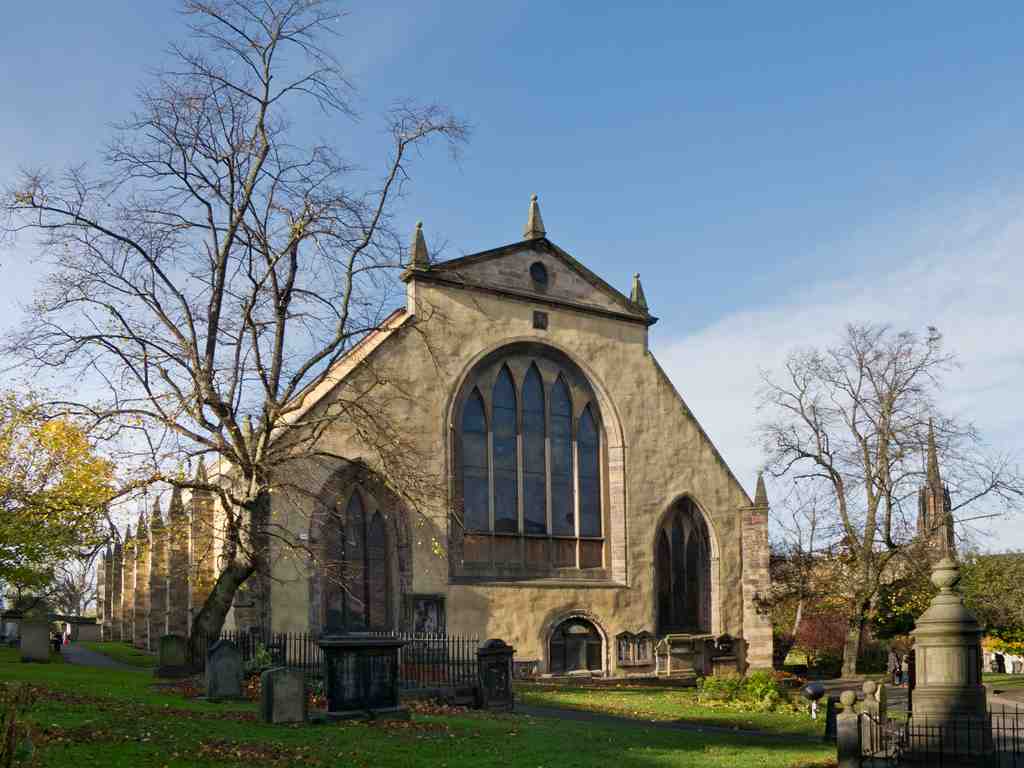
To spot Greyfriars Kirk, look for a large, rectangular church with pale stone walls, tall Gothic windows, and little spire-like finials rising from its corners-it sits within a graveyard, framed by trees and old monuments, right across from the busy streets.
Alright, let’s take a breath and dive into the story of Greyfriars Kirk! As you stand here, imagine the air in Edinburgh centuries ago: chilly mist curling past the gravestones, the echo of footsteps on cobblestones, and the distant sound of church bells drifting across Old Town.
This spot has seen more drama than an entire season of your favorite detective show! The tale begins in the mid-15th century, when a group of Franciscan friars-nicknamed the “Grey Friars” because of their habits-arrived from the Netherlands. They set up shop here at the edge of the city, right where you’re standing. Back then, these grounds were open and peaceful-hard to believe, now that the city seems to rise up on all sides.
Royalty often visited the friars; James IV even called himself their “Royal Protector.” But as power shifted and the Reformation swept through Scotland, the peaceful friary was turned upside down. Statues were stolen, mobs ransacked the buildings, and nearly all the friars eventually fled with hurried footsteps and beating hearts back to the Netherlands. The beautiful chapel and cloisters were torn down, and the stone was carted off to build the city’s new Tolbooth and repair St Giles’.
Soon, these grounds were transformed into a burial place to relieve the overcrowded kirkyards elsewhere. The seeds of the current church were planted in 1602, and by 1620, after more than a little drama with missing shiploads of Swedish timber and some quite confused city planners, Greyfriars Kirk opened its doors. The first service? Held on a weekday-Christmas Day, no less!-just to make the king happy.
But the real fireworks were still to come. In 1638, Greyfriars Kirk became the birthplace of the National Covenant: a grand document of resistance, read out for the first time right here. Imagine the tension; nobles signing the parchment inside the church’s shadowy vaulted interior, while crowds outside buzzed with excitement and hope for Scotland’s future. (It rolled out so fast, it was like the world’s first viral petition.)
Not all was peaceful-far from it! During Oliver Cromwell’s invasion, the Kirk was seized and turned into barracks for soldiers. Picture heavy boots, neighing horses, and a lot of very annoyed ministers.
The misfortunes didn’t end there. In 1718, the church’s tower, used (rather unwisely) to store gunpowder, exploded in the dead of night. The blast ripped through the west end-think of the shock and chaos, the shattering windows, and the roar through the old city. Rebuilding was a major feat, splitting the church into “Old” and “New” Greyfriars, each with its own congregation-a bit like housemates awkwardly sharing one big, echoing living room.
Another disaster struck in 1845 when a fire gutted the church. Some blamed the whole thing on divine judgment-though honestly, it might have just been a dodgy boiler. Restoration took over a decade, but out of disaster came innovation: stained glass windows and a pipe organ appeared for the first time since the Reformation, making Greyfriars a trendsetter in church design.
Inside, you’ll find relics like the original National Covenant, ancient stained glass, and a copy of Psalm 150 carved into the modern organ, along with memorials to heroic-and not-so-heroic-figures from Edinburgh’s past. The walls and pillars themselves are an architectural patchwork: Gothic arches with Baroque swirls, ball-topped obelisks, and a roof that seems to swoop and leap above your head.
Even today, Greyfriars keeps its history alive, offering weekly Gaelic services and supporting the community. For centuries, it’s been a place of struggle, renewal, and laughter-sometimes all in the same day! So as you gaze up at those ancient windows and wander beneath the trees, remember: every stone and grave here has a tale to tell, each one echoing with the voices and footsteps of Edinburgh’s unforgettable past. Keep your ears open-you never know what whispers you might catch on the breeze.
Ready to delve deeper into the setting and kirkyard, architecture or the features? Join me in the chat section for an enriching discussion.




