
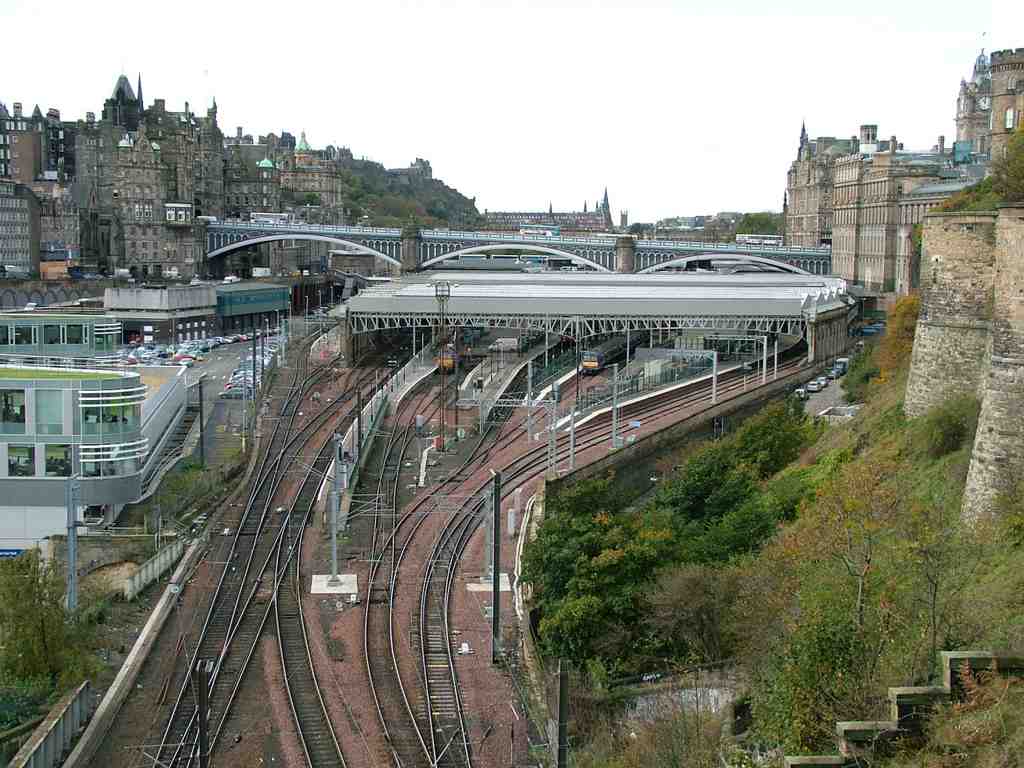
Look for the long, pale stone-and-iron bridge with big repeating arches spanning the valley above the train tracks and station roofs below.
Alright, you’re standing at North Bridge… which is basically Edinburgh’s great urban handshake: it links the Old Town up on the ridge with the New Town over by Princes Street, right across what used to be the North Loch. Today you’ve got traffic humming beside you, and down in the dip you can usually hear that steel-on-steel train hiss drifting up from Waverley Station. It’s a bridge with a view… and a memory.
The first North Bridge began with one of those “we’re building the future” moments. On October 21, 1763, the city’s Lord Provost, George Drummond, laid the first stone. Drummond was a big believer in modernizing Edinburgh, and draining the North Loch that year was part of the makeover. Imagine the scene: the smell of wet mud, carts scraping, workers hauling out muck… and officials congratulating themselves for turning a swampy barrier into an opportunity.
The actual building contract didn’t get signed until 1765, and the job went to architect William Mylne for £10,140… which is roughly £1.6 million in today’s money. The deadline was Martinmas, November 11, 1769, and Mylne even had to guarantee the work for ten years. Confident, right?
Then Edinburgh’s geology cleared its throat.
The slope below the Old Town is steep, and for ages people had tossed excavated earth down toward the loch. So underneath? Not solid ground… more like a giant historical junk drawer of loose fill. Mylne underestimated how deep the foundations needed to go, and with other design issues piled on top… the bridge partially collapsed on August 3, 1769, killing five people. It’s a brutal reminder that “progress” can have sharp edges.
They rebuilt, spending another £18,000-about £2.8 million today-and the bridge finally reopened in 1772. The original was enormous by the standards of the day: multiple big arches, smaller hidden ones at the ends, and a roadway that widened as it met the city on either side. It was Edinburgh stretching itself out.
But cities keep growing, and by the 1890s the old bridge was on borrowed time. The North Bridge you’re on now went up between 1894 and 1897: 525 feet long, 75 feet wide, with three big arched spans. The builder, Sir William Arrol and Company, also worked on the Forth Bridge… so yes, these folks knew their way around ambitious Scottish engineering. The ornamentation was designed by the city architect Robert Morham-because even your everyday commute deserves a little style.
Keep your eyes open on the bridge for a war memorial by sculptor William Birnie Rhind, honoring soldiers of the King’s Own Scottish Borderers lost in campaigns from 1878 to 1902. History here isn’t tucked away-it’s built into the street furniture.
And if you glance around at the edge of the bridge, the buildings tell you how vertical this city is: entrances at road level, and other doors far below in the valley. On one end you’ve got the Balmoral Hotel and Waverley Gate; on the other, the big blocks tied to newspapers, shops, and hotels. North Bridge isn’t just a crossing… it’s a whole stacked-up neighborhood.
One last thing: if you’ve noticed construction gear or patched paving, you’re not imagining it. A major refurbishment kicked off in 2021, and thanks to some nasty surprises in the concrete, the finish line has slid… and slid again… now aiming at spring 2026, with costs at least £85 million. Nothing says “timeless landmark” like an eternally open worksite.
When you’re set, Moubray House is a 6-minute walk heading south.


